The Rev. Dr.. Robin Gorsline identifies as a poet, Queer theologian, and spiritual activist and also serves as Writer-Theologian in Residence at a D.C. church. By his permission, his
poem below is reblogged from the
wonderful blog site, www.gayshiva.tumblr.com. If Whitman hadn’t needed to practice at least a degree of understatement, I find myself wondering
whether he might not have written something like this poem.
Holy Hardness
I woke this morning with a more or less hard-on.
It felt so good I kept it up during meditation
feeling as if God's real presence had settled in my cock
each stroke connecting to a breath, holding my little guy
between, and knowing that my body and my God are connected
in sacred erotic embrace.
Some may see blasphemy in this connection but I remember
Jesus, the Incarnate One, who when focused on healings
and teaching may have set aside his cock but I feel sure in those
quiet alone times away from companions and the world
he too found his hard, connecting with God and his sacred
body with the caresses that bring joy to me.
That early erotic energy continued throughout the day
as I, naked, sat writing and touching myself, feeling the high that comes
when I begin to point toward climax. But I did not want
to explode then, saving it for joy with my man.
I did begin to hope that this time, unlike so many others lately,
our lovemaking might result in the eruption of precious liquid love.
To bed we went that night, and oh how his mouth on my cock and mine on his
brought sweet electric sensations, rising exquisite pure yearning
giving hope that here, now, we, phallus and I, if we can truly be understood
as separate, might experience embodied communion. But it was not to be then, though
my man lay across me and thrust his member between my legs and
ejaculated Oh God! Oh God! Oh God! Thank you God!
This old man did not despair, however, and with more pure organic coconut oil,
I lay gazing on the beauty of my man, stroking, stroking, up, down, up and down
the small but sturdy shaft went from fairly hard to less and back. Then I rose to stand
in front of the mirror to enjoy my own self-lovemaking and knew, oh I knew,
that with more vigorous strokes and a turn back to see the naked
languorous body of my beloved on the bed I would indeed favor the world
with divine liquid love of life--oh God! Oh God! Oh God! Thank you, my God!
It was holy communion then, embodied memory now a few hours past. I sit and type
and stroke and yet again give thanks to my parent God, and Jesus, and Holy Spirit,
grateful to have been created for this mystic sweet union, certain my beloved
and I were brought together for such a time as this, and more to come, yes, more cum.
I am called, we most are called, to such communion, divine eros joining bodies
in delight and ecstasy, it matters not the particular bodies, body parts, numbers,
or ways of joining, all are blessed because all are loved, God sharing
in the joy of orgasm as well as licking, sucking, fucking, kissing,
wondering why we carry so much shame about this holy gift.
So I write, a man now almost three score and ten, slower of gait
but still erect, even at times for my beloved, and when not so favored
I still know pleasure in touch and tongue--I swear so long as I live
I shall enjoy such holy hardness as it is mine to receive and share,
praising God with my upward and more often softer shaft.
It is not performance that counts, or even size, but faithfulness
to union with and through sacred eros, giving thanks to God.
Copyright Robin Gorsline 2016
Used by permission

Wednesday, August 24, 2016

Saturday, August 6, 2016
Green Man

Thanks to John Archibald, for sharing here his homage to the Lord of the Forest. John writes this:
"I love Greenmen.
Such mysterious male energy. Must be those faces made only of leaves; that
image invites a kind of primal reaction from the viewer. Weird, but it catches at
you, as if reminding you of something you’d forgotten, long ago. Some of the medieval
ones actually have roots growing out of their mouths. There was a shop in the
gay neighborhood of Hillcrest in San Diego, called Column One, where over the
years I found a number of Greenmen, orginally in an unpainted beige plaster,
and have painted a number of them.
"I found as well a
number of Greek gods here and there, which I’ve also painted. In the ancient
world, practically all the statues were painted, with the larger, more
important ones being made of molded sheets of ivory and gold, with
semi-precious gems for eyes. They must have been amazing!"


Friday, July 29, 2016
The Acknowledged Christ
 I hope you’ve had the experience, at least once in your
life, of being blindsided by Somebody showing up where you’d least expect.
I hope you’ve had the experience, at least once in your
life, of being blindsided by Somebody showing up where you’d least expect.
Mountains in a sudden flash of sunlight across a harbor.
An impulse at a Hare Krishna parade to join the chanting
from the sidelines, good Methodist that you’ve always been.
The eye contact between you and the unknown woman who’s just
pulled you back onto the curb out of traffic you didn’t see coming.
The desire to kneel down at the back of a church, when you
haven’t darkened the door of such a place since you were sixteen.
The realization, in the middle of a random sexual encounter,
that both of you (or all of you) are in the Presence of something vastly bigger
and more important than a short spell of uncomplicated pleasure--that your
trick is looking back at you with the face of God.
The sacred, grace-filled letting go in the last days of a
lover’s life that Mark Doty describes with such heart-opening clarity and
vulnerability in Heaven’s Coast.
The flash of lightening across the night sky of a quiet mind
in the meditation hall, nice Jewish boy from Dallas that you are.
The kind of experience that leaves you stammering something
like, “Oh--it’s You again.”
From my own perspective grounded in the Christian tradition,
these experiences are already foreshadowed in the vagueness of biblical
accounts of the Resurrection. No two Gospel accounts tell the same stories. Mark,
the earliest of the four Jesus narratives that eventually got included in the
Bible, doesn’t have a resurrection account at all, just an inexplicably empty
tomb from which two women flee in terror at dawn. My favorite is the story from
Luke of two disciples on the road to Emmaus, who fall in with a stranger to
whom they tell the news of Jesus’ death. The stranger starts laying out for
them everything in Scripture that predicted the Passion. That evening, they sit
down with him to a meal, from which he vanishes, in the same moment that they
recognize the risen Lord “in the breaking of the bread.”
There’s plenty of space in that story for me: I don’t know
what the fuck would show up in the Polaroids that nobody took, and I don't much care. I just know that
the encounter broke their lives open, as it breaks mine open.
This isn’t about a resuscitated corpse. In Christian terms,
this is about the Second Person of the Trinity taking flesh at times and in
places you never saw coming, setting ablaze the ordinary world of our material
existence. After all, it was God’s flesh all along, before we were given a life
lease on it. “He comes to us as one unknown,” wrote Albert Schweitzer in The Quest of the Historical Jesus. It’s
about “the acknowledged Christ” (the phrase belongs to Indian theologian M.M.
Thomas), ever present in the world, shoring it up from below as well as drawing
it down from above, known across cultures by a thousand different names, though
none can ever comprehend him/her. The One who vanishes from sight most
completely in the dogmatism of those who think they have sole possession of the
truth.


Friday, July 8, 2016
On Buddhas and Buttholes
The tattoo I added to my left shoulder twelve years ago needs
some retouching. As well as I can judge. I’ve never seen it. At least not right
side around. The mirror is the best I can do.
Without telling you the whole story of how the design came
to me, my ink reads, “Destroyer of
Illusion.” The script looks sufficiently
Indo-Himalayan, the pattern sufficiently abstract, that lots of people curious
enough to ask me about it assume it’s not in English. The letters striate from
the perimeter into a tightly described circle, a part of my body visible to
others but not to me. I take it on faith that it’s there.
Well, maybe you get the idea...
“Destroyer of Illusion” can mean a lot of things. When the
phrase started running incessantly through my mind, I pictured Keanu Reeves in The Matrix as vividly as the warrior
boddhisattvas of Tibetan Buddhism. Only later did I get it that those three
words, and the design I’d made of them, were teaching me a lesson about
acknowledging my First Chakra. Big surprise--embodied wisdom isn’t always a
matter of cognition, or of self-awareness in a dominantly intellectual sense. Sometimes
it’s a matter of going down into the earth and into the silent, unseen roots of
our life, rather than up into the clarity of an elevated realm of light. It’s a
matter of trust that it’s not only safe, it’s even essential, to be seen from
another perspective than that of our own ego.
“We go down, like moles, claws scrabbling in the soil,” sing
The Hidden Cameras. “The journey goes down, not up,” writes Pema Chödrön. “A
man walks upright, and the food in his body is shut in, as if in a well-made
purse,” says Julian of Norwich. “When the time of his necessity comes, the
purse is opened and then shut again, in most seemly fashion. And it is God who does this, as it is shown
when he says that he comes down to us in our humblest needs.”
Saturday, June 25, 2016

Saturday, June 18, 2016
Slow Burn
Nearly a week after the mass murder of forty-nine mostly queer,
mostly brown people, and the critical injury of dozens more, I still feel numb. I need to go on parsing apart my dissociated reaction, but meanwhile, what cuts through my denial is seeing the
faces of the men and women who went to Pulse wanting a night of ordinary, God-given human happiness, but whose precious and irreplaceable lives ended there.


Here’s what I’m not numb to: the spineless cowardice of the
U.S. Congress in its endless deference to the gun lobby. In particular, the
hypocrisy of Republicans who care more for the score of their morally shabby,
backward-looking party than they do for the future of civil society and the
viability of constitutional government. The
desire of of xenophobes once again to
lay blame on Muslims and on Islam, instead of acknowledging that the corrosive rage
of deeply damaged men and contempt for
sexual minorities run through American society like a cancer. And chief among them, the entitled, narcissistic buffoon who will almost certainly be named the Republican candidate for president. The refusal to
acknowledge that virulent hatred and
incitement to violence are in this country more often associated with
right-wing Christian preachers like Baptist ministers Roger Jimenez in Sacramento, California and Steven Anderson in Tempe, Arizona,
to mention only two.
For years, we’ve been marching in Pride parades
more in celebration than in protest or defiance. This year, walking with queer
brothers and sisters will, for many, be once again an act of courage
and witness. And in the assertion, "We are Orlando," a testimony that love is
stronger than death.
Wednesday, June 8, 2016
Other People's Gardens

Peony, poppy, bearded iris, Siberian iris, poppy, peony, peony, lilac, bearded iris, lilac.
One of the daily gifts of the short bicycle commute to my
office is watching other people’s gardens burst into flowers I can’t grow in my
own. Amazingly, I get to live in a place where one tiny front garden borders on
the next, and it’s easy to see them not as my garden, his garden, her garden,
their garden, but as the garden--the “one
great garden which/ is always here” so movingly celebrated in Thom Gunn’s elegy
for his aunt, “Breaking Ground.” I find myself not caring much that I can’t
grow myself what somebody else has grown for all of us. And glad for the things
I grow for them. Gratitude for what I receive, beyond anything I might have
asked or imagined, flows into generosity
flows into gratitude. You can't garden in spaces like these without having at least some awareness that you're planting and weeding and watering for other people, just as they're planting and weeding and watering for you. After a while, the
very distinction between giving and receiving starts to break down in this
non-zero-sum game.


Friday, May 20, 2016
Sacred Clay: A Guest Post by Abwoon
I’m very grateful to Abwoon, an ordained minister and ceramic artist, for his generous sharing below. I read in the following account of his creative practice his devotion to the deep Mystery of embodiment, and a moving faith that spirit and flesh belong together--that, for those of us who walk the Path in cisgendered male bodies, heart and cock belong together, for the repair of our souls and the healing of the world.
You can contact him at abwoonclay@gmail.com.

I'm obsessed with process. I seldom find something interesting without wondering how it came into being. The process of mold making has always roused my curiosity in particular. No matter the material, looking at the finished piece, I love to imagine the mold from which it was pulled.
While preparing myself for my second attendance at Coph Nia, a now-defunct gathering of gay and bi Pagan men, I considered what I could add to my vendor space alongside the essential oil blends I’d prepared and the bodywork I’d be offering. I’d long wanted to learn how to make plaster molds for slipcast ceramics, and I was also interested in the notion of phallic objects for altar and ritual use. It seemed like the perfect time both to learn this process and to create those phalluses.
I worked with a friend I’d met through a ceramics class she'd offered. She’s a master mold maker, and I couldn't have had a better teacher. We worked from a big rubber dildo that I borrowed from a performer friend who'd used it as a prop. My teacher and I created the mold in a day, I brought it home to cure, and over the course of a few weeks I poured and released copies of that mold that each managed to take on its own personality and individual qualities. You might expect a mold to create perfect replicas every time, and in a very controlled, factory setting, that’s exactly the case. I wasn’t looking for that at all. From that mold I pulled phalluses that leaned different directions, curved in their own ways, and displayed a suggestion of the diverse reality of men's members in shape if not in size.
I used a two-glaze process on the phalluses, and the outcome was exactly not what I expected. This aspect of ceramics both interests and maddens me. It’s part of what moves the process beyond the mundane. I find the finished products beautiful, and not what I’d anticipated. They were fired hotter than they normally would be in order to increase their strength. The high temperature changed the behavior of the glazes. At first I was disappointed. I felt that two months’ attention in pouring, releasing, first-firing, glazing, and now second-firing had ended in failure.
I spent some time with them on shelves just to look at them; I needed to see them for what they had become, apart from what I’d imagined. They were and are beautiful in spite of my desire to control the outcome. If that's not a metaphor for life, I don't know what is.
Our lives are beautiful.
What I ended up with in this first (and maybe only) run of ceramic phalluses, is a dozen ceramic cocks of various shape, size, and finish. Some are light; others are heavy. Some are varied in color, others uniform. Some are glossy in finish, others matte. What they all share is an incredible feeling when they rest in your palm. They are solid. They are powerful. They will endure.
It’s been a pleasure to share these pieces with others. It's been a pleasure to walk this path, practicing a new process with my hands while experiencing a higher journey toward accepting my life as it is, apart from expectation, and remembering, every time I lay hold of my own phallus, that I hold something sacred in my palm, a source of pleasure that can be devotional, worshipful. When we remember this sacred dimension of our desire and pleasure, we find ourselves living in a new way. We honor our sexuality as part of the entirety of who we are, and not as a substitute for holistic living. We find that we are called to live out a life that finds the sacred everywhere, just as we find it within.
You can contact him at abwoonclay@gmail.com.

I'm obsessed with process. I seldom find something interesting without wondering how it came into being. The process of mold making has always roused my curiosity in particular. No matter the material, looking at the finished piece, I love to imagine the mold from which it was pulled.
While preparing myself for my second attendance at Coph Nia, a now-defunct gathering of gay and bi Pagan men, I considered what I could add to my vendor space alongside the essential oil blends I’d prepared and the bodywork I’d be offering. I’d long wanted to learn how to make plaster molds for slipcast ceramics, and I was also interested in the notion of phallic objects for altar and ritual use. It seemed like the perfect time both to learn this process and to create those phalluses.
I worked with a friend I’d met through a ceramics class she'd offered. She’s a master mold maker, and I couldn't have had a better teacher. We worked from a big rubber dildo that I borrowed from a performer friend who'd used it as a prop. My teacher and I created the mold in a day, I brought it home to cure, and over the course of a few weeks I poured and released copies of that mold that each managed to take on its own personality and individual qualities. You might expect a mold to create perfect replicas every time, and in a very controlled, factory setting, that’s exactly the case. I wasn’t looking for that at all. From that mold I pulled phalluses that leaned different directions, curved in their own ways, and displayed a suggestion of the diverse reality of men's members in shape if not in size.
I used a two-glaze process on the phalluses, and the outcome was exactly not what I expected. This aspect of ceramics both interests and maddens me. It’s part of what moves the process beyond the mundane. I find the finished products beautiful, and not what I’d anticipated. They were fired hotter than they normally would be in order to increase their strength. The high temperature changed the behavior of the glazes. At first I was disappointed. I felt that two months’ attention in pouring, releasing, first-firing, glazing, and now second-firing had ended in failure.
I spent some time with them on shelves just to look at them; I needed to see them for what they had become, apart from what I’d imagined. They were and are beautiful in spite of my desire to control the outcome. If that's not a metaphor for life, I don't know what is.
Our lives are beautiful.
What I ended up with in this first (and maybe only) run of ceramic phalluses, is a dozen ceramic cocks of various shape, size, and finish. Some are light; others are heavy. Some are varied in color, others uniform. Some are glossy in finish, others matte. What they all share is an incredible feeling when they rest in your palm. They are solid. They are powerful. They will endure.
It’s been a pleasure to share these pieces with others. It's been a pleasure to walk this path, practicing a new process with my hands while experiencing a higher journey toward accepting my life as it is, apart from expectation, and remembering, every time I lay hold of my own phallus, that I hold something sacred in my palm, a source of pleasure that can be devotional, worshipful. When we remember this sacred dimension of our desire and pleasure, we find ourselves living in a new way. We honor our sexuality as part of the entirety of who we are, and not as a substitute for holistic living. We find that we are called to live out a life that finds the sacred everywhere, just as we find it within.
Monday, May 16, 2016
Saturday, April 30, 2016
Waiting on the Season

These last days of April, these first days of May, what I most need to cultivate is patience.
The garden’s
awake, and something new is stirring every day, if not from hour to hour. The clumps of Tulipa tarda whose buds I first noticed just this
morning had started to open in the sun by early afternoon. Two days ago, I wondered
what had happened to the lily-of-the-valley. Today the shoots are coming up
everywhere, reminding me they’re an invasive species, and the last thing I have
to worry about is that they’d ever die out. I didn’t even remember planting wild ginger by the front walk last year, until yesterday I saw the leaves an inch above
the soil, looking like the wings of a pale green moth still unfolding from the
chrysalis.
The longing
for new life is almost more than a dedicated gardener can sustain, once the
winter is truly over and past. The nearby nursery is already stocked and
waiting. I can’t bear the suspense until it’s clearer, two weeks from now, what’s
come through, what’s flourished, what didn’t make it and needs replacing. Three
years after moving into this house, I still don’t completely understand what
will grow in this soil, in this much shade, between the roots of long-established
trees. Every season thus far has involved trial and error. My impatience is
equal parts eagerness to see what’s in store and a fantasy of what I want to do
next with the tiny front and back gardens of a downtown Toronto house. Thank
God I don’t have an American Midwestern quarter-acre to contend with.
My unwillingness to wait on the garden around me reminds me of the impatience we’re
capable of showing toward the garden within. When I hear friends who long for personal growth berating themselves over their lack of progress,
over their loops back into earlier patterns and habits, over their inability to
map a clearly defined path forward, my prayer is that they can offer themselves
a little more of the lovingkindness I’m confident they'd extend without hesitation
to someone else.
Like I should
talk--like I’m not equally capable of smacking myself for not becoming an
overnight boddhisattva.
Patience in
the garden is like the balance of Wisdom and Compassion that we need in order to thrive,
and in order to allow others to thrive.
It’s also
like the patience called for in Matthew 13:24-30--the parable of the weeds
among the wheat. There, the owner of a field tells his servants not to risk
pulling up the crop by mistake before harvest time. The subsequent explanation of that
story, ascribed to Jesus by the Gospel writer, reads like a judgmental othering of the
people on the wrong side of a moral divide. I’m inclined to think of that
exposition, though, as a later addition that obscures, even reverses, the real point. At its core, the parable is a story of the garden of
our souls, and we’re cautioned not to fuck up the process of growth and unfolding
by trying to exert control. We don’t need answers
before the fact. We just need respectful curiosity and the patience to wait--and
gratitude when the results manifest themselves in their own time.
Saturday, April 16, 2016
In the Wake of Resurrection
I began making Jerusalem Cross drawings a couple of years ago, during mornings when I hold space at a drop-in art studio for guests of a daily lunch program at the Church of the Redeemer, Toronto. Whatever project I'm working on there, my attention is bound to be distracted--by requests for advice, by the constant task of putting materials back in order, and, once in a while, by the need to dial down the level of anxiety, manic energy, or conflict that comes into the room. These drawings gave me a pre-determined basic structure to work with and a freedom to play within. I could walk away from them and come back to them easily and quickly.
During a retreat to an Episcopalian monastery about a year ago, I learned something important about how my spirituality has shifted over the years: I've never felt great about much of the Psalms, but this time around, I learned just how low my tolerance has become for incessantly chanting vindictive, paranoid Bronze Age poetry. So during my days there, I needed a practice of prayer that could also serve as an antidote to too much "Forgive Me" this, "I Am Not Worthy" that, and "Crush Everyone Who's Constantly Conspiring Against Me" whatever. These drawings were that alternative prayer.





During a retreat to an Episcopalian monastery about a year ago, I learned something important about how my spirituality has shifted over the years: I've never felt great about much of the Psalms, but this time around, I learned just how low my tolerance has become for incessantly chanting vindictive, paranoid Bronze Age poetry. So during my days there, I needed a practice of prayer that could also serve as an antidote to too much "Forgive Me" this, "I Am Not Worthy" that, and "Crush Everyone Who's Constantly Conspiring Against Me" whatever. These drawings were that alternative prayer.


Saturday, April 2, 2016
Hand in Hand
In
bright, early spring sun--the kind of day that reassures you, when you live in
Canada, that we've all survived another winter--as I coasted my bike up to the
door of my office building, just ahead of me, a family of four was walking
south: mom and daughter in front, father and nine-year-old son behind, hand in
hand, the son a step behind his dad but not, it seemed, in any reluctance at
this public show of affection. It caught me in the throat, in the chest, in the
gut, as such scenes so often do. I was riveted, and I lingered on the steps for
another minute, watching them as they continued on down the street.
I
wondered how many months--or perhaps a year at most?--before the invisible wall
will most likely start to rise--before it will seem uncool to the boy to do
something so childish as hold his father's hand; before it will feel to the
father that it's time for his son to man up.
The
depth of my reaction had everything to do with my own history, with my own
wounds around an emotionally crippled father incapable of reaching out, let
alone making it count in a way that I in turn could hold onto. Such a history
means that a scene like the one I witnessed yesterday morning sticks to me
emotionally, spiritually, and erotically like velcro. It triggers a longing for
paternal connection, for receiving nurture from other men and, just as
importantly, giving them nurture. It energizes the satisfaction I find in
mentoring my graduate students. It goes a long way to explaining why I find it
so fulfilling to hold space for another man (or woman) to explore his /her interior
life more deeply--and often find it easier than having such a space held for me
by someone else. (To borrow a term from our lesbian sisters, you might describe
me as a spiritual "soft butch.") It's bound up with my desire to find
intentional community among men. (As
when I was mesmerized, and incredibly turned on, at the age of seventeen,
watching a documentary about--wait for it--Episcopalian monks in Michigan.
Monks. Episcopalian monks. In Michigan.)
There’s
an odd way in which I can access the depth of the wound around my father’s
unavailability only through the strength of the longings stirred in me by a
scene like yesterday morning’s. Someone reminded me earlier this week that
somewhere, Freud says something like this: that what cannot be endured is
sexualized. Perhaps it’s fair to say as well that what’s too painful to
acknowledge consciously is spiritualized. To say that isn’t to undermine the
legitimacy of either our spiritual or our erotic longings. But it is an invitation to know ourselves more
fully, and to turn our wounds into gifts--as we must, if we’re to live out our
calling to the repair of the self and the healing of the world.
Saturday, March 26, 2016
Thursday, March 17, 2016
Weaving Together: The Stonesong Retreat

We gravitate
toward the sorts of events we’ve learned from experience suit us best. Or else, we glean the full range of what feeds our
hearts and souls by moving between communities. Maybe you need five days of
silent meditation, and a week with
faeries in the wilderness.

Speaking for
myself, I want a strong sense of encounter with the Sacred. I want celebration
of our spiritual paths in their mutually enriching diversity. I want reverence
for the Earth and acknowledgement that we’re a part of its greater and holy
life. I want rituals, both individual and communal, that rise up organically
from the shared experience of those present, rituals that help us access parts
of ourselves and one another that ordinary business-as-usual words and behavior
can’t get at. I want heartfelt intentional communication and equally deep
listening. I want freedom and safety to play and experiment with joyous abandon
in the presence of others.
Those are
the values I’ve brought to my conversations with Frank Dunn, an Episcopal
priest and director of the DC-based men’s consciousness-raising group
Jonathan’s Circle, as we’ve planned The Stonesong Retreat, four days in the
company of kindred spirits in the verdant countryside of western Maryland, 18-21 August.


I invite you
to ask yourself these questions: what
happens in sacred space where you’re
safe to come forward and give voice to the deepest longings of your body, mind,
and soul? What would a community of brothers look like who commit to holding
that space for each other? What spiritual practice might you be called to
create for yourself as an expression of the fullness of life within you? What
rituals would you build together to integrate the spiritual and erotic joys,
sorrows, aspirations, and hopes of all?
If those
questions call to you, then I invite you to please consider joining us. You can access more information on the retreat and registration here.
The time at
Stonesong Awareness and Nature Centre will offer a short, sweet taste of what
it’s like to live mindfully with spiritually and erotically alive men who have
faith that what we discover together will be bigger and richer than what we can
build on our own.
We’ll build
a sacred community.

We’ll explore the
place our human erotic lives hold in the
greater life of Nature.
We’ll create personal and communal ritual.
We’ll share in heart circles.
We’ll celebrate as faeries,
tricksters, and bards.
We’ll exchange our stories.
We’ll allow ourselves and one another times of simple unstructured
relaxation.
In all this, we’ll weave the connections that expand the
possibilties of our lives.
Sunday, February 14, 2016
A Wildwood Eucharist

(Behold, I Stand at the Door and Knock--original collage, 2010)
The following memoir appears in the current issue of RFD, no. 164 (Winter 2015/16).
On a mountaintop
at the end of a twisting road through the redwoods, at the end of a six-day Body
Electric retreat, eight of us make Eucharist a little after dawn on the first
day of the week. The valley spreads out beneath us, a river of blue fog
catching fire and flowing in reverse as the sun rises over it. The ashes of
dozens of men have been scattered here over the years of the AIDS epidemic. A
sublime spot, holy ground, and blessed by gay men who through perilous
experience have forged of irony an essential tool for negotiating the Sacred,
smashing the idols, looking on God and continuing to live: we call it Julie
Andrews Point. These hills are alive.
Peter, a
physician from Mississippi, reads the Epistle; Bill, a Christian Brother who
teaches at a Midwestern Catholic college, the Gospel. Facing Bill across our
circle, I recall from earlier in the week our sweet evening of animated,
heartfelt talk, at the end of which we drifted to the hot tub to float naked in
each other’s arms late into the night. Listening to Peter, I think back to the
exercise for which we found ourselves partnered two days ago, bearing silent,
intentional witness to one another’s erotic self-exploration, out on the same
sweeping overlook where we’re now celebrating the Divine Liturgy. I’ve known
extraordinary bliss in his presence: my ejaculation marked only the beginning
of an orgasm that played over my body and soul like living phosphorous stirred
in the nocturnal waters of a luminescent bay. I couldn’t pinpoint the moment
when it finally ended, as the light poured down over me through the branches of
the oak above our blanket; as dragonflies and grass fulfilled their glorious,
mortal natures; and I along with them.
Robert, a Roman Catholic church musician from Milwaukee, chants the psalm. At last year’s retreat, he and I sat on sarongs spread at the edge of this same promontory to exchange the stories of our erotic lives. The telling led to half an hour of caresses and synchronized breath while we gazed into one another’s eyes.
We hold
history’s shortest (and probably chattiest) Quaker meeting in lieu of a sermon;
and yet by some miracle, though all eight of us in the course of fifteen
minutes have something (conscientiously brief) to say about the readings we’ve
just heard, our words emerge from the silence without diminishing its power.
Bob, a
Disciple of Christ from Oklahoma, says the Words of Institution over bread
confiscated for our dark ritual purposes from the yesterday’s lunch buffet.
These last few days, he’s been the beloved of my New York friend Hank.
Dell, a
Presbyterian turned Sufi turned Anglican turned seeker who now contemplates
another foray into organised Christianity, pronounces a benediction. The warm
connection between us falls short of what I long for. I’ve hung helplessly head
over heels for him since our first fifteen minutes together six days ago. Two
days into our time together I patched together the courage to tell him this, in
a nightly checkin group that includes as well the man who by then had already
won his most intense and focused affection for the remainder of the week. I
nearly hyperventilated at the risk of owning my jealousy of the bond between
them; and received from each of them in turn acceptance, grace, and words of
respect for my courage.
Forty of us
have spent a week creating a miracle of mutual love, support, and radical
honesty, a community of the beloved. All of us have come to this place as men
of Spirit–the eight of us in this circle, the thirty-two still asleep up the
slope–Buddhists, Jews, Hindus, atheists, radical faeries, souls of the New Age,
none of the above. The lived experience of love–the vibrating, enlivening,
penetrating, transforming experience of love–has united us all, however variously
we’ve understood what’s happened here. The confessional distinctions that
divide us have fallen away like skins we’ve outgrown. And here the eight of us
stand to take up once again the words and gestures of one tradition among
many–a path toward the Divine as flawed in its unfolding as any other; a
tradition that has misled so many gay men so heartlessly, in so much of the
world, for so many centuries.
The
fearless, grace-filled truth-telling that we’ve learned together to practice
over the last five days, the acceptance of deep joy into our lives, the
blessings we’ve laid on one another’s lives in compassion for our own wounds
and one another’s, under the tutelage of two extraordinary men who have led us
through the process–these constitute a culture of love and mutual support. What
overwhelms me this Sunday morning, in the presence of the seven brothers who’ve
come with me out to the Point to commemorate the life and death of God made
visible in human flesh, is how deeply and how authentically that culture has
become the hermeneutic ground for theological reflection. The day’s reading
from Colossians 3:5-11 would normally have me muttering under my breath against
Paul, the narrow prick who never got a life. The words sound here and now as
though they’re spoken to us of the community that we ourselves have embodied:
“Do not lie to one another, seeing that you have stripped off the old self with
its practices and have clothed yourselves with the new self, which is being renewed
in knowledge according to the image of its creator.” In that renewal there is
no longer Protestant nor Roman Catholic, neither Californian nor Argentinian,
and ultimately neither Christian, Buddhist, nor atheist; but for us, Love among
us in our flesh is all in all.
In short,
I’ve never heard the Scriptures opened so powerfully by the Spirit as I do this
blessed morning. I’ve never heard the Words of Institution spoken so powerfully
to those who happen to be present at the moment of their recitation. Like
Wesley listening to the words of Luther read aloud, I feel my heart strangely
warmed.
Christianity,
I said last night to Dell as we sat looking at the moon over this valley, is a
crock of shit, but it’s my crock of shit. It’s my flawed, broken vessel for
carrying what cannot and must be carried, what must and cannot be contained in
human language. To stand with these men, to claim together– fearlessly,
defiantly, subversively, and lovingly–the power and authority of the People of
God: this is to behold the vessel at once broken and mended, at once marred and
perfect. This is to behold all things being made new.
Sunday, February 7, 2016
The Big You: Some Wisdom from Richard Rohr
As Lent looms with a whole range of narrow and potentially toxic
associations, here is Franciscan Richard Rohr on another way of framing the
practice of self-examination:
“Grace and mercy teach us that we are all much larger than
the good or bad stories we tell about ourselves or about one another. Please
don’t get caught in your small stories; they are usually less than half true,
and therefore not really ‘true’ at all. They’re usually based on hurts and
unconscious agendas that allow us to see and judge things in a very selectrive
way. They’re not the whole You, not the Great You, not the Great River.
Therefore it is not where your big life can really happen. No wonder the Spirit
is described as ‘flowing like water’ and ‘a spring inside you’... or, at the
end of the Bible, as a ‘river of life’.... Strangely, your real life is not
about ‘you.’ It is a part of a much larger stream called God.
--from Richard Rohr’s meditation for February 4
Sunday, January 17, 2016
The Back of the Bus. Under the Bus. Whatever.
The archbishops of the Anglican Communion just finished four days of meetings at which they voted 27 to 3, with 6 abstentions, to sanction
the Episcopal Church in the USA for “fundamental departure from the faith and
teaching held by the majority of our provinces on the doctrine of marriage.”
The Archbishop of Uganda walked out of the deliberations because that
resolution didn’t go far enough to suit him: he wanted the American and
Canadian churches to be asked to repent and voluntarily withdraw from the
Communion for laxity on matters of homosexuality. The vote by the archbishops
has been billed as the compromise that prevented the Communion from breaking
apart entirely. Its ongoing unity is cold comfort for any of us who look to it
for sexual justice and equity.

The row over sexual minority status within the world’s
largest Protestant denomination came to a head with ECUSA’s ordination of its
first openly gay bishop, Gene Robinson, thirteen years ago. It ramped up when
ECUSA allowed same-sex marriages. The more conservative churches of the Communion
aren’t much happier with the ordination of women priests or the consecration of
women bishops.
There’s no Anglican pope. The Archbishop of Canterbury is
viewed as first among equals. Justin Welby, who now holds that office, played
it both ways in his public statements after the vote. On the one hand, he
remarked that “consequences” were necessary for ECUSA’s break with majority
practice. On the other, he was quoted in this morning’s New York Times as saying, “For me, it’s a constant source of deep
sadness, the number of people who are persecuted for their sexuality.... I wanted
to take this opportunity to say how sorry I am for the hurt and pain, in the
past and present, the church has caused.”

So stop causing it,
already. Welby delivered this well-intentioned and perhaps heartfelt, but
deeply hypocritical canard after encountering protesters who included a number
of Africans who risk violent death, imprisonment, even execution for the crime
of being queer and out in their home countries. Christian charity runs deep in
a room of a few dozen men rehearsing platitudes. It thins out a fair bit when it comes to the
faceless masses of people the church has marginalized for centuries, fomenting their persecution,
rationalizing hatred against them, failing to offer unqualified support or
solidarity, pandering to the worst and most bigoted elements of some societies--even
as secular society in other countries has pulled way ahead. The victims of that
record of malice and indifference might well call for a Truth and
Reconciliation Commission instead of settling politely for the endlessly
deferred prospect of toleration. Of the various provinces of the Anglican
Communion, only ECUSA has had the courage to move forward, at considerable
cost.
I was talking to friend of mine two days ago, when the news
first broke of the decision, who years ago bailed out of Christianity altogether over the endless prevarication of the Anglican Church of Canada on the
issue. The Canadian Anglican hierarchy has long attempted to frame the rights of sexual minorities not as a matter of justice but of pastoral compassion and mutual forbearance. The rhetoric of that particular evasion has been threadbare for decades. (To be fair to the Canadians, there’ll be a vote at their triennial
General Synod this coming summer, thirteen years after gay marriage became
legal in Canada, on whether to change church law to allow same-sex unions. If
that vote passes, a second vote will be required three years later. One wouldn’t
want to rush things.)
Same-sex access to the deeply problematic institution of
marriage is hardly in and of itself the radical rethinking of sexual ethics
that the Christian tradition desperately needs. Neither is the ordination of
openly queer priests. But not even those basic steps toward equity in the face
of human sexual diversity are within the grasp of a small group of men who
claim apostolic authority over 85 million believers worldwide.
Monday, December 21, 2015
Have a Splendid Whatever
For the first eight years after my partner Jonathan and I
met, Christmas was completely off the menu. No tree. No poinsettia. No
evergreen boughs. The memories were too visceral for him of growing up Jewish
in New York and feeling as though the whole city was ramming the holiday down
the throats of his family and neighbours.
Christmas, on the other hand, is wired into my German Lutheran DNA. During
the fifteen years that I shook the dust of homophobic organized Christianity
off my feet, my alienation from the faith I’d grown up in never
extended to hating the season. It always felt to me like the culturally
specific version of something more or less universal--the need to celebrate
light in the depths of a season of darkness. During the years of that long disaffection,
the Solstice Parade that snakes every year through Kensington Market in Toronto
felt like a magical expression of all that that I loved in Yuletide:
as did the Christmas sequence from Bergman’s Fanny and Alexander:
Six years ago, hell-bent on bringing some observance of the
season into the house, I was the one who searched out the hand-cast glass
menorah that we’ve used every year since. Jonathan hadn’t lit one at home for
the four and half decades of his adult life.Two years ago, the first winter
after we changed houses, I acknowledged his ongoing reservations but finally insisted
on a tree. As I unwrapped the ornaments that hadn’t been out of the box for
seven years and started talking about the associations each had--the heavily
oxidized remnants of my grandparents’ decorations, purchased in the 1930’s; the
baroque extravaganzas my mother and I assembled from craft kits when I was in
high school--he got it, and within two days announced that we needed a bigger
tree next time.
Since then, we’ve taken to giving each other Christmas
ornaments as Hanukkah presents. Christmas Eve, I attend midnight mass, as I’ve
done since the late 1990s when I decided once again that the wisdom embedded in
the spiritual traditions of my youth were my birthright, to be claimed on my
own terms. Christmas morning we unwrap presents before heading off for Chinese
food and a movie.
Last Saturday night, I went to a radical faerie Solstice
party. Among the guests was a gifted counter-tenor who sang an aria from Handel’s
Messiah, while a loop of digital photos
on the TV screen featured partially naked people cavorting in a green landscape
last Beltane.
I know that for many queer people who’ve cut ties with the
Christianity of their upbringing as a matter of survival, the season’s
associations bring up far too much of what they need to leave behind.
Nonetheless, here’s my invitation: hang onto the mystery of light kindled in
darkness, of the spirit of generosity towards friend and stranger, of warmth in
the depths of winter. Yes, toss out what doesn’t serve you. But don’t surrender
what fed you as a child, and what some corner of your heart may still long for.
Make it new, make it yours.
Thursday, December 17, 2015


Tuesday, December 1, 2015
From Fantasy to Ritual Practice
There’s a lot of provisional,
not-quite-consolidated experimentation in alternative queer ritual communities--along
with a light-hearted playfulness. After all, we’re making it up as we go along.
Good ritual has a thick, condensed
richness: it’s ambiguous and open-ended
and can mean different things to different people. Good ritual doesn't create a
charmed circle of those "in the know" that excludes everybody else.
But it does require a shared baseline of experience that lets people connect with
each other on ground that’s somehow familiar.
Good ritual improves with repetition: past
experiences of the same words and actions enrich your perception of the ritual
this time around. Rituals are only effective as long as they draw on the values
and expectations of the community that practices them. Good rituals don’t
belong to one inventor or leader. They belong to the whole community. They’re
not full of esoteric, exotic elements that only the officiant claims to
understand.
It's a lot easier to start with an inherited
vocabulary and grammar of ritual--the gestures, the words, the symbolic
objects--than to make it up from scratch. Without an already established
community to plug into--if you're trying with just a few kindred spirits to
create a new ritual from the ground up--the depth of the longing that motivates
you in the first place is probably grounded in your personal world of private
meanings. If you’re trying to create new ritual as part of a group of six or
eight, each of you is almost certainly drawing on a deep reservoir of
undeclared, maybe even unconscious, assumptions and desires.
That raises the stakes enormously. If, by
some long shot, all that unvoiced desire, all those elaborate individual
visualizations, get fulfilled without being explicitly shared and acknowledged,
the experience can be electric for everyone involved. But it’s much more likely
that one person’s fantasy of the perfect ritual will leave somebody else
feeling shut out, turned off, sidelined.
So you have to talk about it.
Not talk it to death: nothing kills good
ritual like attempts to nail down its meaning. You have to speak and listen from
the heart, and so begin to weave a web of shared understanding and expectations,
either before you enter together into ritual time and space, or else as an
early stage of the ritual itself. In either case, what you share becomes the
material for a kind of spiritual jazz improvisation that allows everyone a
chance to riff.
A tantric way of putting this is that you
need tapas--that is, a strong
container--in order for spanda--that
is, playful experimentation--to manifest itself authentically.
Good ritual practice in the major religious
traditions has hundreds or thousands of years of tapas to build on. We, on the other hand, have to create this
communal container ourselves, through mindful attention to each other and a
healthy dose of awareness that what speaks to me may not speak to you, or may
speak to you differently, or may begin to speak to you as we talk about it, and
vice versa.
Sometimes we borrow elements from
traditions we already know, practicing a kind of radical drag of the spirit.
When we do, we’ll probably find that the borrowings spark dramatically different
reactions. A bell may make me think of a Roman Catholic Mass, but remind
somebody else of the bell you ring when entering a Hindu temple, or the bell at
the beginning and end of a Zen sitting. The familiarity may be comforting to an
ex-Catholic, or it may be a stumbling block. Burning sweet grass may be
intended as a respectful homage to Native American practice, but it may strike somebody else as cultural theft. The
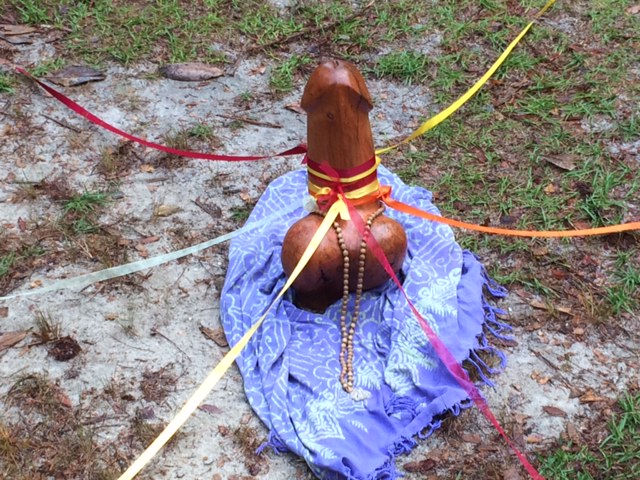
large phallus at the centre of the queer men’s Lingam Puja that I often lead can heal the shame of some
men in the circle gathered around it. But it may turn out to be a painful
reminder to others of the obsession with cock size and performance in commercialized
gay culture. Someone else may object to its appropriation of the central object
of veneration in a Shiva temple.
It’s not that good ritual challenges no
one. On the contrary, good ritual stretches us and becomes a tool for our
growth. But the benefits of ritual happen when we’ve transformed private fantasies
into shared meanings. Doing that takes perseverance and mindful attention.
When it comes to creating explicitly erotic
ritual, the stakes are that much higher. Many attempts to create mindful,
spritually grounded group erotic practice fall apart on the failure to get past
a collection of individuals acting out their individual fantasies, all the
while mistakenly assuming that everyone else involved will be on the same
wavelength. Things can fall apart quickly and completely when it becomes clear
that one man’s expression of the Divine is another man’s freakout.
Why would we be drawn to creating erotic
ritual in the first place? In part, because it’s a way to express and explore communally
the deeper meaning of our sexuality without reducing the magic and wonder that
flows from our unconscious to bloodless, disembodied talk. It’s a path to
healing, as we experience that we’re safe, we’re seen, we’re sacred--and as we
provide that safety and grace for others as well. It’s a path to growth, as we
practice the never-fully-mastered skill of simultaneously respecting boundaries
and reaching out across them to the internal worlds of our fellow travelers. It’s
a path to transcendence, as we connect with the fundamental humanity of other participants--their
longings, their anxieties, their capacity for joy, their generosity, their
vulnerabilities--regardless of whether we’d likely choose erotic encounter with
them as individuals or not. It’s a path to non-attachment, as we learn
simultaneously to honor our desires and to take them less seriously as the
mysteriously fluid and transient phenomena that they are.
Those of us who feel called to connect with
such ritual practice learn pretty quickly that the fantasies we bring with us
only take us the first leg of the journey. More or less immediately, we have to
start loosening our hold on long-treasured (i.e., hot) private scenarios, in
order to make space for the equally treasured scenarios of others. That, in
turn, gets us only to second base. As we speak from the heart, as we listen
with the heart, we start to understand that the adventure of what we create
with others in our circle is more enlivening than what we assumed we wanted in
the first place. As we construct a ritual practice one experiment at a time,
retaining what works, letting go of what isn’t so successful, we begin to mold
a container strong and flexible enough to hold us all: a ritual time and space
where we become more fully ourselves--and where, if we’re blessed, we lose
ourselves in something bigger and richer and more complex than anything we individually
could have asked or imagined.
Monday, November 23, 2015
Checkout Line
I had the pleasure of waiting at the express register behind
a really handsome man a couple of days ago. Buying cereal is rarely so
satisfying.
I felt a freedom and euphoria in appreciating his
beauty. And at once noticed the contrast with an all-too-familiar sort of
longing that has very little to do with genuine pleasure.
That other, less happy brand of desire, which was more or
less all I knew in my teen years and twenties--and which has continued to get
way too much air time in my head in the decades since--leaves me feeling like a
dog straining at a leash, if not like a fish thrashing on the sand. It
comprises equal parts of (1) impossible fantasy scenarios, (2) frustration that
there’s no socially graceful (or even acceptable) way of getting his attention--at
least the kind of attention I might like--(3) ancient insecurities about
whether a man I’m attracted to could possibly find me attractive in return and
(4) painful, ridiculous comparisons between how fabulous my life would be if
only I had his attention and how unfabulous it presently is without it. I’ve
always been more or less incompetent at flirting. If I were better at it, the
dog on my leash might at least be a little less desperate to dash across the
street through oncoming traffic.
This, instead, was more about just being glad the man between
my bran flakes and the cash register was part of the world, and that I had the
pleasure of a couple of minutes crossing paths with him before we walked out
the door in opposite directions. What I was experiencing was desire without
attachment.
I guess some people figure this out early on. I’m glad I’m
getting it now.
Sunday, November 15, 2015
At the Sistine Body Shop
Yes, this is camp. And somehow, also tender, sexy, playful, and profound.

With thanks, as so often, to Hoppergrass for the link to this image by photographer Freddy Fabris.
With thanks, as so often, to Hoppergrass for the link to this image by photographer Freddy Fabris.
Subscribe to:
Posts (Atom)