Tuesday, July 31, 2012

The Holy Hubcap of Antioch

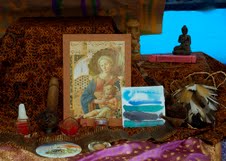
Among the sacred objects I treasure most deeply, I count the rosary I bought at the shrine of St. Francis Xavier in Goa. Also the small, naturally sculpted phallus of smooth white stone I found while walking a beach with the men in my ritual and art-making circle. But the one that really stands out is a Cadillac hubcap.

Last summer one of my mentors found it lying inexplicably in the woods on a morning hike. It sat at the foot of the altar for three days at a workshop before he presented it to me as a parting gift during the closing circle. I knew instantly it would become the tray on which I'd keep a small burner for arati--the cool, steady flame of camphor tablets--along with powders for tilak--the facial markings that declare the wearer's devotion to one or another of the Hindu gods. It needed a good blast of the garden hose and a stiff scrubbing with a wire brush to get what rust I could off the underside.

For the rest of the summer, I waited to see if visitors would recognize its previous incarnation. I enjoyed sharing the joke, whether they caught it on their own or I pointed it out to them. But the moment of recognition also always felt a little risky. Could my arati tray be funny and serious at the same time, a loose adaptation of a practice with millennia of tradition behind it and still a castoff car part that had turned up in the middle of the forest, and that now intermittently flaked rust onto the sari laid over the floor of my tent?

We often want the sacred securely and absolutely separated from the profane. We get uneasy when they turn out to sit cheek by jowl with each other. People may write off a ritual practice as frivolous; they may indeed get angry when they think the line is drawn wrong. Think of the furor that has surrounded public performances and displays of art in which one representation of the holy strikes others as sacrilege.

At the Christian Easter Vigil, an officiant sprinkles the congregation with water to remind them of their baptism into the community of the Church, usually flinging it over their heads from a leafy branch dipped into a basin. A friend of mine one year instead pulled a squirt gun out of his vestments to spritz the kids in his confirmation class. Everyone saw the joke, but not everyone got the point: that we meet the sacred when it breaks into the circumstances of our ordinary existence, and that we ought to rejoice and celebrate that it's so, because otherwise, we'd be far less likely to meet the sacred at all. The kids loved it and were way ahead of some of the stuffier adults in the congregation.

My hubcap didn't work well for all the men who saw it, or saw me using it, either. At a retreat center where eclectic, radical faerie spirituality has a robust presence, the disconnect wasn't always about the danger of being flippant. Instead, at least sometimes, men were puzzled and a little put off by the clear and serious, if unconventional, connection to an established but unfamiliar tradition. It was the arati and the tilak they had more trouble with than the hubcap.

What I'm trying to say about my hubcap is this: sacred symbols aren't doing their work well if we get them perfectly, right away, and they flawlessly confirm our prior expectation of where we'll meet the Divine. Maybe they should make us pull back, just a little, at least once in a while, so that we notice their absurdity. Better they should be a little rough around the edges, with a little rust flaking off, and maybe a dent in the rim.

Saturday, July 14, 2012

In Honor of Pema Chödrön

Today is the seventy-sixth birthday of Pema Chödrön, the resident teacher of Gampo Abbey on Cape Breton, Nova Scotia. Ani Pema is on yearlong retreat for 2012. She has made the suggestion that to honor her, those grateful for her teachings should practice in solidarity with her today.


Here are two excerpts from her writings:

When people start to meditate or to work with any kind of spiritual discipline, they often think that somehow they're going to improve, which is a sort of subtle aggression against who they really are. It's a bit like saying, "If I jog, I'll be a much better person." "If I could only get a nicer house, I'd be a better person." "If I could meditate and calm down, I'd be a better person." Or the scenario might be that they find fault with others; they might say, "If it weren't for my husband, I'd have a perfect marriage." "If it weren't for the fact that my boss and I can't get along, my job would be just great." And "If it weren't for my mind, my meditation would be excellent." But loving-kindness, or maitri, toward ourselves doesn't mean getting rid of anything. Maitri means that we can still be crazy after all these years. We can still be angry after all these years. We can still be timid or jealous of full of feelings of unworthiness. The point is not to try to change ourselves. Meditation practice isn't about trying to throw ourselves away and become something better. It's about befriending who we are already. The ground of practice is you or me or whoever we are right now, just as we are. That's the ground, that's what we study, that's what we come to know with tremendous curiosity and interest. (The Wisdom of No Escape and the Path of Loving-Kindness, pp. 3-4)

How are we going to spend this brief lifetime? Are we going to strengthen our well-perfected ability to struggle against uncertainty, or are we going to train in letting go? Are we going to hold on stubbornly to "I'm like this and you're like that"? Or are we going to move beyond that narrow mind? Could we start to train as a warrior, aspiring to reconnect with the natural flexibility of our being and to help others do the same? If we start to move in this direction, limitless possibilities will begin to open up. (The Places That Scare You: A Guide to Fearlessness in Difficult Times, p. 20)

Tuesday, July 10, 2012

Tree Hugger

I feel stressed today, sitting in the house as a crew takes down the very large maple twenty feet from the front door. They've been at it since around 9 this morning, and they're very good. I hear them strategizing, then the sound of a chainsaw, a warning shouted in Spanish, a crack, a thud that comes up through my feet from the floorboards, laughter, then the blows of a machete hacking the smaller branches into lengths they can load onto the flatbed. They're down to the last lead branch as I write this. It stretches up now about sixty feet on its own, the last remnant of the giant presence that's shaded us year after year, that wrapped us in a living green embrace against the worst of last week's heat wave.

And I'm quietly sick at heart. This is the tree that held through last August's hurricane, when limbs had fallen up and down the street as we came out of hiding at the end of the day. I owe this being a compounded debt of gratitude. I owe it awe for its rootedness and strength, owe it admiration for the birds and insects that have made homes in it. I need its forgiveness that at the signs of disease in its trunk and central leader we decided against the risk it posed so close to the house.

By cordoning it off with a ceremonial rope five days ago, setting a bronze Buddha atop one of its roots, burning camphor at its foot every evening as dusk fell, reverencing it by laying my hands on its trunk, I confirmed our neighbours' hunch that I've gone around the bend. To mourn this tree, to make mourning real by ritualizing its destruction, is a conscious decision I could choose not to make. By early influence and upbringing, I'm disposed to do so--my mother and her people, for all their Protestant piety, were closet animists, without knowing the word--but I could still choose instead to say, "It's only a tree, for God's sake."

But to honor this tree is as much about how I want to be in the world, and who I want to be in the world, as it is about the object of my grief. I'd rather spend the rest of my lilfe as a crazy fag who goes out to the front yard in a sarong at dusk to burn incense at the foot of a doomed maple, and who lavishes as much attention on plants and animals as some people pay their children. I'd rather see the creatures with whom I share this poor, poisoned planet as having as much right to their lives as I and my whole sorry-assed, self-obsessed species. I'd rather stand, in whatever ways I have power and means to stand, with the whales and the old-growth pines and the spotted owls and the orangutans and the few embattled traditional human societies that are left, than with the corporations and governments that treat the earth as so much raw material to chew through: the ecological rapists of Canada, and the US, and Brazil, and China; the oil and mining and automotive companies, the chemical conglomerates, the factory farms.

I'd rather see the Earth as my Mother. I'd rather begin and end the day saying Thank You for the ground under my feet and the light in the sky than taking them as my due.

Wednesday, July 4, 2012

Signs and Wonders

I turned the cards over one by one as I sat in the garden yesterday morning, before I set off for a day that would call for a grounded sense of who I am and the gifts I can offer those I meet; for openness; for risk-taking.

Temperance. The High Priestess. The World.

I was happy not to see again the dark cards that have turned up dauntingly often over the last two weeks: Death, the Nine of Swords, the Ten of Swords.

Along with relief came surprise that I'd turned up three Major Arcana together. A Tarot deck consists of seventy-eight cards: the Minor Arcana in four suits, and twenty-two named cards outside the suits--the Major Arcana. Your chances of turning up one of the Major Arcana are less than three to one. Your chances of turning up three of the Major Arcana in a row are, obviously, much lower. (I'll leave the correct statistic to those who know more math than I've long forgotten.)

Then I settled into the slower, more ambiguous search for what these cards could tell me, digging into the uncertainties, looking in the shadows cast by hesitation for what I might otherwise fail to see. Reading your cards, or having them for you, requires a kind of faith. You have to trust that a series of random occurrences has something to teach you--that hovering just behind pure chance is a sign that points to something you'd do well to notice. You have to get past calculating the odds in order to embrace what Thomas Moore has called "the reenchantment of everyday life."

You don't have to believe deeply. You just have to behave as though you do. You have to give yourself permission to imagine and play with the possibility that the randomness of the world is speaking to you. You can use the Tarot as a technology for the expansion of your soul. You could just as well use astrology; or the I Ching; or ink blots; or the pattern of the flowers that have opened this particular summer day, in this particular meadow. The truth isn't in the cards, but in the dialogue you have with them--a dialogue that can both take you out of yourself and invite you to enter more deeply into yourself.

The faith that the accidental encounters of daily life can speak to you is right next door to naïveté; and just across the street from narcissism. My life history makes me painfully, uneasily aware of what can happen when well-meaning people lose their critical edge. I grew up with a born-again uncle who claimed to have prayed his gas-tank full between paychecks; with an aunt who met the Devil on her way to a family reunion, turning him down, I'm glad to report, when he needed a lift--and who had an unnerving habit of sharing with new acquaintances (like my former partner, the first time she met him) a few of the most important miracles she'd experienced in her life. I've known hyper-rationalist empirical types who've fallen off the wagon into talking about auras and chakras as though they were subject to the same verifiability as the laws of thermodynamics.

And this is why I think a sense of play (and a healthy dose of irony, our cultural birthright as queers) is ever more essential as we integrate the spiritual importance of our everyday experience. As we search the ordinary for the wisdom it has to impart, we need to remind ourselves, more or less continuously, that it's what happens between us and the signs and wonders of our lives--the cards we read; the dragonfly that settles on our arm; the coincidental meeting that feels too providential to ascribe to dumb luck--that opens us up, not those occurrences in and of themselves. There's no objective, "scientific" truth to the Tarot, as far as I'm concerned, but there is what it calls forth in us as we play with what it offers. The chance happenings of my day aren't direct messages from a God who has nothing more pressing to do than send me personal telegrams; but I can choose to take them as evidence of a Mystery that unfolds before me, and, sometimes, an invitation to allow it to unfold within me as well.

(If you're interested in learning the basics of reading the Tarot, Joan Bunning offers a very user-friendly (and free) online course at www.learntarot.com.)

Tuesday, June 26, 2012

Enough With Genius, Already

Above, Joan Miró, Toward the Rainbow, 1941, Metropolitan Museum of Art, Jacques and Natasha Gelman Collection, 1998.

"I dipped my brushes in solvent and wiped them on the white sheets of paper with no preconceived ideas," said Joan Miró of the playful, intimate works on paper, the Constellations, that established his reputation in America when they were shown in New York in 1945. He'd made these paintings, gouache with oil washes, in dark days in indeed, in 1940 and 1941, in occupied France and then in Franco's Spain.

In the amazing retrospective show of his whole career on display at the National Gallery until mid-August, there's a priceless wall of five or six of these pieces. They're the quintessential Miró that you can't help but recognize, if you've had any previous acquaintance with his work at all.

The didactic panels in the show do what they have to do in a major art museum: they tell you why these pieces are important; they nudge you toward reverence in the presence of genius. The Gallery website is quick to quote Miró saying that the Constellations were "one of the most important things that I have done," and to say that as a consequence of the 1945 exhibit Miró was subsequently welcomed in America "as one of the great figures of the modernist movement."

But what turned my crank as I stood in front of these paintings last week was anything but homage to Miró's genius. I love these paintings because I look at them and think, "I could do that. I can do that. I'm going to do that."

Not as brilliantly, not with his sophistication. But Miró is empowering rather than awe-inspiring as an artist. He leads with his playfulness, not with his technical mastery. "I dipped my brushes in solvent and wiped them on the white sheets," he says. It's Miró's "Beginner's Mind," in the Zen sense, that brings me joy and sends me home wanting to let go of preconceived notions as deeply as he did: to be guided by the same pleasure in line and simple shape for their own sake, to be just as seduced by the raw magic of color spreading across white paper, to let things build up associatively and experimentally until the eyes and nose of some loopy, surrealistic creature finally invite discovery amidst the crush of invention.

The cult of genius doesn't have much to do with the artistic impulse. That's what you have to discover in the shadow of everything museums--however necessary and however well intentioned they are--do to convince you otherwise. Behind their incessant talk of importance and lines of influence and recognition lies the prior moment when an artist couldn't stop himself from making marks on paper, when he lost himself, and found himself, in the process of creation--when he made art not because he was an artist, but because he needed to make art in order to be truly alive. When we glimpse it, it's that moment which encourages us to claim our own creativity as well, to go home saying, "I can do that."

Tuesday, June 19, 2012

Blessed Solstice

Supple and turbulent, a ring of men
Shall chant in orgy on a summer morn
Their boisterous devotion to the sun,
Not as a god, but as a god might be,
Naked among them, like a savage source.
Their chant shall be a chant of paradise,
Out of their blood, returning to the sky;
And in their chant shall enter, voice by voice,
The windy lake wherein their lord delights,
The trees, like serafin, and echoing hills,
That choir among themselves long afterward.
They shall know well the heavenly fellowship
Of men that perish and of summer morn.
And whence they came and whither they shall go
The dew upon their feet shall manifest.

Wallace Stevens, "Sunday Morning," Section VII

Tuesday, June 12, 2012

Lost

This is my prayer for you, whoever you are reading this, in these longest, brightest, most generously welcoming days of the year. May you find a way, today, or tomorrow, or the next day, to shirk responsibility, get off track, and lose yourself in something pointless. May you misplace your day planner, smartphone, or whatever you use to keep the list of things you need to accomplish. Or better yet, may you choose to set it aside and take the plunge back into something you know you love but just haven’t the time right now to indulge in.

Maybe it’s waiting for you in the kitchen; or the garden; or the bedroom; or on the easel shoved for the last six months between the filing cabinet and the wall; or on the massage table; in the aquarium shop; in the gallery; in the guitar case; at the animal shelter; in the antique shop; in the knitting bag; on the curb the night before trash pickup; at the beach in a pile of driftwood; in the fabric store; on the bike path; at the greenhouse; deep in the woods; in the middle of a meadow; on the tennis court; in the dance studio.

May it be free of the burden of usefulness. May it carry you far away from any voice within that says, it’s no good, it’s of no interest to anyone else. May you not even think to look over your shoulder for anyone’s approval. May you forget to look at your watch and then be startled to learn how much time’s gone by.

May it pry you loose from grind of work, from the anaesthesia of mass media, from the grip of addiction. If you find it all too easy to get off track, may you do it this time by conscious choice, without guilt, and feel when you’ve done it that it’s enough.

May it make you say, yes. This is what it feels like to be in my own skin, in my own soul, in my own joy. This is what it should feel like to be alive.

Tuesday, June 5, 2012

Old Enough to Be Your Father

At left, James Broughton and Joel Singer. Photograph by Robert Giard.

I’ve been taking inventory lately of how many of my friends are at least fifteen years my senior or junior. I'm attentive to the question because of an intensified sense of my own aging—a function of increasingly exuberant aches and pains, but these last months ratcheted up as well by the number of friends, in most cases people my own age or younger, now facing life-threatening diagnoses. 

A woman I’ve known for over twenty-five years, my closest friend during the time we taught together in San Diego, is twenty years older than me. She has a great gift for intergenerational friendship, of which I’ve been only one of many beneficiaries. I don’t think it’s even a stretch for her to reach out socially to those young enough to be her kids, or even, at this point in her life, practically her grandchildren. It just seems to come naturally.

 I’m six years older now than she was when we met, and I find myself thinking, I should do so well—but in particular, I should do so well in bridging the intergenerational chasm in my relationships with other queer men. As a kid, like so many all-too-well-behaved little gay boys, I gravitated naturally towards adults. In my mid-twenties, determined to embrace a fully gay life, I fell into a narrower cohort of men who saw their place in the world more or less as I did, shaped as we were by the twelve or thirteen years between Stonewall and the onslaught of AIDS. Most of us were deeply energized by the politics of coming out, though not all of us were equally radicalized.

I was insufferable in my impatience toward older men who’d mastered the finely calibrated arts they'd needed to survive a world far more uniformly hostile than the one we had to face, for all the homophobia we confronted and opposed. When these older men and I did befriend one another, I was often patronizing and more or less blind to the treasures of their wry irony; their hard-won but less complicated sense that their personal lives were nobody’s business but their own; their ability to let go of battles that weren’t worth fighting; the flexibility with which they could finesse the very questions of firmly declared sexual identity that my emerging view of the world was based on. My connections with such men often didn’t survive my inflexible judgmentalism. I’d say now that my life was the poorer for it.

Befriending the young, on the other hand, didn’t even seem an option. Any solidarity we might have ventured in the 1980s toward anyone under twenty-one was hysterically denounced as recruitment and predation, and many of us chose the easier and safer path of sealing ourselves off from the next generation's pain and isolation—but also from their promise and energy. Meanwhile, the young learned to fear the stereotyped rapacity of older men. (Later, the drag queens would come home to roost: at least some of those a generation younger than us would use their different experience of AIDS as an excuse to write us off as summarily as we’d dismissed our pre-Stonewall brothers.)

I’m beginning to think that perhaps the single most damaging effect of homophobia on gay culture is the opprobrium it heaps on us, even today, when we risk reaching across age cohorts . The generational segregation that’s become endemic to North American society is all the more absolute in the solitude and misunderstanding that far too often divide gay men now in their fifties and sixties from those in their eighties, as from those in their teens and twenties and thirties. We need queer elders to reassure us that we are in fact part of something more enduring than our own moment; we need queer heirs to whom we can pass on whatever we’ve created of lasting worth. We need networks of friendship and mentorship to help us make sense of the passage of our own lives and to impart meaning and dignity to the mortal condition shared by old and young alike.


If we need these roles and relationships, we need as well the resolve and social means to foster them. We need ceremonies to make them visible and honor them. Amidst the overwhelming attention that gay marriage now commands (for better and for worse), we need rituals to recognize bonds between elder and younger friends, between protégés and mentors, outside the structures of the nuclear family to which even same-sex couples are now pressured to aspire.

Monday, May 28, 2012

Wild Thing

Nothing I could say about Maurice Sendak, in the wake of his death on May 8, hasn’t already been said.

So instead, I’ll just offer thanks for Max, surely the best-known and best-loved terror-in-training in all of American children’s literature. Without Max, without the Wild Things he sailed off to discover, cavort with, tame, and escape, life would be, if not unthinkable, then hardly worth living. For almost fifty years—since the forest first grew in his room one night in 1963—Max has been there to assure us that there is a love that never ceases to cherish and watch over us—not only despite our Wild Things but somehow, mysteriously, also because of them, for all their terrible roars and terrible claws and terrible teeth. Max is there to remind us that when we need to wear our wolf suit, when we need to make mischief of one sort and another, we won’t undo the world, but make it all the richer as we take the risk of exploring our deeper selves.

(Above left, Max with friends, from Maurice Sendak's Where the Wild Things Are, in fair-use illustration of the above commentary.)

Sunday, May 20, 2012

On Holding One's Lovers Lightly

Recently I walked the beach with a friend. The day was near-perfect: bright sun, a cloudless sky, rolling surf a dozen shades of white and green,more plovers than I think I’ve ever seen running up the sand all together.

We’ve been close the last ten or twelve years. Not many more times than that, we’ve tumbled in and out of bed. Whenever it’s happened, it’s been good for us both, sweet, affirming, affectionate. I have no idea when we’ll see one another again. He’s made a decision about where to go next with his life that quite possibly takes him to the other side of the world for the forseeable future. I’m not convinced that what he’s chosen is a great idea. I stuck my oar in some time ago to tell him so. I gather several other friends later echoed what I’d said.

He turned over some alternative ideas during the winter, then decided, he told me a few weeks back, to go ahead with his original plan. I find it way too easy to offer unsollicited advice, but I’m glad to say I fought back the impulse and did my best to listen supportively. If my fears for him are misplaced, he doesn’t need me sapping his declared excitement and enthusiasm. If they aren’t, it’s not my hunch but what he learns of himself that will bring him out the other side of the experience. It’s only the knowledge that rises from within us that counts in the end.

My deep-running desire to be right, to see farther, isn’t about my love for this man, but about an impulse to colonize him, to treat his soul as though it were my own territory. I’m not happy to think how long it’s taken me to realize this, how often I have to learn it again: looking out together hand in hand at the light glinting off the ocean is better than holding up a map to announce with authority, “here we are.”

Friday, May 11, 2012

Claiming the Story

They came to Jericho. As he and his disciples and a large crowd were leaving Jericho, Bartimaeus son of Timaeus, a blind beggar, was sitting by the roadside. When he heard that it was Jesus of Nazareth, he began to shout out and say, ‘Jesus, Son of David, have mercy on me!’ Many sternly ordered him to be quiet, but he cried out even more loudly, ‘Son of David, have mercy on me!’ Jesus stood still and said, ‘Call him here.’ And they called the blind man, saying to him, ‘Take heart; get up, he is calling you.’ So throwing off his cloak, he sprang up and came to Jesus. Then Jesus said to him, ‘What do you want me to do for you?’ The blind man said to him, ‘My teacher, let me see again.’ Jesus said to him, ‘Go; your faith has made you well.’ Immediately he regained his sight and followed him on the way. (Mark 10:46-52, New Revised Standard Version)

The best thing I did last week was hand a few people a pair of scissors and encourage them to cut up the Bible.

It took an hour to work up to it. We’d been reading the story of Jesus healing a blind beggar named Bartimaeus on his way out of Jericho in Mark 10.

We gathered as queer and queer-positive readers and listeners around a sacred text. We weren’t asking for permission to enter. We weren’t interested (at least not for the moment) in “what the Bible really says about homosexuality,” and we certainly weren’t setting out to argue, for the ten-thousandth time, over the so-called “clobber texts”—the handful of mostly short, oblique passages that the likes of Rick Santorum, Billy Graham, and the current Pope pull out of context as warrant for their ongoing bigotry.

The religious right puts much of its energy into pretending that the Bible is a seamless whole, a Magic Decoding Ring that spits out answers for everything. But it’s not. It’s an archive of twenty-five centuries of people struggling to comprehend the Mystery we often call God, and it’s full of contradictions, bearing the traces of the many times that struggle led disparate groups to disparate conclusions.

Instead of looking for pat answers, we gathered last week to enter Scripture as a space we claimed a right to inhabit, a place to find ourselves, much as Bartimaeus in the story claims space despite the pious folks in the crowd around him who want him to shut up. We were there to imagine our way in: to find ourselves among the bystanders, puzzled by what might make a charismatic, iconoclastic young rabbi stop for a persistent beggar at the side of the road; or among the rabbi’s followers; or sitting ourselves in Bartimaeus’s place—the pushy, half-Greek, half-Jewish pariah; the ACT UP protester, half-blind with CMV, disrupting Mass from the back of St. Patrick’s Cathedral; the campy queen who screams like an extra in Ben-Hur or The Ten Commandments.

Before we were finished, making the text our own meant physically taking it apart and pasting scraps onto blank pages as collage: superimposing it over a background; drawing around it; laying one phrase over another. One of us found her way in through the words “Jesus stood still”; another through “take heart”; another through a jumble of phrases spilling disjointedly over one another.

But claiming the story was only the half of it. The other half was being claimed by it: the silence and concentration of half a dozen adults deeply absorbed in a project reminiscent of a kindergarten craft exercise; getting lost in words turned into raw material, rearranging them only to find, when we looked at what we’d made, that the words had rearranged us, called us to an awareness of something we hadn’t seen before. Like Bartimaeus, seeking new sight we received it.

Tuesday, May 1, 2012

Colorful Realm


The scrolls flank the hall leading to the Awakened One seated at the far end: Ananda and Mahakashyapa attend him as he expounds the Lotus Sutra, proclaims compassion personified to all living beings. But interposed, the chatter of several hundred viewers drawn here, as I am, by the hype of PBS and the New York Times. A frenetic pilgrimage, this day of Amtrak back and forth from one imperial city to another for a few hours with these birds and flowers: jostling for a closer look at the filigree of feathers like cloisonné, built up stroke by stroke from shell-white ground in glue, craning, much like the herons that crane back, for a view  of one scene entire.


Itō Jakuchū of Kyoto (1716-1800): well-to-do wholesale grocer, retired at thirty-nine; student of painting and Zen who spends the next forty-five years learning to begin. He starts with the lovely and innocuous, a flight of butterflies defining the space where they aren’t. Then his materials take over: viscous snow splattered on both sides of the silk, across draftsmanship that speaks of consummate control. Just below the white goose, a brushload of ink savage and elegant and more blatantly nothing but itself than DeKooning in his middle years. Streams and garlands that leave little for Klimt to invent. Gold applied sparingly for its dangerous opacity.


Om mane padme hum. Deep in the meditation hall, life bursts the genre, too many invertebrates neither bird nor flower. Sixty-seven species of insects swarm around the frogs, water seething with tadpoles, hanging gourd coiled round by a snake, foliage lovingly painted in every stage of decay, caterpillar chewing exquisitely around the edge of the widening hole into which the leaf will vanish. Fish swim through the air above a pond seen from five viewpoints at once, dissolving the viewer into confusion. And endless: the fascination with chickens nobler than the Forty-Seven Ronin.


And suddenly I love this random crowd of our samsara. I smile and laugh with the woman who walks smack into plexiglass as she approaches plum branches beneath the moon; long to speak to the two men pressed shoulder to shoulder before an octopus floating in space. “What a gift to see this,” I offer lamely to the elderly woman with whom I share a bench and broken ice. "The real gift," she replies, "is to have created it."


I want to say Yes. And No. We are the unfolding now. We are the chattering birds weaving among impossible chrysanthemums.

For more of the paintings from The Colorful Realm of Living Beings,  go to http://www.nga.gov/exhibitions/jakuchuinfo.shtm.

Tuesday, April 24, 2012

Here

It’s a little beyond me how I can feel so overextended, when the demands of what I do for a living are so blessedly light right now, but there it is.

I don’t make it to the end of the lists I create for myself. I get tangled in the desire to move on to the next thing, and the next—and lose the satisfaction of what’s before me in the moment. It doesn’t matter that virtually all the stuff on my agenda right now is there by my own choice, an imagined enrichment of my life: the garden work I want to get to, the hour at the gym, the writing project I’ve meant to focus on for weeks, planning the workshop I’ve looked forward for months to leading.

Of course, to fix this, I just need to speed up and get through what I’m doing now so I can focus on the next thing on the list. Just punch through my rising misgivings that running faster on the treadmill will get me nowhere. Right?

Uh, maybe not. Maybe the only way to stop is to stop. So I’ve taken lately to setting down what I’m doing and taking a hundred steps.

That’s it.

I go out to the garden; or to the street; or maybe as far as a wilder place nearby. As I shift my weight from one foot to the other, the only mantra I need, the only one that seems appropriate, is “Here.”

You’d be astounded how slowly you can walk when you notice every step. Balance is no longer a given; you have to attend to where your weight falls under your foot, and you may feel a little daunted, especially on sand or uneven ground, that you’re so unsteady when you’re not barrelling along. It takes time to repeat “Here” and mean it as you look around you. If you use a mala to keep count of your steps one bead at a time, it will slow you down even further.

By the time I’ve made it to my hundredth step, I’m pried loose, at least a little, from whatever it was that I thought was essential ten minutes ago. Maybe I decide to take another hundred steps, make another circuit of the mala. Maybe I can focus on who in my life I might want to pray for. Or maybe, just for a moment, I look up at the impossible blue of the sky, the impossible green of newly burgeoning foliage, or down at the darkness of moist earth, and see it for a miracle, before I go back to business as usual.

Sunday, April 15, 2012

Traces of Desire

The stills at left and below from Karl Lakolak's videos.

I’m haunted lately by the videos of French artist, choreographer, and performer Karl Lakolak. Among some twenty clips of his work posted to Vimeo, you can access the ethereal and intensely carnal Poème de Ténèbres at http://vimeo.com/user3595253. (I have my friend Tantrika au Naturale to thank for this new obsession.)

Lakolak paints the human body as a canvas and then sets his subjects moving in space. Colors run, smear, and blend, spreading across the body’s surface a record of its gestures and its contact with others. Patterns that begin like the markings of some unknown rite in an unfamiliar culture turn into abstract-expressionist arcs, disrupting the integrity of the naked skin that intermittently shows through. I watch these very beautiful men walk slowly across a tarp laid down on the floor, lose themselves in moving pigment across their own bodies, wrestle and/or make love with one another, and my desire is both intensified and dislocated. The camera panning in close-up across expanses of hue and texture queers any ordinary experience of looking at the body as an objectified whole. Then gradually, or in a sudden flash, a leg, a forearm, a cock, an ear caressed by a hand emerges as something I recognize and can name. Eyes gaze out at the viewer from an enveloping swirl of white and blue.

Flesh becomes an unfamilar country, seen once again as for the first time. And yet Lakolak’s camera often follows the conventions of gay porn: the fetishizing close-ups, the duplicated slow-motion sequences of skin touching skin, the direct gaze of performers into the camera, the obvious disruptions of linear sequence in the editing. His credits mostly acknowledge his performer/dancers by first name only, evoking the commodified false familiarity of sex films.

Then once again the camera moves on, or the shot is cut. Flickering superimposed images fold the experience of time over itself. As the clip cuts back and forth between later and earlier stages of the process, a smear of rich, complex grey left across a man’s back when his lover rolls away turns in the next shot back into a clean tattooed flank still untouched by paint. I find the erotic charge of my fascination both thwarted and teased on by spatial ambiguity and temporal confusion.

In Décembre, as a man stands absorbed in the diffuse autoeroticism of moving paint across his own body, then of removing it with a cloth, there hovers swaying to his left a figure with a papier-maché horse’s head. The apparition is draped in black fabric painted in white with a looping cursive script, an incantation only fragments of which are intelligible. Such fabric, worn by masked figures, hung at the back of the stage, or laid across the floor, appears as a motif throughout the series. Lakolak assumes the role of a latter-day shaman, dismantling and transmuting ordinary identities, inviting us both to relinquish what we think we understand of the flesh and to lose ourselves more deeply in it.

Saturday, April 7, 2012

Otherworld


Photo from Jeremy Kai, Rivers Forgotten.

Cross-hatched across stretches of west central Toronto lies the web of another streetscape. It’s as real as the one I know intimately after years of walking and biking these neighbourhoods; but strangely disarticluated from the predictable, domesticated routes I habitually take to work, to the houses of friends, to shops along not-too-distant thoroughfares. These alleyways behind the streets occasionally extrude onto the named grid sporting streetsigns of their own, vestiges of a largely erased past when a two-story brick garage behind my friend Kim’s back gate in Little Italy was a poultry store; when the lone house opening directly onto an alley down the block from me wasn’t an anomaly.

Turning my bike down one of these alternate routes can be like going down Alice’s rabbit hole. Harbord Street vanishes behind me, and soon I have no idea where I map onto the familiar street that lies twenty meters to my right. Buildings jutting above the garage roofs reassure me that College Street is somewhere ahead, but none of those I’m sure I ought to recognize quite register as landmarks. Then I make a turn and come out near a familiar intersection of the main commerical strip with Grace.

I’m on the way to Kim’s house with a belated birthday gift, a collection of impulse buys: an orange silk scarf; a chocolate bar; a candle holder of Indian soapstone carved as the footprint of the Buddha; a CD of music from the South African townships; and a haunting little book the staff has placed insidiously beside the cash register in the bookstore I poked into on my way back to my bike from the earlier purchases.

Forgotten Rivers by Jeremy Kai (Koyama Press) is a collection of photographs of the culverts through which flow the city’s long-buried streams. Garrison Creek at one time ran above ground just a couple of blocks from my house; Taddle Creek through the campus of the University of Toronto, a few hundred meters from my office. And so on across the city. A few photos at the beginning of the collection show the portals to these channels, surrounded by reassuringly ordinary vegetation, the concrete around the iron grates sprayed over by street artists.

Then come the more unsettling pictures. The tunnels—sometimes claustrophic, sometimes cavernous—are eerily lit in contrasing colors as they branch off from one another. Sprays of water pour from apertures set high in the walls, or down a flight of steps, turned to a ghostly mist by the long shutter exposure in the dim light. Looking at these images, I’m poised on an edge between attraction and apprehension. In some pictures (as Kim points out when we go through the book together), the presence of a human figure buffers the uncanniness of the spaces.

Kai’s images, like the experience of turning off the familiar streets of my daily routine, but far more dramatically, lead through an ordinary, everyday portal into a parallel world. Think of medieval tales of the Welsh Otherworld, or of latter-day recapitulations like Marion Zimmer Bradley’s The Mists of Avalon or Phillip Pullman’s The Golden Compass. Or think of the world of our own unconscious; of the silent water flowing underground through our own souls (with apologies to David Byrne and the Talking Heads).

I find myself strangely prizing this other city, this Otherworld; drawn to the portals where the veil between it and my ordinary perception of place grows thin. Losing myself for the moment—not without a whisper of primal fear that I might not find my way out again—I reemerge after all into a familiar landscape, and in that moment know the place as for the first time. All the more so on this first day of Passover, this first day of departure from Egypt's familar territory; on this Holy Saturday, in the darkness of a tomb that isn't the last word of the story.

Friday, March 30, 2012

Riffing in Faith, Building from Scratch

Photographs at left courtesy of Andrew Graham.

None of us knew what might happen next.

The six of us knew we wanted another weekend in community, after our first gathering in the autumn. Our experiments those two days in November gave us a glimpse of what we might do together in a zone of freedom and safety to speak our longings and fears, our gratitudes and hopes. We took first steps at building ritual together to bring forth what was in us: to make the unseen visible, to give it shape, to call one another as witnesses to what was moving through our souls. We searched for the beginnings of a shared practice of gesture, symbol, and language to speak of our separate journeys, and of what we could share. We welcomed one another into a candlelit circle. We walked the labyrinth one of us had contrived out of twine. We named stones for what we needed to let go of, waded into freezing surf, and cast them into the sea.

Gathering again last weekend, just after the spring equinox, at the cabin one of us had offered for our reunion, we walked in a kind of blind faith—knowing we needed each other, but maybe a little bit at a loss to say exactly why; knowing something awaited us larger and fuller than what any of us had brought on his own, but having no clear vision of what that bigger whole would look like.

And then, undramatically, it began to unfold. Andrea’s house and the land it sat on were magical, a radical faerie sanctuary in miniature waiting to happen. The tent Drew had brought became a temple, decorated with the bag of Indian fabrics, prayer flags, and icons I’d shlepped on the train. A totemic painting Drew created two years ago became its central altarpiece. A watercolour seascape Martin had sent Nick as a postcard held him present in our circle despite the scheduling conflict that kept him away.The bread Andrea and Drew had baked before the rest of us arrived became the food we offered each other in welcome the next morning when we formallly entered ritual time and space.

Saturday afternoon, we all dove into the art materials that Robert, Drew, Nick, and I offered for shared use. We sat together for three hours, mostly in silence, absorbed in the deep play of the process, shutting out the voices of self-judgement that might have hushed the creative children we were inviting back into the light and open air. The found objects Andrea salvaged from a dumpster Friday night on a walk down to the pond made their various appearances: a garbage can lid became a mandala hung from the branches at the top of the garden steps; the coffee table Drew had succeeded in repairing took its place in front of the living room couch.

“What happens next?” Robert asked at one point as the afternoon wound down, and our energy with it. I felt both a restlessness in the question and my own anxiety in having no ready answer. We’d talked that morning in the tent about the rituals we aspired to create over the course of the day; much of what we’d shared still remained unaddressed. As we settled into the evening’s fading light, Drew showed us the recent photographs he’d brought to share; Robert read his poetry. We unpacked what Nick had described in the morning as his “gift of noise”—a cache of borrowed drums, rattles, and chimes. Andrea lit the fire that figured centrally to his vision of what the night should bring.

But none of us mustered the energy, or claimed the authority, to call us back into conscious, explicit focus on the intentions we’d set for ourselves. I found myself in the night’s deepening silence reviewing how much of my own aspirations I’d succeeded in claiming, wondering how we could all best find what we needed in what already felt like the approaching last hours of our time together.

I know many people who long for intentional community. My sense is that fewer of us succeed in finding it. Our culture makes us uneasy with the artificiality of ritual action. This is especially true of improvisational ritual that we invent together in short, intermittent bursts of community, between which we return to our separate, individualistically oriented lives. The more of our lives we spend apart, the more artificial these rituals feel when we first create them. The more artificial they feel, the more insecure we may in turn be about stepping into a role of leadership, or even about being the one who gently nudges a group back toward the formality of ritual time and space. All that played into how unsettled I felt amidst the silence late on Saturday night.

Back in the tent on Sunday morning, we began by sharing what the day before had given us; what we still hoped for; and how we imagined we could use our remaining hours to find it. As we went around the circle giving voice again to our intentions, I saw that the evening before had provided exactly what we’d needed, each in his own way, in order to recharge and to consolidate. I understood that the diffuse, loosely shared experience had given us breathing space now to become more closely attuned to one another, finding in each other’s intentions a fundamental vibration with our own; hearing in one another’s aspirations an invitation to name and express ours as well.

I asked the others to stand witness to a simple naming of my past and present lovers, an exercise poised for me somewhere between celebration and mourning. But it called forth from the whole group a shared meditation on the richness of our erotic histories—and for their sometimes painful complexities--manifesting more grief and more joy than we could have asked or imagined. The short, straightforward ritual that one man asked us to perform for his healing and growth blossomed into a drumming procession around the boundaries of the garden, a thanksgiving and blessing for the land and for the hospitality of our host; a joyful affirmation of community; an expression of hope for our future gatherings.

As we basked in the surprise of what we could create together, I reflected on everything we’d done to pave the way for its abundance. We’d shown patience and openness to the shifting rhythms of our energy. We’d asked , “What happens next?” but we’d held the question lightly and not forced the answer. We’d been careful to listen to one another, yet not hesitated to hear through the ears of our own experience, or to reply in the voice of our own longings.

To put it in more traditionally religious terms, we’d walked in faith. But other ways to name what we did probably shed just as much light on what happened between us. We’d created a kind of spiritual jazz, picking up on the lines others had offered, building on them in call and response. We’d assembled a collage, setting the pieces each of us had brought into new contexts that both honored and transformed them. We'd put the yeast into the flour, kneaded the dough, and then waited. We’d built out of the materials that lay to hand a house not quite like anything we’d seen before.

Friday, March 23, 2012

Green Blade Rising

What other year have the first days of spring felt so like, well, the first days of spring? None that I’ve spent in Toronto, certainly, through most of my adult life. Neither of my winters in San Diego, where the modulation of seasons was so subtle, to a native of the Midwest, that it took me most of my time there even to register that they shifted at all. Perhaps, occasionally during my Indiana youth, the last ten days of March felt palpably and dramatically like the beginning of something new.

But yesterday after lunch, the short break I meant to take from desk work inside, cutting back last season’s dead growth in a border along the side of the house, was a path out of my small, goal-oriented self and into the bigger, wider-open self that’s out there waiting for me to show up and step into it.

Every handful of sere brown ribbon pulled away from green blades of Siberian iris now just breaking the soil carried me further from the wintry work that still waited inside. Every glint of sun off the leaves of the laurels ringing the front garden pulled me into the next task of pruning them back from late summer’s growth spurt—just one or two bushes, I said to myself; just one or two more; until all thirteen were finished and I’d yet to return to what had seemed so pressing—and so bloodless— two hours before.

Even spraying the vegetation outside the fence with reconstituted coyote piss to discourage the deer brought me joy.

And I found myself—750 miles from where I began my life, and over a decade after my mother’s death—welling up with gratitude to her that she gave me this: the capacity to lose myself in the endless task of caring for things rooted in earth. Gardening was her one grand pleasure in a life that had far too much of duty in it, and far too little of pride.

It’s taken decades to feel that gratitude so richly and so without complication. She and I had a vexed, unhelpfully impacted relationship, full of emotions too tangled and too co-dependent to parse apart without years of pain and mutual frustration. The relief of being able to let go into such gratitude, at long last, is one of the blessings of mid-life, a compensation for the aching joints that remind me this morning of how I spent yesterday.

Another gift, so bound up with the first that it’s really another aspect of the same, is to know that my garden is not her garden. I’m not trying to recapture the lost Eden of a nostalgically misremembered origin. I’m glad to have come so far—into the freedom outside the closet that was the price of life in the bosom of my family; into my power as a man who’s found his own way into connection with the Source of his larger self.

Laying aside my rake as I passed the backyard altar that’s waited untended since my summer practice there ended at the fall equinox, I knelt before it for the first time in a new season. The tiny soapstone Buddha needed straightening, balanced precariously on a loosened bit of mortar between bricks. A few leaves needed brushing away from the stones a friend placed last fall in a ring around the Shiva lingam at its center. I said a short prayer for a friend struggling with advanced cancer; for another whose chronic pain continues to shrink the circuit of his life. And rejoiced that what my mother gave me set me on a path that I’ve claimed as my own.

Sunday, March 18, 2012

Repair of the Self, Repair of the World: Two Quotations

“If I am not for myself, who will be for me? But if I am only for myself, what am I? And if not now, when?”—Hillel

“To begin with oneself, but not to end with oneself; to start from oneself, but not to aim at oneself; to comprehend the self, but not to be preoccupied with oneself. . .”—Martin Buber

Friday, March 9, 2012

Ex Voto

SEFFERINO VALDERRAMA SE QUEDO DORMiDO FUMANDO Y EN SUEÑOS SE LE PARESiO LA VIRGEN DE ZAPOPAN QUE LE DiJO—DISPiERTA HIJO QUE ESTAS EN PELiGRO Y EL DESPERTO Y ViO SU COJiBA QUE SE iNSENDiABA Y iSO JUSTO EN TiENPO PARA CORRER A LA COSiNA POR AGUA Y APAGAR EL FUEGO Y ANTE ESE PORTENTOSO MiLAGRO LO DiVULGA CON ESTA RETABLO EL 25 DE ENERO DEL AÑO DE 1943

While our own house gets painted, we’ve moved into a friend’s around the corner for two weeks. The place we’ve borrowed is nostalgic and understated, a rebuilt fisherman’s cottage on the bluff above the dunes, and here and there a little quirky: it’s full of testimonies to our friend’s eye for the beauty of small and often unassuming objects. Antique patent medicine bottles in pale sea-green glass line the mantle of the fieldstone hearth; scallop shells from the beach cover a counter in the bathroom.

Along a narrow span of wall between the stairs and an office nook hangs a vertical row of five “primitive” paintings on tin panels, each depicting a narrowly averted disaster in a naïve style that might elicit more amusement than empathy if you’re not used to seeing such pictures. Two young women sit on rocks by a stream with their feet in the water, mouths round in astonishment as three cartoonish crocodiles swim toward them. In another scene, two more women bathe in a river oblivious to the men lurking in the bushes behind them. A youth dives to the bottom of a lake where another young man lies unconscious. A man leaps from a canoe to rescue an infant. A sleeper awakes to find his bed in flames, a cigarette visible on the quilt just to the side of a blaze obligingly contained between the dreamer’s feet and knees. In an upper corner of each painting appears an image of the Virgin Mary that that looks as though it might have been incompetently sculpted out of marzipan.

And then you read the testimonial added in crude script in a blank strip at the bottom of the last of these panels: “Sefferino Valderrama fell asleep smoking and in his dreams there appeared to him the Virgin of Zapopan who said to him awake son because you are in danger and he woke up and saw the coverlet which was burning up and just in time to run to the kitchen for water and to quench the fire and in view of the portentous miracle he makes it known with this retablo on 25 January in the year 1943.”

These five panels are retablos, a deep tradition of Mexican folk art, paintings in thanksgiving for deliverance from danger. I don’t know how I feel about seeing them displayed as charming objects on par with the seashells and the glass bottles. Seventy years ago Sefferino saw his survival not as blind fortune but as miracle, and presumably hung this expression of gratitude in a local church in Mexico, alongside countless other testimonials like it. Whoever he was, he chose in the very act of offering this panel to unite himself to something larger than himself: to the Power that he saw as sustaining his life; to a community disposed to affirm the presence of the Holy in deliverance from danger, rather than chalk it up to dumb luck. He performed this act of devotion to inspire reverence in the viewer, not momentary arm’s-length pleasure.

And I find myself asking, what would it be like to claim the making of retablos for myself, as a way to reflect on what’s sustained and empowered my life? What are the events, who are the people, who’ve thrown me a lifeline when I’ve needed one most? Could I make these occasions of deliverance into visible material for further reflection? Could I, like Sefferino, choose thus to bear witness to the hand of God in my life? What would a gay man’s retablo look like? Where might it be displayed, and who might see it?

Friday, March 2, 2012

At the Harvest: A Queer Midrash

You’re bone tired but can’t sleep. Still caked in sweat and dust, you fell onto your bedroll as soon as you’d eaten what the servants had prepared, without even rinsing off. Just as well: by dusk tomorrow, thirst will claim every ounce of the water the women carried to the field. The sound of exhausted men sighing around you in their sleep merges into the breathing of a single spent beast; the women lie farther off, beyond the baskets of already-threshed barley.

Out of the darkness rise images of the wiry young Moabite woman, lean but tireless, and strong as an ox, to see her load a basket onto her shoulder that half your men would strain to lift. Her hair cut short, just growing in after she’d shaved it in mourning, she must have looked more like your kinswoman’s son than her daughter-in-law as they made their way back here from far beyond the Jordan. It would have served them well as protection on the road.

You see her gathering leftovers at the edge of the field, moving twice as fast as most of your own people, and carrying bound sheaves to the threshing floor once she’d filled her own basket to the brim. You picture her the morning of the day before, standing before you asking for charity in her thickly accented Hebrew, then retreating to the far side of the field to embrace with relieved laughter the older woman you still didn’t recognize as your emigrant cousin’s widow. You begin to doze off imagining her.

And wake to realize she’s there in the flesh, leaning above you in the light of the setting moon, putting a finger to the half-smile on her lips, then pulling down the loincloth that’s all you could bear to leave on in the strangely humid heat. Exhausted as your are, your erection’s been tenting it all the time you’ve thought of her.

It’s no sooner sprung free of the linen than she’s straddling you, slipping herself around you, gripping you as she sets up her own rhythm. She’s in charge of what’s happening between you and riding you for her own purposes, not yours; and yet, in the gleam of her eye in the dim light, you see her seeing you, see her taking satisfaction that you’re losing all control and turning into a bucking animal whose only reason for being is this. It goes on like this for what seems like the whole night. You‘re vaguely aware that you could wake those around you, but there’s nothing you can do to stop yourself. Nor would you if you could.

Purple light explodes behind your eyes. As your seed courses into her, your soul is somewhere outside your body altogether, and you see the future in a flash: the child she’s conceiving at this moment and will bear in nine months; the life you and she and her mother-in-law will lead together; the children of your son playing at the edge of the field as your people bring in the harvest some year long hence. You’re seized by an intuition that what’s just happened will change not only your life and the lives of your household, but somehow, countless years from now, the whole world. And you’re weeping as you see it all.

Your heart still racing as she rhythmically strokes your hair, she presses her forehead to yours and comforts you like a child. You whisper her name. She is Ruth.

Thursday, February 23, 2012

Dust


At right, ash paintings by members of the Wellsprings collective, Church of the Redeemer, Toronto, March 2011

I hate Lent.

It’s a magnet for much of what’s worst about the Christian tradition: the individualistic moralism; the wallowing self-accusation, as though that were of itself a virtue; the willful refusal to acknowledge what’s good and right about our lives, and not in need of rescue. Virtually every time I’m asked to participate in a public litany of private wrongdoing, my heels dig in. I’m not unaware that I screw up, massively, in my personal life. But the platitudinous catalogues that usually get rattled off in penitential liturgies can’t possibly access the specific ways I’ve been less generous, less compassionate, less loving, less just, than I want to be (and that I believe I’m called to be).

At the same time, despite their public performance, these rites rarely get to the heart of what repentence at a systemic social level might mean. So get back to me when the Roman Catholic bishops go down without hesitation on their knees, every last mitred one of them, to beg forgiveness from the survivors of sexual abuse by the clergy; or when in a public liturgy Americans repent of standing by passively while our elected government has waged pointless, brutal, and unjust wars for a decade; or when Canadians confess our shameless exploitation of the environmental riches that national rapacity has proven all too finite.

My disaffection as a gay man is all the deeper because the language that gets used in these services inevitably conjures up too many years of hearing it used like a blunt instrument of homophobia. On the very fine website, Out in Scripture (www.sites.hrc.org/scripture), writing about the Bible readings for Ash Wednesday services, Dierdre Hinz observes, “We have to be very careful when we speak of repentance in relation to the LGBT community. Some have internalized the negative and oppressive views expressed in cultural, political and religious realms. Others may blame themselves for not being more vocal or outspoken in response to these views and their attendant policies.” Douglas Abbott adds, “Repentance for the LGBT community has historically been an indictment of sin. Being called to repent and then being denied an opportunity to experience forgiveness within a faith community is the reality many LGBT people endure.”

And yet, there I was this afternoon, kneeling in front of a woman who invited me to remember that I’m dust, that to dust I shall return, and pressed home her point with a smudge of black ash applied with her thumb to my forehead. She made the rounds of the twenty of us who were there: the cancer survivor, the toddler in the arms of her mother, the diagnosed cancer patients, the nine-year-old twins on either side of their father.

Paradoxically, I can embrace Ash Wednesday itself without deep reservation, precisely because it’s there to remind me, in community with everyone else present, that mortality is the most basic fact of our lives—that we aren’t here forever, that we aren’t self-sufficient, that everything we use to ward off the admission of our fragility in fact gets in the way of living the life we’re given.

Strangely, this gesture that might seem grim and relentless almost always feels to me like one of the most intimate and loving connections that people can make with one another through ritual, precisely because of its unflinchingly honest mutuality. This afternoon, the pressure of the officiant’s thumb above my eyes gave way to the warmth of her palm laid briefly and gently on the side of my head as she finished delivering her reminder that someday I’m going to die. Herself the last among us to receive the sign of ashes, she accepted them from her own daughter.

As for the next six weeks, I could easily give up church for Lent. Except that there’s no telling when something as simple as a pinch of ash may break through all the piously masochistic shlock and wake me up to embrace more fully the real nature of the life I’m called to live.

Thursday, February 16, 2012

Servant of the Dance

Martin Luther King holds up his booking number. The bars of a cell in Birmingham jail are visible behind him—except where the nimbus blocks them out. The mug shot is an icon; the icon a mug shot.


A naked man sits cross-legged on the floor of a cave, beating a drum, flanked by Neolithic pictograms on the wall behind him. His moustache and tightly curled black hair suit him to a dance floor ca. 1980; the enormous horns protruding from his forehead do not. Nailholes are visible in his hands and feet. He is Lord of the Dance: the Christ transcending time, at once archaic Horned God and Castro Clone.

Two men embrace in Roman military garb, staring out toward the viewer with serious attitude, despite their lavender cloaks: the lovers Sergius and Bacchus, martyred in the fourth century in the hope of being reunited in heaven; another pair of early Christians in the Roman army, Polyeuct and Nearch, cling to one another more tenderly.

Harvey Milk holds a candle in darkness, and is also accorded the visual trappings of a saint’s veneration—as are Rumi, Mohandas Ghandi, and Albert Einstein.


These and dozens more images are the work of Robert Lentz, OFM (Order of Friars Minor, a.k.a. the Franciscans). The grandson of Russian immigrants to Colorado and reared in the Eastern Orthodox tradition, Lentz trained as a painter of icons in the late 1970’s. Since then, his art has celebrated the presence of the Holy both within and far beyond the Christian tradition, among the poor and oppressed, among the socially despised and culturally marginalized, among the visionary and subversive.

Above left, Robert Lentz’s icons of Martin Luther King, Lord of the Dance, Polyeuct and Nearch, and Harvey Milk, all courtesy of the distributor of Lentz’s images,Trinity Stores, www.trinitystores.com.