Friday, May 20, 2016

Sacred Clay: A Guest Post by Abwoon

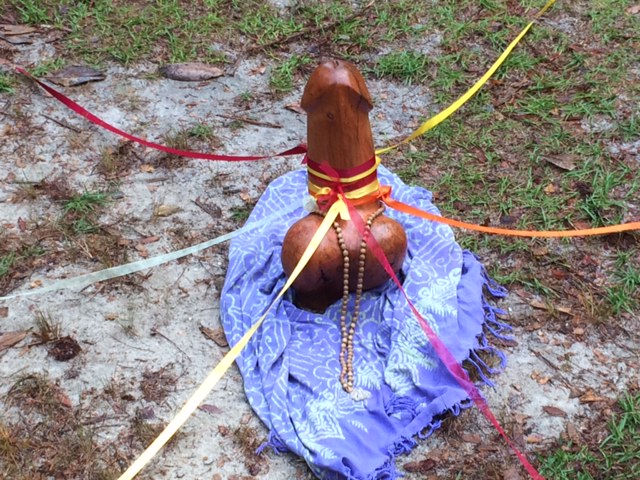
I’m very grateful to Abwoon, an ordained minister and ceramic artist, for his generous sharing below. I read in the following account of his creative practice his devotion to the deep Mystery of embodiment, and a moving faith that spirit and flesh belong together--that, for those of us who walk the Path in cisgendered male bodies, heart and cock belong together, for the repair of our souls and the healing of the world.

You can contact him at abwoonclay@gmail.com.


I'm obsessed with process. I seldom find something interesting without wondering how it came into being. The process of mold making has always roused my curiosity in particular. No matter the material, looking at the finished piece, I love to imagine the mold from which it was pulled.

While preparing myself for my second attendance at Coph Nia, a now-defunct gathering of gay and bi Pagan men, I considered what I could add to my vendor space alongside the essential oil blends I’d prepared and the bodywork I’d be offering. I’d long wanted to learn how to make plaster molds for slipcast ceramics, and I was also interested in the notion of phallic objects for altar and ritual use. It seemed like the perfect time both to learn this process and to create those phalluses.

I worked with a friend I’d met through a ceramics class she'd offered. She’s a master mold maker, and I couldn't have had a better teacher. We worked from a big rubber dildo that I borrowed from a performer friend who'd used it as a prop. My teacher and I created the mold in a day, I brought it home to cure, and over the course of a few weeks I poured and released copies of that mold that each managed to take on its own personality and individual qualities. You might expect a mold to create perfect replicas every time, and in a very controlled, factory setting, that’s exactly the case. I wasn’t looking for that at all. From that mold I pulled phalluses that leaned different directions, curved in their own ways, and displayed a suggestion of the diverse reality of men's members in shape if not in size.

I used a two-glaze process on the phalluses, and the outcome was exactly not what I expected. This aspect of ceramics both interests and maddens me. It’s part of what moves the process beyond the mundane. I find the finished products beautiful, and not what I’d anticipated. They were fired hotter than they normally would be in order to increase their strength. The high temperature changed the behavior of the glazes. At first I was disappointed. I felt that two months’ attention in pouring, releasing, first-firing, glazing, and now second-firing had ended in failure.

I spent some time with them on shelves just to look at them; I needed to see them for what they had become, apart from what I’d imagined. They were and are beautiful in spite of my desire to control the outcome. If that's not a metaphor for life, I don't know what is.

Our lives are beautiful.

What I ended up with in this first (and maybe only) run of ceramic phalluses, is a dozen ceramic cocks of various shape, size, and finish. Some are light; others are heavy. Some are varied in color, others uniform. Some are glossy in finish, others matte. What they all share is an incredible feeling when they rest in your palm. They are solid. They are powerful. They will endure.

It’s been a pleasure to share these pieces with others. It's been a pleasure to walk this path, practicing a new process with my hands while experiencing a higher journey toward accepting my life as it is, apart from expectation, and remembering, every time I lay hold of my own phallus, that I hold something sacred in my palm, a source of pleasure that can be devotional, worshipful. When we remember this sacred dimension of our desire and pleasure, we find ourselves living in a new way. We honor our sexuality as part of the entirety of who we are, and not as a substitute for holistic living. We find that we are called to live out a life that finds the sacred everywhere, just as we find it within.

Monday, May 16, 2016

Pentecost

If God were as small
as the houses we frame--how
deeply fucked we'd be.

Saturday, April 30, 2016

Waiting on the Season


These last days of April, these first days of May, what I most need to cultivate is patience.

The garden’s awake, and something new is stirring every day, if not from hour to hour. The clumps of Tulipa tarda whose buds  I first noticed just this morning had started to open in the sun by early afternoon. Two days ago, I wondered what had happened to the lily-of-the-valley. Today the shoots are coming up everywhere, reminding me they’re an invasive species, and the last thing I have to worry about is that they’d ever die out. I didn’t even remember planting wild ginger by the front walk last year,  until yesterday I saw the leaves an inch above the soil, looking like the wings of a pale green moth still unfolding from the chrysalis.
The longing for new life is almost more than a dedicated gardener can sustain, once the winter is truly over and past. The nearby nursery is already stocked and waiting. I can’t bear the suspense until it’s clearer, two weeks from now, what’s come through, what’s flourished, what didn’t make it and needs replacing. Three years after moving into this house, I still don’t completely understand what will grow in this soil, in this much shade, between the roots of long-established trees. Every season thus far has involved trial and error. My impatience is equal parts eagerness to see what’s in store and a fantasy of what I want to do next with the tiny front and back gardens of a downtown Toronto house. Thank God I don’t have an American Midwestern quarter-acre to contend with.
My unwillingness to wait on the garden around me reminds me of the impatience we’re capable of showing toward the garden within. When I hear friends who long for personal growth berating themselves over their lack of progress, over their loops back into earlier patterns and habits, over their inability to map a clearly defined path forward, my prayer is that they can offer themselves a little more of the lovingkindness I’m confident they'd extend without hesitation to someone else.
Like I should talk--like I’m not equally capable of smacking myself for not becoming an overnight boddhisattva.
Patience in the garden is like the balance of Wisdom and Compassion that we need  in order to thrive, and in order to allow others to thrive.
It’s also like the patience called for in Matthew 13:24-30--the parable of the weeds among the wheat. There, the owner of a field tells his servants not to risk pulling up the crop by mistake before harvest time. The subsequent explanation of that story, ascribed to Jesus by the Gospel writer, reads like a judgmental othering of the people on the wrong side of a moral divide. I’m inclined to think of that exposition, though, as a later addition that obscures, even reverses, the real point. At its core, the parable is a story of the garden of our souls, and we’re cautioned not to fuck up the process of growth and unfolding by trying to exert control. We don’t need answers before the fact. We just need respectful curiosity and the patience to wait--and gratitude when the results manifest themselves in their own time.

Saturday, April 16, 2016

In the Wake of Resurrection

I began making Jerusalem Cross drawings a couple of years ago, during mornings when I hold space at a drop-in art studio for guests of a daily lunch program at the Church of the Redeemer, Toronto. Whatever project I'm working on there, my attention is bound to be distracted--by requests for advice, by the constant task of putting materials back in order, and, once in a while, by the need to dial down the level of anxiety, manic energy, or conflict that comes into the room. These drawings gave me a pre-determined basic structure to work with and a freedom to play within. I could walk away from them and come back to them easily and quickly.

During a retreat to an Episcopalian monastery about a year ago, I learned something important about how my spirituality has shifted over the years: I've never felt great about much of the Psalms, but this time around, I learned just how low my tolerance has become for incessantly chanting vindictive, paranoid Bronze Age poetry. So during my days there, I needed a practice of prayer that  could also serve as an antidote to too much "Forgive Me" this, "I Am Not Worthy" that, and "Crush Everyone Who's Constantly Conspiring Against Me" whatever. These drawings were that alternative prayer.


Saturday, April 2, 2016

Hand in Hand

In bright, early spring sun--the kind of day that reassures you, when you live in Canada, that we've all survived another winter--as I coasted my bike up to the door of my office building, just ahead of me, a family of four was walking south: mom and daughter in front, father and nine-year-old son behind, hand in hand, the son a step behind his dad but not, it seemed, in any reluctance at this public show of affection. It caught me in the throat, in the chest, in the gut, as such scenes so often do. I was riveted, and I lingered on the steps for another minute, watching them as they continued on down the street.

I wondered how many months--or perhaps a year at most?--before the invisible wall will most likely start to rise--before it will seem uncool to the boy to do something so childish as hold his father's hand; before it will feel to the father that it's time for his son to man up.

The depth of my reaction had everything to do with my own history, with my own wounds around an emotionally crippled father incapable of reaching out, let alone making it count in a way that I in turn could hold onto. Such a history means that a scene like the one I witnessed yesterday morning sticks to me emotionally, spiritually, and erotically like velcro. It triggers a longing for paternal connection, for receiving nurture from other men and, just as importantly, giving them nurture. It energizes the satisfaction I find in mentoring my graduate students. It goes a long way to explaining why I find it so fulfilling to hold space for another man (or woman) to explore his /her interior life more deeply--and often find it easier than having such a space held for me by someone else. (To borrow a term from our lesbian sisters, you might describe me as a spiritual "soft butch.") It's bound up with my desire to find intentional community among men.  (As when I was mesmerized, and incredibly turned on, at the age of seventeen, watching a documentary about--wait for it--Episcopalian monks in Michigan. Monks. Episcopalian monks. In Michigan.)

There’s an odd way in which I can access the depth of the wound around my father’s unavailability only through the strength of the longings stirred in me by a scene like yesterday morning’s. Someone reminded me earlier this week that somewhere, Freud says something like this: that what cannot be endured is sexualized. Perhaps it’s fair to say as well that what’s too painful to acknowledge consciously is spiritualized. To say that isn’t to undermine the legitimacy of either our spiritual or our erotic longings. But it is an invitation to know ourselves more fully, and to turn our wounds into gifts--as we must, if we’re to live out our calling to the repair of the self and the healing of the world.

Saturday, March 26, 2016

each change a small death
a present resurrection
every gift received

Thursday, March 17, 2016

Weaving Together: The Stonesong Retreat


Gathering, Workshop, Retreat: they’re all labels for temporary communities gay and bi men form in search of bigger life and deeper connection. Each raises its own expectations. Advance planning from the top down,  or a container held open for the community to fill spontaneously. More focus on spirituality or less. A one-off event, or a reunion of men who gather repeatedly and build up a web of continuing connections over time.

We gravitate toward the sorts of events we’ve learned from experience suit us best. Or else,  we glean the full range of what feeds our hearts and souls by moving between communities. Maybe you need five days of silent meditation, and a week with faeries in the wilderness.
 
Speaking for myself, I want a strong sense of encounter with the Sacred. I want celebration of our spiritual paths in their mutually enriching diversity. I want reverence for the Earth and acknowledgement that we’re a part of its greater and holy life. I want rituals, both individual and communal, that rise up organically from the shared experience of those present, rituals that help us access parts of ourselves and one another that ordinary business-as-usual words and behavior can’t get at. I want heartfelt intentional communication and equally deep listening. I want freedom and safety to play and experiment with joyous abandon in the presence of others.
Those are the values I’ve brought to my conversations with Frank Dunn, an Episcopal priest and director of the DC-based men’s consciousness-raising group Jonathan’s Circle, as we’ve planned The Stonesong Retreat, four days in the company of kindred spirits in the verdant countryside of western Maryland, 18-21 August.
 
 
I invite you to ask yourself these questions:  what happens  in sacred space where you’re safe to come forward and give voice to the deepest longings of your body, mind, and soul? What would a community of brothers look like who commit to holding that space for each other? What spiritual practice might you be called to create for yourself as an expression of the fullness of life within you? What rituals would you build together to integrate the spiritual and erotic joys, sorrows, aspirations, and hopes of all?
If those questions call to you, then I invite you to please consider joining us. You can access more information on the retreat and registration here.
The time at Stonesong Awareness and Nature Centre will offer a short, sweet taste of what it’s like to live mindfully with spiritually and erotically alive men who have faith that what we discover together will be bigger and richer than what we can build on our own.
We’ll build a sacred community.
We’ll  explore the place our human erotic lives hold in  the greater life of Nature.
We’ll create personal and communal ritual.
We’ll share in heart circles.
We’ll  celebrate as faeries, tricksters, and bards.
We’ll exchange our stories.
We’ll allow ourselves and one another times of simple unstructured relaxation.
In all this, we’ll weave the connections that expand the possibilties of our lives.

Sunday, February 14, 2016

A Wildwood Eucharist


(Behold, I Stand at the Door and Knock--original collage, 2010)

The following memoir appears in the current issue of  RFD, no. 164 (Winter 2015/16).

On a mountaintop at the end of a twisting road through the redwoods, at the end of a six-day Body Electric retreat, eight of us make Eucharist a little after dawn on the first day of the week. The valley spreads out beneath us, a river of blue fog catching fire and flowing in reverse as the sun rises over it. The ashes of dozens of men have been scattered here over the years of the AIDS epidemic. A sublime spot, holy ground, and blessed by gay men who through perilous experience have forged of irony an essential tool for negotiating the Sacred, smashing the idols, looking on God and continuing to live: we call it Julie Andrews Point. These hills are alive. 

Peter, a physician from Mississippi, reads the Epistle; Bill, a Christian Brother who teaches at a Midwestern Catholic college, the Gospel. Facing Bill across our circle, I recall from earlier in the week our sweet evening of animated, heartfelt talk, at the end of which we drifted to the hot tub to float naked in each other’s arms late into the night. Listening to Peter, I think back to the exercise for which we found ourselves partnered two days ago, bearing silent, intentional witness to one another’s erotic self-exploration, out on the same sweeping overlook where we’re now celebrating the Divine Liturgy. I’ve known extraordinary bliss in his presence: my ejaculation marked only the beginning of an orgasm that played over my body and soul like living phosphorous stirred in the nocturnal waters of a luminescent bay. I couldn’t pinpoint the moment when it finally ended, as the light poured down over me through the branches of the oak above our blanket; as dragonflies and grass fulfilled their glorious, mortal natures; and I along with them.

Robert, a Roman Catholic church musician from Milwaukee, chants the psalm. At last year’s retreat, he and I sat on sarongs spread at the edge of this same promontory to exchange the stories of our erotic lives. The telling led to half an hour of caresses and synchronized breath while we gazed into one another’s eyes. 

We hold history’s shortest (and probably chattiest) Quaker meeting in lieu of a sermon; and yet by some miracle, though all eight of us in the course of fifteen minutes have something (conscientiously brief) to say about the readings we’ve just heard, our words emerge from the silence without diminishing its power. 

Bob, a Disciple of Christ from Oklahoma, says the Words of Institution over bread confiscated for our dark ritual purposes from the yesterday’s lunch buffet. These last few days, he’s been the beloved of my New York friend Hank. 

Dell, a Presbyterian turned Sufi turned Anglican turned seeker who now contemplates another foray into organised Christianity, pronounces a benediction. The warm connection between us falls short of what I long for. I’ve hung helplessly head over heels for him since our first fifteen minutes together six days ago. Two days into our time together I patched together the courage to tell him this, in a nightly checkin group that includes as well the man who by then had already won his most intense and focused affection for the remainder of the week. I nearly hyperventilated at the risk of owning my jealousy of the bond between them; and received from each of them in turn acceptance, grace, and words of respect for my courage.
Forty of us have spent a week creating a miracle of mutual love, support, and radical honesty, a community of the beloved. All of us have come to this place as men of Spirit–the eight of us in this circle, the thirty-two still asleep up the slope–Buddhists, Jews, Hindus, atheists, radical faeries, souls of the New Age, none of the above. The lived experience of love–the vibrating, enlivening, penetrating, transforming experience of love–has united us all, however variously we’ve understood what’s happened here. The confessional distinctions that divide us have fallen away like skins we’ve outgrown. And here the eight of us stand to take up once again the words and gestures of one tradition among many–a path toward the Divine as flawed in its unfolding as any other; a tradition that has misled so many gay men so heartlessly, in so much of the world, for so many centuries.


The fearless, grace-filled truth-telling that we’ve learned together to practice over the last five days, the acceptance of deep joy into our lives, the blessings we’ve laid on one another’s lives in compassion for our own wounds and one another’s, under the tutelage of two extraordinary men who have led us through the process–these constitute a culture of love and mutual support. What overwhelms me this Sunday morning, in the presence of the seven brothers who’ve come with me out to the Point to commemorate the life and death of God made visible in human flesh, is how deeply and how authentically that culture has become the hermeneutic ground for theological reflection. The day’s reading from Colossians 3:5-11 would normally have me muttering under my breath against Paul, the narrow prick who never got a life. The words sound here and now as though they’re spoken to us of the community that we ourselves have embodied: “Do not lie to one another, seeing that you have stripped off the old self with its practices and have clothed yourselves with the new self, which is being renewed in knowledge according to the image of its creator.” In that renewal there is no longer Protestant nor Roman Catholic, neither Californian nor Argentinian, and ultimately neither Christian, Buddhist, nor atheist; but for us, Love among us in our flesh is all in all.
 
In short, I’ve never heard the Scriptures opened so powerfully by the Spirit as I do this blessed morning. I’ve never heard the Words of Institution spoken so powerfully to those who happen to be present at the moment of their recitation. Like Wesley listening to the words of Luther read aloud, I feel my heart strangely warmed. 

Christianity, I said last night to Dell as we sat looking at the moon over this valley, is a crock of shit, but it’s my crock of shit. It’s my flawed, broken vessel for carrying what cannot and must be carried, what must and cannot be contained in human language. To stand with these men, to claim together– fearlessly, defiantly, subversively, and lovingly–the power and authority of the People of God: this is to behold the vessel at once broken and mended, at once marred and perfect. This is to behold all things being made new.

Sunday, February 7, 2016

The Big You: Some Wisdom from Richard Rohr

As Lent looms with a whole range of narrow and potentially toxic associations, here is Franciscan Richard Rohr on another way of framing the practice of self-examination:

“Grace and mercy teach us that we are all much larger than the good or bad stories we tell about ourselves or about one another. Please don’t get caught in your small stories; they are usually less than half true, and therefore not really ‘true’ at all. They’re usually based on hurts and unconscious agendas that allow us to see and judge things in a very selectrive way. They’re not the whole You, not the Great You, not the Great River. Therefore it is not where your big life can really happen. No wonder the Spirit is described as ‘flowing like water’ and ‘a spring inside you’... or, at the end of the Bible, as a ‘river of life’.... Strangely, your real life is not about ‘you.’ It is a part of a much larger stream called God.
--from Richard Rohr’s meditation for February 4
 

Sunday, January 17, 2016

The Back of the Bus. Under the Bus. Whatever.

The archbishops of the Anglican Communion just finished four days of meetings at which they voted 27 to 3, with 6 abstentions, to sanction the Episcopal Church in the USA for “fundamental departure from the faith and teaching held by the majority of our provinces on the doctrine of marriage.” The Archbishop of Uganda walked out of the deliberations because that resolution didn’t go far enough to suit him: he wanted the American and Canadian churches to be asked to repent and voluntarily withdraw from the Communion for laxity on matters of homosexuality. The vote by the archbishops has been billed as the compromise that prevented the Communion from breaking apart entirely. Its ongoing unity is cold comfort for any of us who look to it for sexual justice and equity.

The row over sexual minority status within the world’s largest Protestant denomination came to a head with ECUSA’s ordination of its first openly gay bishop, Gene Robinson, thirteen years ago. It ramped up when ECUSA allowed same-sex marriages. The more conservative churches of the Communion aren’t much happier with the ordination of women priests or the consecration of women bishops.
There’s no Anglican pope. The Archbishop of Canterbury is viewed as first among equals. Justin Welby, who now holds that office, played it both ways in his public statements after the vote. On the one hand, he remarked that “consequences” were necessary for ECUSA’s break with majority practice. On the other, he was quoted in this morning’s New York Times as saying, “For me, it’s a constant source of deep sadness, the number of people who are persecuted for their sexuality.... I wanted to take this opportunity to say how sorry I am for the hurt and pain, in the past and present, the church has caused.”
So stop causing it, already. Welby delivered this well-intentioned and perhaps heartfelt, but deeply hypocritical canard after encountering protesters who included a number of Africans who risk violent death, imprisonment, even execution for the crime of being queer and out in their home countries. Christian charity runs deep in a room of a few dozen men rehearsing platitudes.  It thins out a fair bit when it comes to the faceless masses of people the church has marginalized for centuries, fomenting their persecution, rationalizing hatred against them, failing to offer unqualified support or solidarity, pandering to the worst and most bigoted elements of some societies--even as secular society in other countries has pulled way ahead. The victims of that record of malice and indifference might well call for a Truth and Reconciliation Commission instead of settling politely for the endlessly deferred prospect of toleration. Of the various provinces of the Anglican Communion, only ECUSA has had the courage to move forward, at considerable cost.
I was talking to friend of mine two days ago, when the news first broke of the decision, who years ago bailed out of Christianity altogether over the endless prevarication of the Anglican Church of Canada on the issue. The Canadian Anglican hierarchy has long attempted to frame the rights of sexual minorities not as a matter of justice but of pastoral compassion and mutual forbearance. The rhetoric of that particular evasion has been threadbare for decades.  (To be fair to the Canadians, there’ll be a vote at their triennial General Synod this coming summer, thirteen years after gay marriage became legal in Canada, on whether to change church law to allow same-sex unions. If that vote passes, a second vote will be required three years later. One wouldn’t want to rush things.)
Same-sex access to the deeply problematic institution of marriage is hardly in and of itself the radical rethinking of sexual ethics that the Christian tradition desperately needs. Neither is the ordination of openly queer priests. But not even those basic steps toward equity in the face of human sexual diversity are within the grasp of a small group of men who claim apostolic authority over 85 million believers worldwide.

Monday, December 21, 2015

Have a Splendid Whatever

For the first eight years after my partner Jonathan and I met, Christmas was completely off the menu. No tree. No poinsettia. No evergreen boughs. The memories were too visceral for him of growing up Jewish in New York and feeling as though the whole city was ramming the holiday down the throats of his family and neighbours.

Christmas, on the other hand,  is wired into my German Lutheran DNA. During the fifteen years that I shook the dust of homophobic organized Christianity off my feet, my alienation from the faith I’d grown up in never extended to hating the season. It always felt to me like the culturally specific version of something more or less universal--the need to celebrate light in the depths of a season of darkness. During the years of that long disaffection, the Solstice Parade that snakes every year through Kensington Market in Toronto felt like a magical expression of all that that I loved in Yuletide:
as did the Christmas sequence from Bergman’s Fanny and Alexander:
Six years ago, hell-bent on bringing some observance of the season into the house, I was the one who searched out the hand-cast glass menorah that we’ve used every year since. Jonathan hadn’t lit one at home for the four and half decades of his adult life.Two years ago, the first winter after we changed houses, I acknowledged his ongoing reservations but finally insisted on a tree. As I unwrapped the ornaments that hadn’t been out of the box for seven years and started talking about the associations each had--the heavily oxidized remnants of my grandparents’ decorations, purchased in the 1930’s; the baroque extravaganzas my mother and I assembled from craft kits when I was in high school--he got it, and within two days announced that we needed a bigger tree next time.
Since then, we’ve taken to giving each other Christmas ornaments as Hanukkah presents. Christmas Eve, I attend midnight mass, as I’ve done since the late 1990s when I decided once again that the wisdom embedded in the spiritual traditions of my youth were my birthright, to be claimed on my own terms. Christmas morning we unwrap presents before heading off for Chinese food and a movie.
Last Saturday night, I went to a radical faerie Solstice party. Among the guests was a gifted counter-tenor who sang an aria from Handel’s Messiah, while a loop of digital photos on the TV screen featured partially naked people cavorting in a green landscape last Beltane.
I know that for many queer people who’ve cut ties with the Christianity of their upbringing as a matter of survival, the season’s associations bring up far too much of what they need to leave behind. Nonetheless, here’s my invitation: hang onto the mystery of light kindled in darkness, of the spirit of generosity towards friend and stranger, of warmth in the depths of winter. Yes, toss out what doesn’t serve you. But don’t surrender what fed you as a child, and what some corner of your heart may still long for. Make it new, make it yours.

Thursday, December 17, 2015

No Two Alike: Paper Cuts by Chris Ofner

With thanks to Chris for sharing.


Tuesday, December 1, 2015

From Fantasy to Ritual Practice

There’s a lot of provisional, not-quite-consolidated experimentation in alternative queer ritual communities--along with a light-hearted playfulness. After all, we’re making it up as we go along.

Good ritual has a thick, condensed richness:  it’s ambiguous and open-ended and can mean different things to different people. Good ritual doesn't create a charmed circle of those "in the know" that excludes everybody else. But it does require a shared baseline of experience that lets people connect with each other on ground that’s somehow familiar.
Good ritual improves with repetition: past experiences of the same words and actions enrich your perception of the ritual this time around. Rituals are only  effective as long as they draw on the values and expectations of the community that practices them. Good rituals don’t belong to one inventor or leader. They belong to the whole community. They’re not full of esoteric, exotic elements that only the officiant claims to understand.
It's a lot easier to start with an inherited vocabulary and grammar of ritual--the gestures, the words, the symbolic objects--than to make it up from scratch. Without an already established community to plug into--if you're trying with just a few kindred spirits to create a new ritual from the ground up--the depth of the longing that motivates you in the first place is probably grounded in your personal world of private meanings. If you’re trying to create new ritual as part of a group of six or eight, each of you is almost certainly drawing on a deep reservoir of undeclared, maybe even unconscious, assumptions and desires.
That raises the stakes enormously. If, by some long shot, all that unvoiced desire, all those elaborate individual visualizations, get fulfilled without being explicitly shared and acknowledged, the experience can be electric for everyone involved. But it’s much more likely that one person’s fantasy of the perfect ritual will leave somebody else feeling shut out, turned off, sidelined.
So you have to talk about it.
Not talk it to death: nothing kills good ritual like attempts to nail down its meaning. You have to speak and listen from the heart, and so begin to weave a web of shared understanding and expectations, either before you enter together into ritual time and space, or else as an early stage of the ritual itself. In either case, what you share becomes the material for a kind of spiritual jazz improvisation that allows everyone a chance to riff.
A tantric way of putting this is that you need tapas--that is, a strong container--in order for spanda--that is, playful experimentation--to manifest itself authentically.
Good ritual practice in the major religious traditions has hundreds or thousands of years of tapas to build on. We, on the other hand, have to create this communal container ourselves, through mindful attention to each other and a healthy dose of awareness that what speaks to me may not speak to you, or may speak to you differently, or may begin to speak to you as we talk about it, and vice versa.
Sometimes we borrow elements from traditions we already know, practicing a kind of radical drag of the spirit. When we do, we’ll probably find that the borrowings spark dramatically different reactions. A bell may make me think of a Roman Catholic Mass, but remind somebody else of the bell you ring when entering a Hindu temple, or the bell at the beginning and end of a Zen sitting. The familiarity may be comforting to an ex-Catholic, or it may be a stumbling block. Burning sweet grass may be intended as a respectful homage to Native American practice, but it may  strike somebody else as cultural theft. The large phallus at the centre of the queer men’s Lingam Puja  that I often lead can heal the shame of some men in the circle gathered around it. But it may turn out to be a painful reminder to others of the obsession with cock size and performance in commercialized gay culture. Someone else may object to its appropriation of the central object of veneration in a Shiva temple.
It’s not that good ritual challenges no one. On the contrary, good ritual stretches us and becomes a tool for our growth. But the benefits of ritual happen when we’ve transformed private fantasies into shared meanings. Doing that takes perseverance and mindful attention.
When it comes to creating explicitly erotic ritual, the stakes are that much higher. Many attempts to create mindful, spritually grounded group erotic practice fall apart on the failure to get past a collection of individuals acting out their individual fantasies, all the while mistakenly assuming that everyone else involved will be on the same wavelength. Things can fall apart quickly and completely when it becomes clear that one man’s expression of the Divine is another man’s freakout.
Why would we be drawn to creating erotic ritual in the first place? In part, because it’s a way to express and explore communally the deeper meaning of our sexuality without reducing the magic and wonder that flows from our unconscious to bloodless, disembodied talk. It’s a path to healing, as we experience that we’re safe, we’re seen, we’re sacred--and as we provide that safety and grace for others as well. It’s a path to growth, as we practice the never-fully-mastered skill of simultaneously respecting boundaries and reaching out across them to the internal worlds of our fellow travelers. It’s a path to transcendence, as we connect with the fundamental humanity of other participants--their longings, their anxieties, their capacity for joy, their generosity, their vulnerabilities--regardless of whether we’d likely choose erotic encounter with them as individuals or not. It’s a path to non-attachment, as we learn simultaneously to honor our desires and to take them less seriously as the mysteriously fluid and transient phenomena that they are.
Those of us who feel called to connect with such ritual practice learn pretty quickly that the fantasies we bring with us only take us the first leg of the journey. More or less immediately, we have to start loosening our hold on long-treasured (i.e., hot) private scenarios, in order to make space for the equally treasured scenarios of others. That, in turn, gets us only to second base. As we speak from the heart, as we listen with the heart, we start to understand that the adventure of what we create with others in our circle is more enlivening than what we assumed we wanted in the first place. As we construct a ritual practice one experiment at a time, retaining what works, letting go of what isn’t so successful, we begin to mold a container strong and flexible enough to hold us all: a ritual time and space where we become more fully ourselves--and where, if we’re blessed, we lose ourselves in something bigger and richer and more complex than anything we individually could have asked or imagined.

Monday, November 23, 2015

Checkout Line

I had the pleasure of waiting at the express register behind a really handsome man a couple of days ago. Buying cereal is rarely so satisfying.

I felt a freedom and euphoria in appreciating his beauty. And at once noticed the contrast with an all-too-familiar sort of longing that has very little to do with genuine pleasure.
That other, less happy brand of desire, which was more or less all I knew in my teen years and twenties--and which has continued to get way too much air time in my head in the decades since--leaves me feeling like a dog straining at a leash, if not like a fish thrashing on the sand. It comprises equal parts of (1) impossible fantasy scenarios, (2) frustration that there’s no socially graceful (or even acceptable) way of getting his attention--at least the kind of attention I might like--(3) ancient insecurities about whether a man I’m attracted to could possibly find me attractive in return and (4) painful, ridiculous comparisons between how fabulous my life would be if only I had his attention and how unfabulous it presently is without it. I’ve always been more or less incompetent at flirting. If I were better at it, the dog on my leash might at least be a little less desperate to dash across the street through oncoming traffic.
This, instead, was more about just being glad the man between my bran flakes and the cash register was part of the world, and that I had the pleasure of a couple of minutes crossing paths with him before we walked out the door in opposite directions. What I was experiencing was desire without attachment.
I guess some people figure this out early on. I’m glad I’m getting it now.

Sunday, November 15, 2015

At the Sistine Body Shop

Yes, this is camp. And somehow, also tender, sexy, playful, and profound.


With thanks, as so often, to Hoppergrass for the link to this image by photographer Freddy Fabris.

Sunday, November 8, 2015

Topsy Turvy

I've just e-published an erotic novella on LuluBooks. I wanted to tell a story that exemplified the ways that our sexual energy, when we live it out in good faith and mutual respect, can transform our lives for the better. Two middle-aged men trying to make it work in a small college town; a sexy flirt in a wheelchair; a snowdrift; some rope... Here's the opening, and a link to the download.

1

The music is insipid and too loud and the lighting stinks, but Underdog is the best bar in town for our Saturday night tandem cruise–the sort of place that can only exist in a fair-sized Midwestern college town, with enough gay guys around to create critical mass, but not enough to split apart into erotic niche markets. Corn-fed blond farmboys (more often than not, they desperately want to get their legs in the air, but you’ll never read the signals if you aren’t a corn-fed blond farmboy yourself); willowy, epicene aspirants to the remake of Brideshead Revisited (one kid, I swear to God, came in every weekend last fall wearing tweed and shlepping a teddy bear); daddies like my Jim; a gaggle of drag queens from the music department (who regularly arrive en masse as the cast of the opera the music school is currently performing); vanilla frot enthusiasts like me; and several extremely hot transmen (one of whom, with quite possibly the most perfectly defined chest in town, and almost certainly the hairiest, is chair of the economics department). It’s a scene that could go horribly awry with rampant bitchiness: everybody knows everybody, at least by face. But somehow, it all holds together with good humor and good will, and the gossip remains if not minimal, then at least mostly benevolent and playful.

It took Jim and me a lot of time and some very rocky steering to work out the arrangement that had brought us here together every weekend and reunited us at home by Sunday noon to compare notes, usually to end up back in the sack together for another hour, getting each other off on common ground while swapping stories of scenes we couldn’t imagine sharing.

Nearly three years ago in 1997, at the September reception for new faculty, we zeroed in on each other across a room awash in academic small talk. Within fifteen minutes we’d sequestered ourselves in the corner. So much for networking with the other new hires. Jim’s thick white hair, his close-cropped beard, his ice-blue eyes, the obvious heft of his shoulders under his shirt, all drew me like a bee to clover. His tanned, thickly muscled forearms reminded me of my grandfather’s as I sat as a little kid on the arm of his chair, watching him blow smoke rings while the Cincinnati Reds ran the bases on TV.

Before I’d screwed up the nerve to ask him back to my place, he asked me back to his.  We tried to be discrete about it, though the matching bulges in my freshly pressed chinos and his faded jeans would have given us away to anyone who glanced our way below waist-level.

We’d barely closed his door before we started clawing off each other’s shirts....
 
*****
 
The full text of Topsy Turvy is available for download here:


Sunday, November 1, 2015

On the Feast of All Saints


The Redeemer (Philip Hitchcock)
 
 
Lazarus, Brother of Mary and Martha (John Dugdale)
 
 
Sts Sergius and Bacchus (Philip Gayton)
 
 
Sts Sergius and Bacchus (Robert Lentz)
 
 
A saint known only to God (photo received from Hoppergrass)

Saturday, October 17, 2015

Hoosier Perceval


Photo received from Corvus O Diomasaigh


Once alone in the Welsh woods there lived a woman and her son. Her husband had lived with them at first; but he had a tendency to turn hairy and sprout horns at the full moon–not every month, perhaps, but as often as not–and to come back in the morning scratched and covered in dirt, with leaves in his hair. So she’d sent him away to a hut further along the track. From this hut she would summon him when so inclined. And often she was, provided he agreed to keep the stipulated distance and pretend that the full moon was irrelevant.

The boy grew up remarkably unacquainted with ordinary society; he had a heart at once innocent and yet given to murmurs of unpredictability. Through the drinking of a draft prepared by his mother from herbs planted by many other hands, he lost most memory of the father who died before the son was grown.

The loss of childhood did not come easily to him, and no more the putting on of manhood. Amidst his long mourning for the one and his confusion at the other, he sought the help and teachings of a smiling wizard who took him to the wizard’s tower, opened all the wrong books, taught him the wrong spells, and sent him off along the wrong path.

The boy remained nameless for longer than comfortable to anyone in the story. As he travelled on, he came to a gleaming palace, was invited to the requisite feast, saw the requisite bleeding lance carried in before the wounded king, and failed to ask the requisite question. In fact, he got into something of a habit of walking into such places, sitting down to such feasts (although they always seemed at the moment like new experiences, not old ones repeated), and never managing to ask quite the right question. His path came to be littered with wounded kings whom he could not cure, although from each of them (had he cured them) he longed to hear his name and learn the secret of his true identity.

One of the wounded kings was especially dear to him–the last in the series, as the legend relates according to the available sources. He chose to remain in this palace for some time after it became evident that the moment that might have cured the king was long past. In this palace he did indeed ask the right questions, more or less, but too late to work the necessary alchemy. Because he thought that tweaking the questions slightly and trying again might produce more auspicious results, he became a master of thwarted persistence, admired by some of the courtiers for his good will, ridiculed by a few (though as time went on by an increasing number) and arousing the impatience of several who wanted him just to get on with it.

Finally, the king himself announced that enough was enough. The boy’s frustration had been mounting for some time, both at his own failure and at the king’s singular passivity in refusing to offer such promptings as he might have provided; yet he was devastated to be exiled from the court at which, despite the king’s suppurating, ulcerated flank, there had been good company (such as he’d not experienced in childhood) and three square and very pleasant meals a day. There was also the king’s own company, which the boy, who had now grown to be a youth in a body old enough to be his father’s, found agreeable, endearing, and deeply familiar, providing the obvious was not mentioned. The youth began to blame himself for so often attempting to ask the right question at the right time. When he finally left the palace, he had in fact convinced himself that the responsibility lay with him and him alone for not achieving the desired outcome to this adventure.

In another part of the forest dwelt a tribe of magicians who travelled widely and with whom the youth began to cross paths. They had come to constitute a tribe not by birth but by common consent and a shared awareness of their powers, which were in fact less consistently reliable than they liked to admit to one another. Those powers, however, were real enough to be soon evident to the youth (in a body now old enough to be his father’s) and so he fell in with them, despite his misgivings that the wizard of the tower might in fact have been one of their number.

One day, consorting with one of these magi, he found that they had crossed together into the Otherworld, where his brother magus began to snuffle and snort like an animal; to his own surprise, he did as well. The visit to the Otherworld didn’t last long, but he shortly came to be absorbed in scanning the ground around him for hints of other such portals, not knowing exactly what lay on the other side of them, but increasingly convinced that going through these portals would lead to a very important discovery about himself.

Whereas these meetings with the forest magi were intermittent, his meetings with a kindly hermit, who stayed in one place, were a regular feature of his week. The hermit was on the whole remarkably accepting of the youth’s explorations among the magi and seemed inclined to respect the importance of these encounters. The hermit was committed to helping the youth reverse the effects of the draught that had expunged the memory of his father. His good will came to be more important to the boy than was the releasing of the spell, long deferred as it was–it being the practice of the hermit that the youth must master each clause of the spell for himself in order to break its power. It was a long and very complicated spell, some of it in archaic languages, the grammar of which had to be at least minimally deciphered before moving on to the next phrase. Some of the magi were inclined to scoff at the hermit; others were deeply respectful of his longer, slower, and less spectacular wisdom.

At times the youth grew weary of the whole enterprise. He found that wandering through the forest had become tiresome without the magic of the tribe, but the excitement of their magic trivial without the patience of the hermit. He had no desire to choose between them. The memory of his excursion into the Otherworld as an animal self with the magus who accompanied him there continued to burn in his mind, but more importantly, in his heart. And he came to bless the blood of his father that ran in his veins.

He continues to wander the forest: quests have a way of being endless, whether one wishes them so or not.

Tuesday, September 15, 2015

Unbinding Isaac

A d'var Torah (sermon) given at Congregation Shir Libeynu for the second day of Rosh Hashanah on Genesis 22:1-19.


May the words of my mouth and the meditations of all our hearts be holy and acceptable in your sight, Adonai our Strength and our Redeemer.
What an honor to be asked to give a talk for the second day of Rosh Hashanah, I told Rabbi Aviva in the spring.  And then the realization. Oh great. The Binding of Isaac.
Let's start here: God does not desire, God has never desired, the death of children. I'd go so far as to suggest that any healthy and humane and yes, any truly devout and righteous reaction to this story involves an element of visceral revulsion. It's a great credit to the tradition of scholarship on the passage that Jewish exegesis has for many centuries made space for such responses. The early midrash Bereshit Rabbah imagines God as saying "I never considered telling Abraham to slaughter Isaac," distinguishing between the verb for slaughter and the verb for sacrifice. The Spanish Rabbi Yona Ibn Yanach in the 11th century followed in this tradition when he wrote that God demanded only a symbolic sacrifice. A later Spanish Rabbi Yosef Ibn Caspi in the 14th century wrote that Abraham allowed his imagination to lead him astray, making him believe that he had been commanded to slay his son. Ibn Caspi asked, "How could God command such a revolting thing?"
Another possibility is that the test is actually not whether Abraham will be willing to sacrifice Isaac, but whether he will have the moral integrity to reply to God, "Are you out of your freaking mind?"--a test he fails.
I find great comfort in these voices of exegetical dissent to the disturbingly broad current of interpretation that in considering this story represses empathy and accepts without hesitation the legitimacy of God asking anything God wants, or at very least the legitimacy of God testing Abraham by asking for something so outrageous that he never intended for Abraham to go through with it. "Hey, just kidding," says the angel, which supposedly turns it into a story of God's mercy and favor to one so righteous that he's assented to an atrocity. Such interpretations remain blind not only to the monstrous pressure this puts on Abraham's motivations, but to the trauma suffered by Isaac--a trauma that some have identified as scarring Isaac for life and leading down the generations to some of the spectacular relational dysfunction that follows in the later chapters of Genesis. That kind of emotional dissociation in the interpretation of scripture has led to some heartless attitudes in all three of the Abrahamic religions, as English biologist Richard Dawkins has gleefully pointed out in his ongoing sophomoric rant against all religious faith.
But this morning I want to invite you down a path that begins by looping back for its starting point to Yosef ibn Caspi's suggestion that we might read this story as an account of Abraham being awakened, in the nick of time, from a delusion into which his own imperfect perception of the Divine had led him. I invite you to consider the story as exemplifying the possibilities of our developing understanding of God--through all human religious history, through the history of Judaism, and through the course of our own individual spiritual journeys.
In other words, we have to make  a radical distinction between what Abraham perceives God as saying to him, and what HaShem, the Ground of our Being, could possibly whisper in the hearts of the righteous. So I'm asking you to entertain the possibility that when the text says that God spoke to Abraham, we can read this as stating Abraham’s own point of view at the time, not an absolute point of view that establishes the demand to sacrifice Isaac as the genuine will of God. We might support this argument by observing that the description of the command to sacrifice, at the beginning of the parshat, is notably distinct from the last-minute command to stop. We hear at the very beginning of the reading that Elohim tests Abraham. Later, it's not Elohim but an angel who speaks, and more perhaps to the point, God is referred to this time not as Elohim, but by the Divine Name, as Adonai. Some modern scholars have suggested that this represents a splicing of originally separate narratives, or alternatively, that the prevention of the sacrifice represents an interpolation that reflects the unease of later redactors with the story. In any case, if we put pressure on this distinction of language, it's also striking that the voice of deliverance is not the voice of Elohim Godself, but of Adonai's messenger.
We don't have to look far into the record of religious self-assurance to see Abraham's deluded certainty at work. We can see it in the collusion of multiple Christian denominations in the tragedy of the residential school system, with its decades of attempted cultural genocide against the First Nations. We can see it in theocratic tyranny  over the lives of generations of women and children in Ireland. We can see it in the rise of Hindu fundamentalist violence in India. We can see it in Buddhist violence against the Muslim Rohingya in Myanmar. We can see it in the horrors of Muslim-on-Muslim violence in Iraq, Syria, Afghanistan, Pakistan, Nigeria. We see it in the refusal of ultra-Orthodox settlers to cease from further illegal appropriation of West Bank land to which they have no rightful claim. We can see it in stabbing attacks on marchers in the Tel Aviv Pride parade. We can see it in American Christian fundamentalists picketing the funerals of men who died of AIDS in the 1990s and the funeral of Matthew Sheppard when he died of a brutal queer-bashing outside Laramie, Wyoming. In all these cases, it's the certainty that there is no gap between God and our understanding of God and God's will that has laid Isaac on the altar and put the knife in Abraham's hand.
In and of itself, this isn't a hard lesson for most of us in this particular congregation to absorb. Shir Libeynu exists in great part because many of us have had the experience of being Isaac, laid on somebody else's altar. Many of us had the experience of leaving the faith communities of our origin because of the marginalization we felt as feminist women, as queer, as intermarried, as not Jewish enough, as not Jewish at all. Speaking for myself, I'm here not only in spiritual solidarity with my partner Jonathan, but because of the deep, solemn joy I derive from being called to account in light of the original goodness of my created nature, our created nature; the deep joy I derive from being called in these Yamim Noraim to take part in the sanctification of time itself--a joy I simply cannot find in the self-abnegating penitential practices of Lent in the Christian tradition in which I was reared, and in which I still participate, albeit with a wary, critical edge.
That said, it's incumbent on us this holy day to remember that we're called to account for the ways in which we've also been Abraham with the knife in our hand, in which we continue to be Abraham, ready to do something terrible if we're not listening for a voice that comes from beyond the limits of our imagination to call us back from the brink. The paradox of our lives is that we can be both Isaac and Abraham at once--even when our liberal, freethinking credentials are impeccable. In our own small way, we participate in Abraham's misguided zeal every time we justify our behaviour toward others by imagining that there's no gap between our conception of the Divine and the Divine itself. Every time we're not prepared to hear the angel say, "Dayenu, already. That's your child on the altar, and any god you imagine might desire his death is not Adon Olam, the Rock of your Salvation and the Sustainer of heaven and earth."
We let ourselves too easily off the hook when we imagine it's only others who can set up their own sense of divinely sanctioned certainty like an internal mental idol on whose altar we're prepared to immolate love. Today's parshat invites us to recognize that our conception of the Holy One is always imperfect, always provisional, always fall short. It warns us that we're likely to go the farthest off course when we forget that and forge ahead, using our own understanding of truth and righteous action to ride roughshod over the dignity, the livelihood, even the lives of others.
More optimistically, today's reading reminds us simultaneously that humanity is capable of spiritual growth, that religious traditions are capable of spiritual growth, that we as individuals are capable of spiritual growth, and that our errors, even our truly terrible errors, once we put them behind us, are themselves part of the path forward. Abraham hears the angel and lowers the hand that he held ready to strike. Ireland votes for same-sex marriage. The Confederate battle flag comes down from the South Carolina Statehouse. Parents who've ostracized queer kids come around to love and inclusion and celebration of their children's lives. Kids who've shut out newly self-declared queer parents, or divorced parents, or polyamorous parents, come around to empathy and acceptance. An eighteenth-century slaveship captain turns his boat around in mid-Atlantic and sails back to Africa, goes on to write Amazing Grace, and spends the rest of his life as an abolitionist. We let go of our self-assured knowledge and stop using God, or God's will, or our notion of Truth with the dreaded capital T, in order to justify making those around us into objects of our sacrifice. We open our eyes to the fact that beyond our imperfect understanding, it's the beloved who lies at risk right before our eyes, it's the beloved we're ready to slay who shows us the genuine presence of the Holy One, and the deeper Truth. The angel not only stops Abraham in the nick of time, but blesses him for the worthiness of his desire to serve God that has coexisted with his delusion.
We're all Abraham. At the same time, we're also all Isaac. And I invite you, as these Days of Awe continue to unfold, to engage in some midrash of your own, imagining what it was like as Abraham unbound his beloved child. What passed between them? Did the angel hang out for a while coaching them through a sort of personalized Truth and Reconciliation process? Or just disappear, as angels so often do? Did they break down weeping together at the side of the road, as Jacob and Esau will do two generations on? Did they succeed in the work of healing as they went back down the mountain, rejoined the servants, made their way back to Sarah?