Friday, March 10, 2023

One Step. Now Another.


Every few years, a really crappy hiking experience turns out to be a good spiritual discipline. 

Seven years ago, it was going up a mountain near Aix-en-Provence. Last Sunday, it was hiking a trail north of Palm Springs.


My pathological fear of heights is foundationally psychological--I can remember it from the age of five. But as I plough into my late sixties, my balance grows increasingly precarious because of my degenerative spine. A walking stick is mandatory equipment for me these last few years, and the reassurance it provides gives me ongoing access to experiences I'd probably have given up by now without it. 


(Next up: state-of-the-art knee braces! Which I probably should have bought before the current trip.)


I'd been on Sunday's trail before, and remembered it involved a climb up to the ridge above a broad gravel wash that the trail crossed at the outset. I remembered last time, on a sunny afternoon, encountering a basking rattlesnake in the middle of the turnoff to the ascent--the object of wary fascination to four or five others who were also strategizing how to negotiate our way around it. I didn't remember how long the series of switchbacks would go on--about fifty minutes. And in the overcast cold, we'd naively failed to take into account the rise in altitude, and the consequent drop in temperature on a very windy day.


In short, the whole damn thing was the opposite of fun. Remaining aware that we were passing through a landscape of rare and spectacular views only made it worse. Part of my mind could still register that no other consciousness in the universe but mine was being gifted with this precise experience, at this moment in time.


But fuck that. All I need is the peripheral awareness that space is dropping away a few feet to one side of me, and I become incapable of focusing on anything except the two and a half feet of ground where I'll take my next step, trying to keep my breath slow and even, with every switchback shifting the walking stick from hand to hand to keep it between me and the downward slope--and, in a strong cold wind, trying not to freak out at the lessened stability of my gait.


Because it's Lent--because it's a season that's all about facing the truth that our lives are precarious, transitory, limited, and dependent on a Mystery far greater than our small selves--I found myself thinking, as I trudged along, about desert experiences. Above all, about the episode near the beginning of Matthew's Gospel in which Jesus, during his forty days in the desert, rejects Satan's encouragements to create an illusion of false security for himself. 


My pathetic, wimpy progress along a moderately difficult marked trail was hardly a moment of heroic asceticism. But what putting one foot in front of the other for an anxious hour reminded me of was this: that when we strip away all the distractions, our life is about taking one step at a time amidst uncertainty and insecurity, trusting that Something, or Someone, will go on bearing us up. And that the present moment is the only moment we have.


Rabbi Nachman of Bratslav said that all of life is a very narrow bridge, and the main thing is not to be afraid.

Saturday, March 4, 2023

A Litany against Shame in the Season of Lent

In a season of Christian practice that's far too often about mortification and self-loathing, what can an alternative, body-affirming, sex-positive spiritual discipline look like? A practice that affirms the presence of God in our flesh--in all of our flesh--and the presence of our flesh in God? A practice that meditates on the transitory, finite nature of our lives--for we are dust, and to dust we shall return. A practice that calls us to humility and invites us to take each moment as a gift that we're given, rather than as something we hold as of right?


With all this in mind, I offer you this litany, as a shield against shame--and an encouragement to conform our erotic longings to our spiritual aspirations. Scandalous as those will find it who see the body as the enemy of Spirit, rather than its incarnation.


Source of Life--

Hail, Holy Phallus


Ever-changing sign of our mortality--

Hail, Holy Phallus


Ladder set between earth and heaven--

Hail, Holy Phallus


Union of our animal and spiritual natures--

Hail Holy Phallus 


Teacher of true humility, grounding us in the earth--

Hail, Holy Phallus


Flaming sword that wards off shame from the Garden of Original Innocence--

Hail, Holy Phallus


Destroyer of Illusion--

Hail, Holy Phallus


Seat of Wisdom to the mindful--

Hail, Holy Phallus


Font of Compassion to the open-hearted--

Hail, Holy Phallus


Bearer of comfort and portal to transcendent joy--

Hail, Holy Phallus


Sacred Cock of Jesus--

Pray for us


Sacred Cock of Jesus--

Pray through us


Sacred Cock of Jesus--

Make of our flesh Your Flesh


OM NAMA SHIVAYA PAN PRIAPUS CERNUNNOS SACRED COCK OF JESUS LORD OF THE DANCE NAMA OM


Saturday, February 25, 2023

There is a journey you must take...


It is a journey without destination. There is no map. Your soul will lead you. And you can take nothing with you.


Meister Eckhart: Selected Writings. Trans. Oliver Davies. New York: Penguin, 1994. Pp. 246-7.

Tuesday, February 21, 2023

Fat Tuesday and the Forty-Day Hangover


Hey, it's nearly Lent. The next season of the Church Year carries associations so toxic for me that just about every February, I come close to folding my cards and chucking the spiritual tradition of my upbringing--deeply flawed as it is, and despite the riches it still contains that I don't want to forgo (as I did for the fifteen years I wanted absolutely nothing to do with Christianity). It doesn't help that the current leadership of my congregation, bless it, gives a disproportionate share of floor time to young, straight, white, well-intentioned, cis-gendered guys who've found too many answers they're too ready to impart to the rest of us.

So if my disaffection resonates, here's a very partial list of alternatives to the usual breast-beating and encouragements of self-loathing.

You could consider giving up church for Lent.

You could read one Mary Oliver poem every day for Lent. 

You could read Terence McNally's play Corpus Christi for Lent.

You could watch the first season of Six Feet Under for Lent.

You could watch Babette's Feast for Lent.

You could read Angels in America for Lent, or watch the HBO adaptation with Meryl Streep playing a rabbi, a Mormon mother, and the ghost of Ethel Rosenberg.

You could listen to a Leonard Cohen song every day for Lent.

You could consider (with Peter Rollins) Atheism for Lent

For Lent, you could get up every morning and tell yourself out loud, "My sins didn't kill Jesus." 

For Lent, you could get up every morning and tell yourself out loud, "Bigotry, self-righteousness, and the thirst for power killed Jesus." 

You could listen to Jessye Norman singing a spiritual every day for Lent.

You could rip a page out of the Book of Leviticus every day for Lent. (And burn it if you need to.)

You could exchange names with a homeless person every day for Lent.

You could try to give up single-use plastics for Lent. (Good luck with that one. Maybe just try to reduce the harm.)

You could think of someone who's suffering and just hold them in mind for ten breaths every day for Lent.

You could thank God for your queer self every day for Lent.

Sunday, February 12, 2023

Rise to the Occasion: An Aspirational Erotic Retreat for Cis-Gendered Men

July 22-28, 2023, experience the sweet joy of expansively embodied community: a gathering of men ready to explore the erotic and spiritual treasures at the core of our deepest, most authentic selves, amidst the natural beauty of western Maryland's rolling hills. 


Start the day together with conscious breath, yoga, stretching, meditation, and mindful self-pleasure. Share what’s moving within you in our daily heart circle.  Find joy, generosity, and healing in heart-centered, respectfully structured erotic exploration with your fellow travellers. 


Participate in honest, unrestrained conversations about your experience of living in a male human body. Express your gender in the ways that feel most natural to you, and in ways you’ve always wanted to explore--feather boas and biker’s caps (worn separately or together) are equally welcome. Immerse yourself in the green magic of the land.


In this six-day retreat, capped at twenty-four participants, we’ll especially celebrate the power of self-pleasure to open the heart. We’ll use the joy that rises from our own bodies to help us create an environment of full acceptance for one another and ourselves.


Play with abandon. Touch with wonder and delight. Practice generosity. Heal your soul. Repair the world. Come home to the deep truths of your nature.

Access full details of the retreat here.


Icon by Barrie Petterson

Saturday, February 4, 2023

Theologians may quarrel...


...but the mystics of the world speak the same language.

--Meister Eckhart

Friday, January 27, 2023

When Silence Speaks


Portrait of John Boswell by Robert Giard, 1987

I used to be a professor of medieval studies, but usually my academic writing isn't relevant here. Now I'm making an exception because, well, I'm just so pleased to be finished with a book I worked on for four years--and because it's about recovering part of the history of men loving men long before Stonewall. We need a past we can live with in order to build a future we can live toward. 

John Boswell knew that when he published Christianity, Social Tolerance, and Homosexuality in 1980. It was an ambitious, dauntingly footnoted monograph about the medieval past, but it was a best seller to a surprisingly broad audience. The gay literary and current affairs review Christopher Street ran a cartoon in which one guy sitting at a bar asked another, "How about coming back to my place for a little Christianity, social tolerance, and homosexuality?" Among the notes of appreciation sent to Boswell by readers, one included the questions, "Do you have a boyfriend? And if so, would you consider dumping him?"


For my part, by the time I wrote Queering Medieval Latin Rhetoric: Silence, Subversion, and Sexual Heterodoxy, I’d spent thirty years loitering in the margins of medieval texts–squinting in the half-light, as it were, for signs of mutual recognition, like the sodomites of Dante’s Seventh Circle.

But sometimes the guesswork of cruising is even more engaging than any ensuing hook-up. On the subject of same-sex desire and expression, it took me a long time to realize that I find what medieval authors don’t say–and how they don’t say it–even more fascinating than what they make clear.

Paradoxically, a lot of queer historical scholarship in the 1990s was obsessed with driving a wedge between pre-modern texts and the desire of modern readers to reclaim the past. Since no one could have named homosexuality in modern terms in the twelfth century, or the fifteenth, or indeed before the word’s mid-nineteenth-century coinage, it basically wasn’t there at all, so the argument ran.

A lot was sacrificed in the more extreme versions of this critique. The drive to find one’s own gay experience mirrored by generations long gone, albeit in a glass darkly, was dismissed as naïve–from the left by queer theorists, but also by socially conservative scholars invested in shutting down any serious consideration of deviant medieval sexualities.

What I set out to do with this book was to listen to the different ways that medieval writers didn't talk about gay sex. Silence isn't just one thing. Some silences speak volumes: they point directly to what they claim they're not talking about. The right kind of silence can hint at desires that can’t be directly named. That was true in the Middle Ages, as it was true in mid-twentieth-century America--and as it still is today, in places like the state of Florida. (Thank you, Ron DeSantis.)

We need a queer past to make sense of our experience, as much as we need a queer future to work towards. We need GLBTQ ancestors whose promise and potential we can apppropriate to ourselves. Sometimes, we have to look for them between the lines, in unspoken hints and oblique innuendo.

Wednesday, January 25, 2023

If the only prayer you said was Thank you...


...that would be enough.

--Meister Eckhart

Saturday, January 21, 2023

At the Sistine Body Shop

Yes, this is camp. And somehow, also tender, sexy, playful, and profound. 


With thanks, as so often, to Hoppergrass for the link to this image by photographer Freddy Fabris.

Saturday, January 14, 2023

The Goal


The goal of an erotic spiritual practice isn't satisfaction.

The goal is to embrace desire as Life's unbounded and endless longing for Itself.
To take it as a teacher. 
To see that what you have, you cannot possess.
To see that what you lack, you already have.

Friday, January 6, 2023

Like Rome


I don't remember where it is that Freud says that the mind is like Rome. Or maybe that's not exactly the way he puts it. Maybe my memory is playing a trick: building something new on top of what's buried further down. (OK, Google settled this almost instantly: it's from Civilization and Its Discontents--but as far as I'm concerned, that's not only cheating, it short-circuits the fertile pleasures of not knowing for sure.)

Beneath the streets we travel, beneath the gardens we plant, beneath the houses we build: a past that may disappear beneath the surface but doesn't go away. The underground stream that rises up into a basement. The sinkhole that opens when the roof of a buried chamber collapses. The thud of stone against the shovel in the garden. The three columns that remain of an ancient temple, beside a six-lane thoroughfare. The amphitheater capped by apartments and TV antennae. The expressway that follows the route of a 2000-year-old road. That's what the complexity of our minds is like, Freud says. 
Except that the state of our mind isn't just like Rome in the present moment: every period of its history is alive and vibrating in the here and now. As though the Rome of six-lane avenues and electric lines were also, simultaneously, the Rome of Caesar and Cicero, of the Empire in decline, of the Renaissance Popes, of the Risorgimento, of Mussolini, of Fellini. You can buy holographic postcards in Rome of the principal ancient monuments and watch them oscillate back and forth, as you tilt them up and down, between a photograph of the ruins and a reconstruction of the buildings' original state. 
That's a little more like our minds, in the complex indeterminacy of the relation between our conscious awareness and the unconscious or forgotten layers that complicate and enrich our experience. Except that our minds contain strata upon strata, not just two. Think of the times you've gone back to your family of origin and found that suddenly, once again, you're fifteen years old. Or six. Or ten. Or (perhaps happily, perhaps hellishly) all of the above.
St. Augustine likened our memory to an inexhaustible storehouse. Julian of Norwich called our souls a noble city in the midst of which God's throne is set. Buddhist masters like Thich Nhat Hanh and Pema Chödrön talk about befriending our feelings and learning to care for them, rather than brushing them aside and neglecting them, or else projecting them outwards as though those around us bore responsibility for them. Among contemporary queer authors who get this, graphic novelist Allison Bechdel stands out for her two memoirs of her relationships with her father and mother, respectively: Fun Home and Are You My Mother?
Coming to know our own minds better, to wander around and descend through the complexity of those layers, is one of life's great adventures. The best practices of psychotherapy are driven by lively excitement to know ourselves, rather than by the misery that may have brought us to our shrink in the first place--by the desire to make friends with our unconscious, rather than trying to hunt it down and kill it. The best practices of mindful erotic self-awareness are also about lively curiosity and acceptance of who we are, and how we came to be who we are, as something wondrous and worthy of curiosity and respect, as well as celebration. Impatience, shame, and judgment are the adversaries of genuine insight and growth. 

In the apocryphal Gospel of Thomas, Jesus says, "If you bring forth what is within you, what you bring forth will save you. If you do not bring forth what is within you, what you do not bring forth will destroy you." It's the water that flows underground that sustains our gardens.

Saturday, December 31, 2022

Inviting the Kami

On a bright, warm afternoon yesterday, last week's polar vortex behind us, a Rose of Sharon needed attention. It was my way of looking forward in hope to the burgeoning of a new year. 

In winter, when the leaves have fallen, you can see branch structures you only guessed at in summer. But you can only estimate what will happen when the earth warms again--what remaining bud will take up the challenge in answer to your pruning.  My friend Erika's instinct is vastly better than mine, but even a consummate expert can only prompt a tree or shrub to respond. You're inviting a living thing into a partnership. 


It's not the only way to prune. You can, instead, try to wrestle a hedge into geometric submission. It will look just about the same in winter as in high summer, just grey and thin instead of green and dense. You can create a garden that unilaterally imposes your own will on the landscape. 


At one end of the continuum, the vast and elegant sterility of Versailles. At (or near) the other, the tea gardens of Kyōto, where every tree, every stone, and the garden as a whole, is a You to which the gardener responds--a divinity, a kami, owed veneration and respect, a Presence that makes a reciprocal claim on its caregiver.


The care of the soul isn't all that different. The repressions of orthodox religious strictures  prune inner life down to held-in-advance notions of human experience that shear away everything outside their preconceived lines. Some strains of Christianity might well be near the head of the line on this score, but before you name it as the singular culprit, maybe talk to some queer Jews, Muslims, Buddhists, and/or Hindus about their struggles to get free of the homophobia they've experienced from within their traditions of origin, and about the internalized toll it can take.


There's another way of shaping the soul--with careful attention to and respect for what's already there. Waiting patiently until the branch structure reveals itself in season. Inviting it to become more itself, to become more fully what it has always been, or has been growing towards. And there is no aspect of our inner life of which this is more true than of our erotic desires, and how we choose to express them.


On this eve of a new year, ask yourself not what you want to impose upon yourself, but rather what is arising from within you, waiting to burst out in leaf and flower in its own time, in ways you can imagine, but which you cannot entirely predict or control.


Friday, December 30, 2022

God Expects Just One Thing of You...


... that you should come out of yourself insofar as you are a created being and let God be God in you.

---Meister Eckhart

Sunday, December 18, 2022

From Fantasy to Ritual Practice


Coming up on Winter Solstice, the rhythms of nature call out for ritual observance. And I'm thrown anew deep into my fantasies of how I'd like to mark it with a community of men who love men. Over the years, I've found some of what I've longed for--but never all of it at once.

There’s a lot of provisional, not always quite consolidated experimentation in alternative queer ritual communities--along with a light-hearted playfulness. After all, we’re making it up as we go along.

Good ritual has a thick, condensed richness:  it’s ambiguous and open-ended and can mean different things to different people. Good ritual doesn't create a charmed circle of those "in the know" that excludes everybody else. But it does require a shared baseline of experience that lets people connect with each other on ground that’s somehow familiar. 
Good ritual improves with repetition: past experiences of the same words and actions enrich your perception of the ritual this time around. Rituals are only  effective as long as they draw on the values and expectations of the community that practices them. Good rituals don’t belong to one inventor or leader. They belong to the whole community. They’re not full of esoteric, exotic elements that only the officiant claims to understand.
It's a lot easier to start with an inherited vocabulary and grammar of ritual--the gestures, the words, the symbolic objects--than to make it up from scratch. Without an already established community to plug into--if you're trying with just a few kindred spirits to create a new ritual from the ground up--the depth of the longing that motivates you in the first place is probably grounded in your personal world of private meanings. If you’re trying to create new ritual as part of a group of six or eight, each of you is almost certainly drawing on a deep reservoir of undeclared, maybe even unconscious, assumptions and desires. 
That raises the stakes enormously. If, by some long shot, all that unvoiced desire, all those elaborate individual visualizations, get fulfilled without being explicitly shared and acknowledged, the experience can be electric for everyone involved. But it’s much more likely that one person’s fantasy of the perfect ritual will leave somebody else feeling shut out, turned off, sidelined. 
So you have to talk about it.
Not talk it to death: nothing kills good ritual like attempts to nail down its meaning. You have to speak and listen from the heart, and so begin to weave a web of shared understanding and expectations, either before you enter together into ritual time and space, or else as an early stage of the ritual itself. In either case, what you share becomes the material for a kind of spiritual jazz improvisation that allows everyone a chance to riff.
A tantric way of putting this is that you need tapas--that is, a strong container--in order for spanda--that is, playful experimentation--to manifest itself authentically.
Good ritual practice in the major religious traditions has hundreds or thousands of years of tapas to build on. We, on the other hand, have to create this communal container ourselves, through mindful attention to each other and a healthy dose of awareness that what speaks to me may not speak to you, or may speak to you differently, or may begin to speak to you as we talk about it, and vice versa. 
Sometimes we borrow elements from traditions we already know, practicing a kind of radical drag of the spirit. When we do, we’ll probably find that the borrowings spark dramatically different reactions. A bell may make me think of a Roman Catholic Mass, but remind somebody else of the bell you ring when entering a Hindu temple, or the bell at the beginning and end of a Zen sitting. The familiarity may be comforting to an ex-Catholic, or it may be a stumbling block. Burning sweet grass may be intended as a respectful homage to Native American practice, but it may  strike somebody else as cultural theft. The large phallus at the centre of the queer men’s Lingam Puja  that I often lead can heal the shame of some men in the circle gathered around it. But it may turn out to be a painful reminder to others of the obsession with cock size and performance in commercialized gay culture. Someone else may object to its appropriation of the central object of veneration in a Shiva temple.
It’s not that good ritual challenges no one. On the contrary, good ritual stretches us and becomes a tool for our growth. But the benefits of ritual happen when we’ve transformed private fantasies into shared meanings. Doing that takes perseverance and mindful attention.
When it comes to creating explicitly erotic ritual, the stakes are that much higher. Many attempts to create mindful, spritually grounded group erotic practice fall apart on the failure to get past a collection of individuals acting out their individual fantasies, all the while mistakenly assuming that everyone else involved will be on the same wavelength. Things can fall apart quickly and completely when it becomes clear that one man’s expression of the Divine is another man’s freakout.
Why would we be drawn to creating erotic ritual in the first place? In part, because it’s a way to express and communally explore the deeper meaning of our sexuality without reducing the magic and wonder that flows from our unconscious to bloodless, disembodied talk. It’s a path to healing, as we experience that we’re safe, we’re seen, we’re sacred--and as we provide that safety and grace for others as well. It’s a path to growth, as we practice the never-fully-mastered skill of simultaneously respecting boundaries and reaching out across them to the internal worlds of our fellow travelers. 
It’s a path to transcendence, as we connect with the fundamental humanity of other participants--their longings, their anxieties, their capacity for joy, their generosity, their vulnerabilities--regardless of whether we’d likely choose erotic encounter with them as individuals or not. It’s a path to non-attachment, as we learn simultaneously to honor our desires and to take them less seriously as the mysteriously fluid and transient phenomena that they are.
Those of us who feel called to connect with such ritual practice learn pretty quickly that the fantasies we bring with us only take us the first leg of the journey. More or less immediately, we have to start loosening our hold on long-treasured (i.e., hot) private scenarios, in order to make space for the equally treasured scenarios of others. That, in turn, gets us only to second base. 
As we speak from the heart, as we listen with the heart, we start to understand that the adventure of what we create with others in our circle is more enlivening than what we assumed we wanted in the first place. As we construct a ritual practice one experiment at a time, retaining what works, letting go of what isn’t so successful, we begin to mold a container strong and flexible enough to hold us all: a ritual time and space where we become more fully ourselves--and where, if we’re blessed, we lose ourselves in something bigger and richer and more complex than anything we individually could have asked or imagined.

Saturday, December 10, 2022

On Buddhas and Buttholes

Nathan, my tattoo artist earlier this fall, looked at the earlier piece I had inked on my left shoulder eighteen years ago and urged me not to bother having it retouched. I needed his advice, since I’ve never seen it. At least not right side around. The mirror is the best I can do.

Without telling you the whole story of how the design came to me, it reads, “Destroyer of Illusion.”  The script looks sufficiently Indo-Himalayan, the pattern sufficiently abstract, that lots of people curious enough to ask me about it assume it’s not in English. The letters striate from the perimeter into a tightly described circle, a part of my body visible to others but not to me. I take it on faith that it’s there.
Well, maybe you get the idea... 
“Destroyer of Illusion” can mean a lot of things. When the phrase started running incessantly through my mind, I pictured Keanu Reeves in The Matrix as vividly as the warrior boddhisattvas of Tibetan Buddhism. (God knows, he's hotter.) Only later did I get it that those three words, and the design I’d made of them, were teaching me a lesson about acknowledging my First Chakra. Big surprise--embodied wisdom isn’t always a matter of cognition, or of self-awareness in a dominantly intellectual sense. Sometimes it’s a matter of going down into the earth and into the silent, unseen roots of our life, rather than up into the clarity of an elevated realm of light. It’s a matter of trust that it’s not only safe, it’s even essential, to be seen from another perspective than that of our own ego.

“We go down, like moles, claws scrabbling in the soil,” sing The Hidden Cameras. “The journey goes down, not up,” writes Pema Chödrön. “A man walks upright, and the food in his body is shut in, as if in a well-made purse,” says Julian of Norwich. “When the time of his necessity comes, the purse is opened and then shut again, in most seemly fashion.  And it is God who does this, as it is shown when he says that he comes down to us in our humblest needs.” 

Monday, December 5, 2022

Clarity is Overrated


As we approach the longest night of the year--as more or our life is lived amidst shadows, and out of the clear light of day--maybe it's a good time to focus on the vital, enlivening importance of what we don't know. 

Western rationalism is deeply invested in Figuring It All Out. If we don't know it yet, we will in the future. And if we don't know yet, that's a problem. But onward and upward. 


"I think, therefore I am," proclaimed Descartes. Who also said that since animals aren't rational, they're simply automata. So hey, treat them like objects, and raise them by the billions in hideous conditions. Rational humans are lords of creation. Clear-cut those forests so first-world consumers can wipe our asses in comfort and order merchandise online for packaged home delivery to our hearts' content.


What a sad, impoverished, dystopian universe we've projected onto the Creation that we're all a mere part of. And what a sad, constricted view of the self goes along with it. 


It's the extraordinary and layed depths of our souls, which we'll never ourselves fully know at a conscious level, that impart richness to our glorious, and mortal existence. It's what's half-visible in the shadows, in moonlight, in the shifting light of fire kindled in darkness, that mirrors who we are at the only partially known core of our being. It's what's stored and only half-inventoried in the endless rooms of our memory that allows us a lifelong adventure of the inward journey.


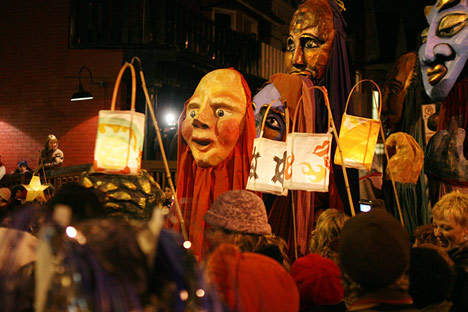
Photos from past years of the Kensington Market Festival of Lights, Toronto

Tuesday, November 29, 2022

The Acknowledged Christ


I hope you’ve had the experience, at least once in your life, of being blindsided by Somebody showing up where you’d least expect. 

Mountains in a sudden flash of sunlight across a harbor. 

An impulse at a Hare Krishna parade to join the chanting from the sidelines, good Methodist that you’ve always been.

The eye contact between you and the unknown woman who’s just pulled you back onto the curb out of traffic you didn’t see coming.

The desire to kneel down at the back of a church, when you haven’t darkened the door of such a place since you were sixteen.

The realization, in the middle of a random sexual encounter, that both of you (or all of you) are in the Presence of something vastly bigger and more important than a short spell of uncomplicated pleasure--that your trick is looking back at you with the face of God. 

The sacred, grace-filled letting go in the last days of a lover’s life that Mark Doty describes with such heart-opening clarity and vulnerability in Heaven’s Coast.

The flash of lightning across the night sky of a quiet mind in the meditation hall, nice Jewish boy from LA that you are.

The kind of experience that leaves you stammering something like, “Oh--it’s You again.”

From my own perspective grounded in the Christian tradition, these experiences are already foreshadowed in the vagueness of biblical accounts of the Resurrection. No two Gospel accounts tell the same stories. Mark, the earliest of the four Jesus narratives that eventually got included in the Bible, doesn’t have a resurrection account at all, just an inexplicably empty tomb from which two women flee in terror at dawn. My favorite is the story from Luke of two disciples on the road to Emmaus, who fall in with a stranger to whom they tell the news of Jesus’ death. The stranger starts laying out for them everything in Scripture that predicted the Passion. That evening, they sit down with him to a meal, from which he vanishes, in the same moment that they recognize the risen Lord “in the breaking of the bread.” 

There’s plenty of space in that story, for me: I don’t know what the fuck would show up in the Polaroids that nobody took. I just know that the encounter broke lives open, as it breaks mine open.

This isn’t about a resuscitated corpse. In Christian terms, this is about the Second Person of the Trinity taking flesh at times and in places you never saw coming, setting ablaze the ordinary world of our material existence. After all, it was God’s flesh all along, before we were given a life lease on it. “He comes to us as one unknown,” wrote Albert Schweitzer in The Quest of the Historical Jesus. It’s about “the acknowledged Christ” (the phrase belongs to Indian theologian M.M. Thomas), ever present in the world, shoring it up from below as well as drawing it up from above, known across cultures by a thousand different names, though none can ever comprehend him/her. The One who vanishes from sight most completely in the dogmatism of those who think they have sole possession of the truth. 


Ocean of Wisdom. 

Ghandiji. 

Shiva, Krishna, Ram, Sita, Ma Durga.

George, on the streetcorner.

Cernunnos, horned Lord of the Dance.


The concept of “the acknowledged Christ”--the presence of the Second Person of the Trinity in the cultures and religions of the Subcontinent--is a staple of the ecumenical theology of Indian Christianity. M.M.Thomas (1916-1996), a lay member of the southwest India’s Mar Thoma Church and perhaps the most influential Christian theologian of modern India, brought the term into common usage in his books The Acknowledged Christ of the Indian Renaissance (London, 1969), Man and the Universe of Faiths (Madras, 1975), and My Ecumenical Journey: 1947-1975 (Trivandrum, 1990).  

Saturday, November 5, 2022

Not One and Not Two


Nathan at work at Pearl Harbor Gift Shop, Kensington Market, Toronto


Back in May, I posted a meditation that ended with the assertion, "There is trinity around us, and trinity within us." I chose this week to inscribe a symbol of that on my body.

Two weeks ago I shared here the image of a Celtic interlace phallus. I first encountered it on the wonderful blog, now long discontinued, of a visionary who went by the name of Corvus some ten or twelve years ago. On that site he offered beautiful, rich directions for men's communal sex magick rituals. (Corvus, wherever you are today, Blessed Be.)


In its very structure, that cock-knot is a meditation on what it means to find trinity within. It's made of two intertwining endless loops, each self-contained and yet wound around and into and out of one another to manifest a third thing. Each complete in itself, and neither complete in itself. What's more, each depending on the Third that is the background on which they're inscribed--whether on stone, or on skin.


The first loop is Phallus, the second loop is Phallus, and the surface on which they rest is Phallus. And yet these three are one Phallus.


When we dive deeply into our innate erotic capacity, we're never truly alone. The relationality that's wired into who we are  at the core of our being is always with us, even in the most private act of self-love and self-pleasure.  I am the perceiver, but I am also the perceived. I am the lover, but I am also the beloved. I am immersed in my own consciousness, but my consciousness is built on all the interactions I've had with the world and others in the world, from the moment I took my first breath. And in the interaction between the one and the other, there is always a Third.


This is why the experience of solosexual bliss can become a meditative gateway into the Mystery of our lives. When men fully embrace this truth, masturbation isn't devalued as a substitute for "real" sexual expression. And sex with our partners is an extension and a sharing of the riches we contain within.


Friday, October 21, 2022

From Our Very First Breath

 "From our very first breath, we are in relationship. With that indrawn draft of air, we become joined to everything that ever was, is and ever will be. When we exhale, we forge that relationship by virtue of the act of living. Our breath commingles with all breath, and we are a part of everything. That's the simple fact of things. We are born into a state of relationship, and our ceremonies and rituals are guides to lead us deeper into that relationship with all things. Big lesson? Relationships never end; they just change. In believing that lies the freedom to carry compassion, empathy, love, kindness, and respect into and through whatever changes. We are made more by that practice."

--Richard Wagamese, from Embers


Sunday, October 2, 2022

Dickhenge Revisited

Twelve years ago, this shrine blossomed at Easton Mountain. It was my joy to tend it and offer its sacred hospitality to the men gathered there.