Showing posts with label Easton Mountain. Show all posts

Thursday, October 18, 2012

Living Soulfully

Last Sunday afternoon, I spent two hours in a church basement with thirteen other men, most of whom I was meeting for the first time. Maybe the fact that we'd come together wasn't exactly miraculous. But as we went around the circle introducing ourselves and sharing what had led us to gather, the hope I heard most of us voice seemed rare and precious.

Many though not all of us had in common that we'd spent time at Easton Mountain; or else at least we shared curiosity about Easton's mission of building more vibrant, more spiritually engaged, more inclusive community among gay men. But more immediately, what had brought us together was the desire to find such connection closer to home than the seven-hour drive from Toronto to Easton itself.

Easton's own programs, and the programs it hosts, are extraordinary and precious resources for personal growth and transformation, for the formation of new friendships, for the weaving of wider communal bonds. But as with so much of our experience of spiritual community as gay and otherwise queer men, these brief, finite opportunities to build our own culture are here one day and over the next, as we move back again from such gatherings into a world that we haven't made for ourselves, where we stand at the margins, where we're not quite fully at home.

There's a wistfulness that's an almost inevitable hangover from the peak experiences of "workshop culture. " It's a longing to walk more easily, and more often, into the space of deep connection. It's a dissatisfaction that the texture of everyday life allows so little space to integrate deep friendship, queer eros, faith, playful abandon, and resolve to change the world.

A place like Easton Mountain,to offer sustained hope for the transformation of queer men's spiritual realities, has to find ways of becoming more than itself--more than a few acres of land in upstate New York, however beautiful and peaceful they are; more than a week or two at a time of celebration and release from the constraints of life in a heteronormative world; more even than the few men who live on its land and hold space, ready to welcome those who come. It has to spread itself out as a widening network of complex, interwoven, multiple connections, like rhizomes just under the surface of the soil.

That's my prayer for what the fourteen of us in Toronto, together with those who find their way to us in coming weeks and months, might become: a web of roots strong enough to hold together, vibrant enough to send up fabulous green shoots into the gay sunshine, extensive enough to link us to men who share our vision at the foot of a mountain in upstate New York; in Boston; in Philadelphia; in New York City; in Florida; in New Jersey.

Chapters of Living Soulfully, an organization of men whose lives have been touched by the promise of Easton Mountain, offer fellowship and opportunities for local community in a growing number of cities and regions: see www.livingsoulfully.org and the Facebook pages of local groups.

Thursday, December 8, 2011

My Bracelet of Surrender: A Guest Post by Steve Brammeier

Here Steve shares his experience of creating and walking with a prayer that can be held in the hand--and perhaps call the mind back when it decides to go off in another direction.

My Spiritual practice isn't always the same. Sometimes, I feel that I'm failing because I'm not disciplined in specific spiritual ritual and therefore less spiritual. I'm fortunate enough to have an extra bedroom that serves as a "quiet room." I have my altar there. There's also an easy chair for comfortable sitting and enough room to set up a massage table. My altar holds items that are sacred to me; things that have come into my life at special times, or from individuals who have touched my life. For a while I was meditating every morning for ten minutes or so at my altar. In the last few months I seem antsy when I try to do that every day. I feel like my day is pulling me into it.

At the suggestion of a mentor well-versed in the spiritual practices of many different cultures, I decided to create a beaded bracelet as a ritual that could become a portable sacred object. I was fortunate to be at Easton Mountain during the summer, with Easton's wonderful “Beading Tree,” an outdoor craft studio created by Hunter Reynolds, as a resource. I didn't have a specific theme or design in mind as I made my bracelet. I just found beads that appealed to me and assembled them. The finished product ended up being highly symbolic of earth, fire, wind and water. I place the bracelet on my altar and frequently take it with me into my day. When I get to work, I take it off, wrapping in around my wallet, which I place in my desk drawer, so I'm less likely to forget it when I leave. Then before I go to bed I place it back on my altar, spending a few minutes connecting with the sacred objects there.

The bracelet became a large part of my Vision Quest experience this summer in Colorado. I took the bracelet into nature on my solo of four days of fasting. I kept it tied in a bandana with the rest of my sacred objects. I would open the bandana every morning as part of my ritual on the mountain. On the third day, I took the bracelet on a meditating walk through the forest. I held it in my hand, moving from bead to bead as I walked. Later that day back at my campsite, I realized I did not have the bracelet. I looked through everything multiple times. I was devastated that somehow I had lost it. How could this object that had come to me in such a meaningful way and become so sacred to me be lost? How could I now believe in whatever seemed to me to be intuitively connecting with me? I knew it was just an object, but it held my hope, my joy, and my trust in the knowledge of my own spirit.

I became despondent. I considered ending my solo time on the mountain early. I went deep into the shadow of doubt. I climbed into my sleeping bag well before sundown and stewed in my own juices of misery.

The next morning I resolved to retrace my steps, figuring I likely would come across the place where I'd set it down. There is not a lot else to do alone on the mountain and no one else there to pick it up, so I went out again. It was not a frantic walk, but a quiet, deliberate, thoughtful search. I did not find it. Part of my practice on the mountain also included drawing Animal Spirit cards. My card that morning called me to "surrender." So, I resolved that my spiritual path could be less about actively seeking or searching and more about surrendering to what was being put in front of me: my bracelet and my guidance would "find" me if I keep an open awareness.

More things transpired that day and night, but that realization was a turning point. I moved out of the shadow and came down the mountain the next morning as scheduled, feeling strong.

Two days later, while riding my bicycle from Breckenridge to Frisco, I discovered a little bead shop. I went in to see what I could find and ended up with specific intention recreating my bracelet—this his time with a stretchy cord that allows it to fit perfectly over my hand and snugly on my wrist. It has almost exactly the same design and has come to be a significant part of my life. I feel like spirit taught me a huge lesson and my bracelet indeed "found" me again.

Sunday, August 7, 2011

Dickhenge

I’m feeling, uh, a little self-conscious about this post. What’s a pro-feminist, post-modernist, sometime queer theorist doing building a phallic shrine, for the use of the temporary communities that are passing through Easton Mountain, week by week, for Eros Spirit Camp, Recovery Camp, and Gay Spirit Camp? Won’t Luce Irigaray and Leo Bersani hunt me down and kill me for this? I won’t riff on the paradox for too long: I’ll save that sort of reflection for a heavily footnoted article that maybe twenty people will read.

Instead, I’ll simply say this: the inevitable woundedness of queer male sexuality in a homophobic world needs safe containers where we can affirm our desire and the animal nature that generates it. We need welcoming spaces where nature and culture converge in our sexuality differently from the toxic ways they converge (or don’t) in a mainstream culture that serves us so badly: where we can open the connection between our hearts and our cocks; between our human sexuality and the cosmos of which we're a part.

I set out two weeks ago to create a shrine along Shinto principles, inspired by the phallic cults of central Japan, wherein smiling middle-aged matrons in kimono carry absurdly oversize joysticks down the street in annual processions.

Things didn’t quite turn out as I planned.

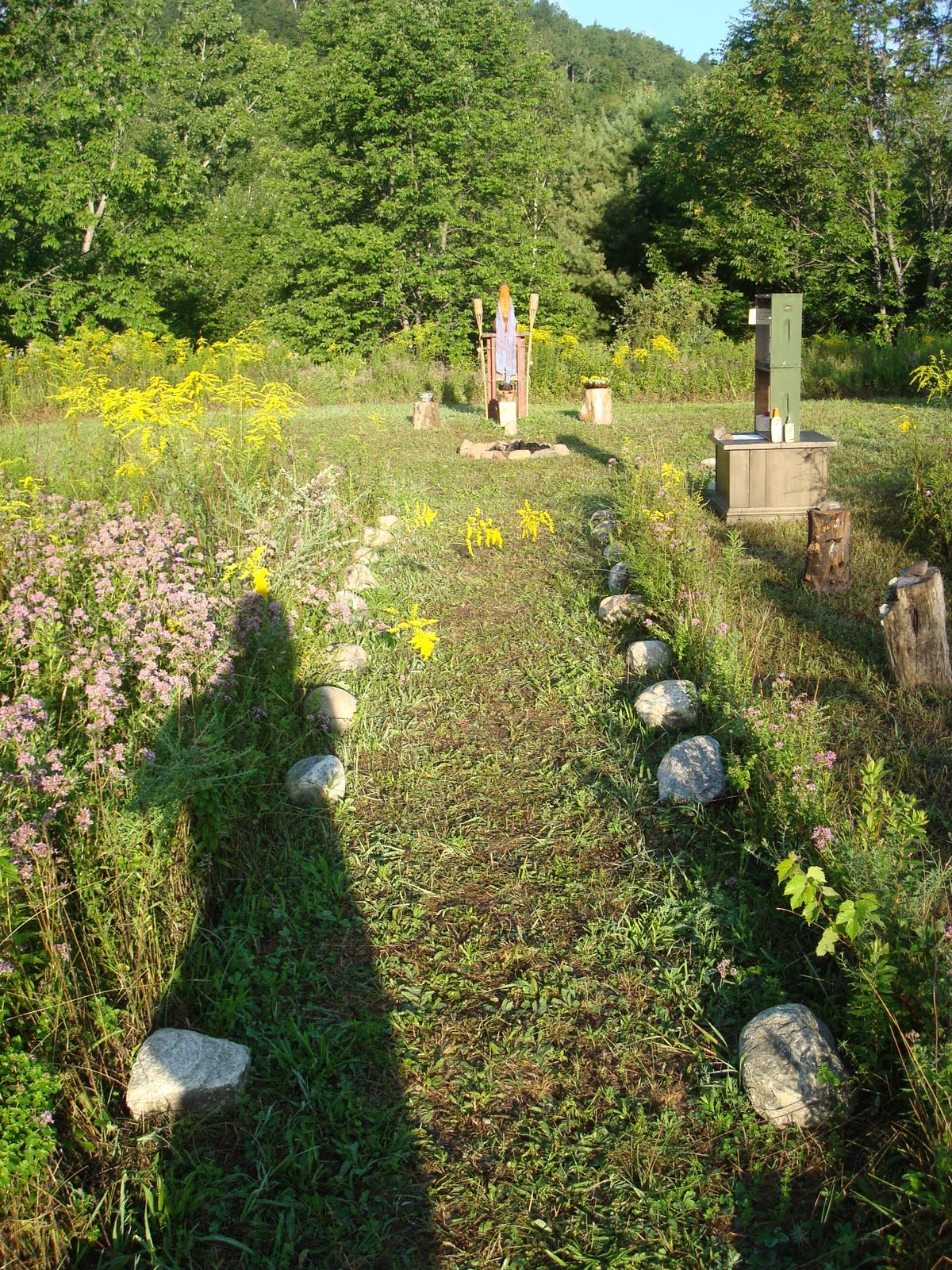
I found a circle in the meadow, recently mown for a sweat lodge yet to be built. The spot cried out. I found the perfect ceremonial table—tall, narrow, simply and roughly made but elegant—sitting neglected in the greenhouse. I flanked the mown path into the circle with two lines of stones, fanning a few more out into the circle.

And then realized to my astonishment that I was giving form to an enormous outdoor yoni-lingam: the phallus of Lord Shiva contained by the vagina of his Consort. Eight of us carried a two-foot wooden cock up the hill, banging drums, to install it as the central symbol of veneration, the first night of Eros Spirit Camp.

Unfortunately, I had to settle for Tiki torches for nighttime illumination. The effect is a little cheesy, as though someone is about to be voted out of the tribe on Survivor: Penis Island.

The next day along came the groundskeeper, who promptly mowed a second birth canal into the yoni: never attach to the results of your actions. I turned the second passage into a kind of gallery with sawn stumps in place of columns in order to restore the integrity of the space.

Then a thoughtful friend pointed out that the layout made no place for anal eroticism, no place for trans men. So last week’s first project was digging a hole behind the altar on the axis of the shrine, edged with stones, covered with charcoal, and dusted with vermillion powder; and rearranging the fire circle between the altar and the entrance into a vulva.

Next comes an entrance gate now that more of us are well and truly invited in.

Monday, June 20, 2011

Ritual Resources

A little over a year ago, I created Anchorhold to share my love of ritual. Since then, I've written here about its power to express what words fail to capture of our experience, our needs, our aspirations; about how it can help us rediscover and reinvent ourselves-as individuals and as part of a wider community of gay, bisexual, and otherwise queer men.

I’m delighted that this blog has logged over 5000 visits since then.

I’m also eager to hear if you find something useful when you come here. I encourage you to make comments and to use this site as a forum to exchange the discoveries, the wisdom, and the fun of your own practice.

Over the next weeks, I'll continue to write about specific topics in ritual practice, and then to archive these posts in the sidebar under their own heading of “Ritual Resources.” I hope you’ll use the comment function to share your own related experiences.

This July and August, I’ll serve as Ritualist in Residence at Easton Mountain, building a shrine to the community's collective erotic energy and hosting a laboratory space where men can play and experiment hands-on with symbols and practices inspired by a wide range of traditions. My Ritual Resource posts to Anchorhold will become hard-copy flyers for participants to take away as aids for the invention or enhancement of their own practice.

I also invite you to contact me one on one, if you feel I could be of use to you as a sounding board, as a facilitator, as a witness, as a participant in your practice. It’s part of my calling to offer myself as a companion on your journey of ritual exploration.

Friday, December 24, 2010

On the Eve of Nativity: Shekinah


What fires our devotion to either masculine or feminine aspects of the Divine–in Its intrinsic nature, Its relation to the world, Its presence enthroned in our souls? Why does such imagery feel so essential at one stage of the journey, then less so at another? And how does all this relate to the sexual identities of queer men?

The very traditional crucifix I bought when I was twenty-one was gaunt and Germanic. It freaked out more than one of my best friends–and especially those with strong feminist commitments. Jesus wasn’t just undeniably dead, but undeniably male, and I was hardly the first conflicted gay youth who needed the dying Christ as the one lean, naked man he could adore without enduring a toxic amalgam of crushing shame and guilt. I certainly won't be the last. Eventually the crucifix came down off the wall when I fled Christianity entirely for fifteen years. When that long sabbatical was over, my pieties had shifted.

Still, I needed to find room within the life of God for my own embodiment–for what was unmistakably transcendent and sacred in my erotic experience; for what was undeniably erotic in my devotion. By dwelling on the gender and sexuality of Jesus, as resolutely as mainstream Christian religiosity works to strip him at least of the latter, if not always the former, I staked an essential claim to my wholeness as a sexual being with a spiritual life and a spiritual being with a sexual life. St. John of the Cross, riffing on the Song of Songs with a homoeroticism that hid in plain sight, gave voice to the roiling welter of my longings. Theodore Jennings’ The Man Jesus Loved (Cleveland: Pilgrim Press, 2003), opened for me a vision of queer men’s marginalized experience enshrined at the heart of the Christian tradition–as did Terence McNally’s sometimes maligned but courageous and moving play, Corpus Christi.

And then–something shifted. Profoundly. Slowly. Starting with a day given over entirely to imagery of the Goddess at the Body Electric School’s Erotic Temple retreat. In digging deeper into Julian of Norwich’s vision of God as both Father and Mother. In building an outdoor altar that turned out to be disastrously and arrogantly incomplete in its failure to honor God’s feminine aspect in the world. In praying for Luke, a friend’s grandson born dangerously premature: I knew nothing better that I could ask on his behalf, but that God’s Shekinah–her Presence–would enfold him as the womb he still so desperately needed in order to survive--and realizing that, when all was said and done, Luke and I were in the same boat. Finally, in my spiritual director's encouragement to meditate on Jesus’s own experience of Advent–the whole of which he spent in amniotic fluid.

The shift has been, and continues to be, a wondrous discovery. After years of needing an image of God in which I could recognize myself in order find validation, I surprise myself by taking rich comfort in the enfolding Shekinah of God as Mother; in a validation prior to all our searching, all our striving. I have no idea how long I’ll float here, before the next stage in the journey. I only know that this is a place of safety and of deep, unspoken joy.

Wednesday, August 11, 2010

Fragments of the Self


Drama queen that I am, I’ll say this: collage saved my life.

Six years ago, when I was up to my monkey mind in unresolved grief–over my mother's death, over the collapse of a relationship I'd expected would continue the rest of my life–I opened my friend Sara Norquay’s e-mail. Packing up for a stay in Paris, she made her modest proposal: I'll send you the first sentence of a story. Illustrate it, she said; then send me the next line. You won't see my pages. I won't see yours. The words we'll share in common. At the end, we'll find ourselves in the bargain we've struck with each other.

Great, I thought. Now I’m an illustrator who can't draw for shit. I'm in, I said. Hit me. Sara threw me a line. It became thread through the labyrinth, clothesline enough to hang myself with, fragments shored against my ruin, an unfamiliar garden long seen but known for the first time.

As I struggled to make Sara’s words mine, I sat with a miscellaneous pile of scraps: haiku my ex-partner and I had written for each other on paper napkins in the teahouse of a Japanese garden. Banknotes in European currencies no longer accepted as legal tender. A wasp’s nest collected on the campus where I teach. Playbills and invitations to exhibitions. Notecards I’d received. The wings of moths. Ticket stubs for Götterdämmerung. My own sketches, now cannibalized as raw material for this new project. A tourist map of Venice. A page torn from Remembrance of Things Past, partially burnt as the paper in which I’d rolled a joint.

The private associations of all these materials jostled with what they could possibly mean to anyone else. I found the freedom to lay these shards of memory out on paper precisely because they were neither wholly part of me nor wholly separate. Veiled safely in enigma, I spilled my guts.

Who wrestled with whose angel? Over the course of twenty images, I became Narcissus at his well; Icarus at take-off; Orpheus in the Underworld; shaman; fool; slut; Destroyer of Illusion; Brunhilde at the pyre; Blake’s tyger in the forest.

Collage is a natural medium of expression for a self always in process, always gleaning fragments from the treasure-house of experience, always asking, “What do I do with this?” Think of your deepest self as a sheet of flawless paper: perfect, receptive, awaiting transformation. Your experiences are the materials that you're given. Every day, you are the artist; every day, you are the work of the Artist. To sit with a sheet of paper and the scraps of your life, the images that lie to hand; to wait patiently until they’re ready to arrange themselves; to enter into a dialogue with what’s emerged and then to move it further along: this is a point where the material world can rub up against the evidence of things not seen.

My collaboration with Sara, “Mouffetard’s Week: An Unfamiliar Garden,” will be on display at Sage Café in Toronto during the month of September. Meanwhile, next week I head to Easton Mountain’s Gay Spirit Camp to lead two collage workshops, along with three on Queer Midrash as a response to Judeo-Christian Scripture.

Thursday, July 22, 2010

Sometimes a Phallus is Simply a Phallus


There are fire rituals. And then there are absolutely fabulous fire rituals.

The men of Easton Mountain’s Gay Freedom Camp early in July asked themselves, “What’s holding you back from living the freer life you dream of? What will you cast into the flames so that new possibility can come out of the ashes?”

Then they handed it all over to Shiva. His dreadlocks are flying. A river of sweat spins off his forehead as he whirls. He raises one foot in a gesture of power and freedom, raises a hand to tell you not to fear, raises in another the flame of destruction and purification. He has more hands left over to receive what you need to give up.


You’ve seen him dancing in his ring of fire in a hundred restaurants. If you’ve also seen the ceremonial lingam that embodies his energy, you might never guess that its decorous abstraction represents his phallus; or that the yoni on which it rests is the vagina of his consort, who contains his power and prevents it from utterly destroying the cosmos.

No mistaking Shiva, though, in the spectacular lingam sculpted by the gifted and ingenious Moss and decorated by the endlessly creative Hunter Reynolds.

Tuesday, July 6, 2010

Queer Midrash


For the last thirty-five years, the religious right has been swinging the Bible like a club. But it's a bigger, richer, more liberating, and, yes, sexier book than Pat Robertson would ever want to admit. Reading it together and responding to it as gay men with word, movement, art, and music, we can reclaim it for ourselves as a site of spiritual growth and empowerment, a source of heightened self-awareness, and even a space for the holy, erotic playfulness of our queer imagination.

Perhaps we can't afford to stop arguing over the “proof texts” that for centuries have served to marginalize same-sex love: bigots still have to be resisted, and people of good will with an at least partially open mind need to be convinced. But sooner or later, it's soul-destroying to focus only on the negative work of proving homophobes wrong. For our own spiritual nourishment, we need to sidestep that whole, sorry debate with people we’ll never convince, and instead to take back a sacred text on our own terms. It’s our right to discern how our lives as men who love men are reflected back to us in a book that comprehends so much of Western culture’s search for the Divine.

One tool for that reclamation is midrash, a staple of Jewish biblical interpretation that starts with the questions a biblical story raises but doesn’t answer; a midrashic interpretation fills in the missing details in order to provide answers to those questions. Who is the mysterious young man who flees naked from the scene of Jesus’ arrest in the Gospel of Mark? What was the nature of the bond between David and Jonathan? Between Ruth and Naomi? Between Jesus and the Beloved Disciple?

Abraham Katzman takes up this challenge in his wonderfully homoerotic meditation on the Exodus, “Wicked Child” (in The Badboy Book of Erotic Poetry, ed. David Laurents, 1995). In the Passover Haggadah, the "wicked child" is the one who defiantly refuses to believe that the Exodus has anything to do with his own life. Katzman has the chutzpah to claim the Exodus for two queer men in the midst of their very steamy lovemaking. The poem’s speaker addresses his still bound and just now unblindfolded lover: “I will explain to you this holiday./ I will explain to you Passover./ How our people, our tribe, wandered the desert/ for forty years. How we were slaves in Egypt./ How our gay tribe of jews/ fucked each other’s asses/ even then in the desert./ How we spoke of it as holy./ As a way to understand G-d.”

The photography of Oscar Wolfman (accessible through the link to his website in the sidebar of this blog, and on display this month at Queen Gallery in Toronto) offers an often lush and sometimes deeply unsettling visual trope on portions from the Torah and other scripture.

An extraordinary collection of poems by Brian Day, Conjuring Jesus(Guernica Editions, 2009), re-imagines the life of Jesus with unapologetic desire for his flesh. What’s more, Day breaks open the stories to embrace the spirituality of other world traditions: in his retelling, the raising of Lazarus becomes a lover’s encounter with the sleeping Krishna: “Krishna is wrapped in strips of gravecloth,/ his skin moist with the fragrant oils of death./ Each summons the other from across the rock,/ which is loosed by the falling tears of Jesus,/ by the yearnings of Krishna as he lies like a stone.”

At Easton Mountain’s Gay Spirit Camp from 16-23 August, I’ll lead three workshops on the practice of queer midrash. I can’t imagine a greater privilege than encouraging gay men to take back the Word and being present to witness their integrity and pride in laying claim to the sacred page.