I'm delighted to share this space with my friend and fellow traveller Suzanne Akbari--as I hope to share it in the future with other readers and seekers. Suzanne speaks eloquently of times when we think we're attuned to the presence of the Divine in our experience--and then suddenly find out that we've almost missed it, until it presses in on us whether we're ready or not: sometimes smacking us square in the face; sometimes coming at us obliquely, right at the periphery of where we're so intently focused on finding it.
We expect to find the divine in quiet places – serene places, houses of worship, peaceful gardens. But sometimes the divine erupts, with a kind of bright, abrupt violence, and it comes as a beautiful surprise. One afternoon last month, in Provincetown, I came to meet my daughter before her early evening sailing race. She asked me to meet her in the enclosed garden behind a shop on Commercial Street called WA. I knew that she and her friends used this garden all the time as a kind of teen rendezvous location, usually during the lunch break from their sailing club.
I followed the narrow passageway that runs along the left side of the building into the garden. I had never been in the garden before, but I had seen the store, which is full of tastefully arranged household accessories for the enlightened home decorator. Right behind the store is a tiled garden space surrounded by greenery on all sides, with a leafy wooded hillside at the back (the Bradford Street side is high there) and an assortment of tasteful waterfalls, wooden benches, and Buddha statues (all of these items with price tags). I got there a couple of minutes early and so I waited quietly in the empty garden. It’s a lovely space with the dripping water and the greenery, though the piped in New Age music was a little off-putting. I walked around, looking at the smooth smiling faces of the Buddha statues, and sat on a wooden bench at the side of the garden to wait.
So then comes trickling in a whole bunch of kids, about a dozen of them aged eight to fourteen, just gotten out from the sailing club, dressed in damp rags of various sorts, wet from swimming and sailing all day. They were all chatting and flirting and quarreling, eating and drinking, sitting on each others’ laps and chewing gum, as children that age do, and I started thinking, My god, this is so inappropriate, they're so disruptive, someone is going to come out of the store – and then I suddenly thought, ‘No, this is totally appropriate.’ Someone had brought a pizza and they were all eating and talking, all colorful and half dressed and entirely full of young life. I looked at them and thought, Wow, this is as Buddhist as the WA garden could ever possibly get.
I had seen the divine erupt before: I had seen it for the first time as a teenager practicing meditation by looking at a candle flame, and suddenly I saw waves and waves of red light. Even though I kept practicing meditation, I never saw it again. I had felt the sudden pressure of the divine once when floating in the water on an intensely sunny day, feeling the water outside and the water inside me, and no longer having any sense – just for a moment – of the boundaries of my body. But I had never seen so vividly and with such pulsing animation the energy of the divine. It’s good to make spaces for the divine, sacred enclosures or altars where we invite the divine to dwell. But sometimes the divine erupts upon you, in the most unexpected way; it takes your breath away.

Monday, August 29, 2011

Tuesday, August 23, 2011
Praying in Front of God and Everybody
 “What are you doing?” my four-year old neighbor asked me as I approached my backyard altar yesterday morning. Our houses stand less than ten yards apart, and the grownups observe a studied and necessary convention of privacy. It’s hard not to be aware of one another’s comings and goings, our social arrangements, even sometimes a fragment of domestic argument that drifts from one window to another. We’re careful to maintain the fiction that we know of one another’s lives only what we’ve chosen to share. It’s the business of a four-year-old, thank God, to chip away at the careful artificiality of our boundaries.
“I’m taking this bowl away to fill with fresh water for some flowers,” I answered breezily, brushing off her well-founded curiosity why a grown man goes out, rings a bell, kneels briefly twice day, five steps from her cellar door, in front of a half-disintegrated brick barbecue, gets up a few minutes later, bows, and goes back into the house. I’m already exotic, since I live with another man. This puts me right over the top.
What kept me from instead sharing some less evasive introduction to my practice? I could have explained that this is where I say prayers twice a day: as the daughter of practicing Roman Catholics, she would have found that intelligible enough. I could have explained that the flowers are like the flowers in church, that the bell helps me remember that the time I spend here is important, like the incense I burn at dusk and the small camphor fire I light in the clay puja lamp. I could have explained that the colored stones arranged in a circle in front of the small bronze Buddha represent the north, east, south, and west and remind me that the earth is our mother.
Instead, I let my self-consciousness about personally chosen ritual get in the way of our exchange, and in the process contributed to a child’s incipient sense that ritual is private, eccentric, and not to be talked about—perhaps that it’s even, in some sense, illicit.
I can do better than this. I can do better by her, and by myself, and by the world she’s growing up to create.
Sunday, August 7, 2011
Dickhenge
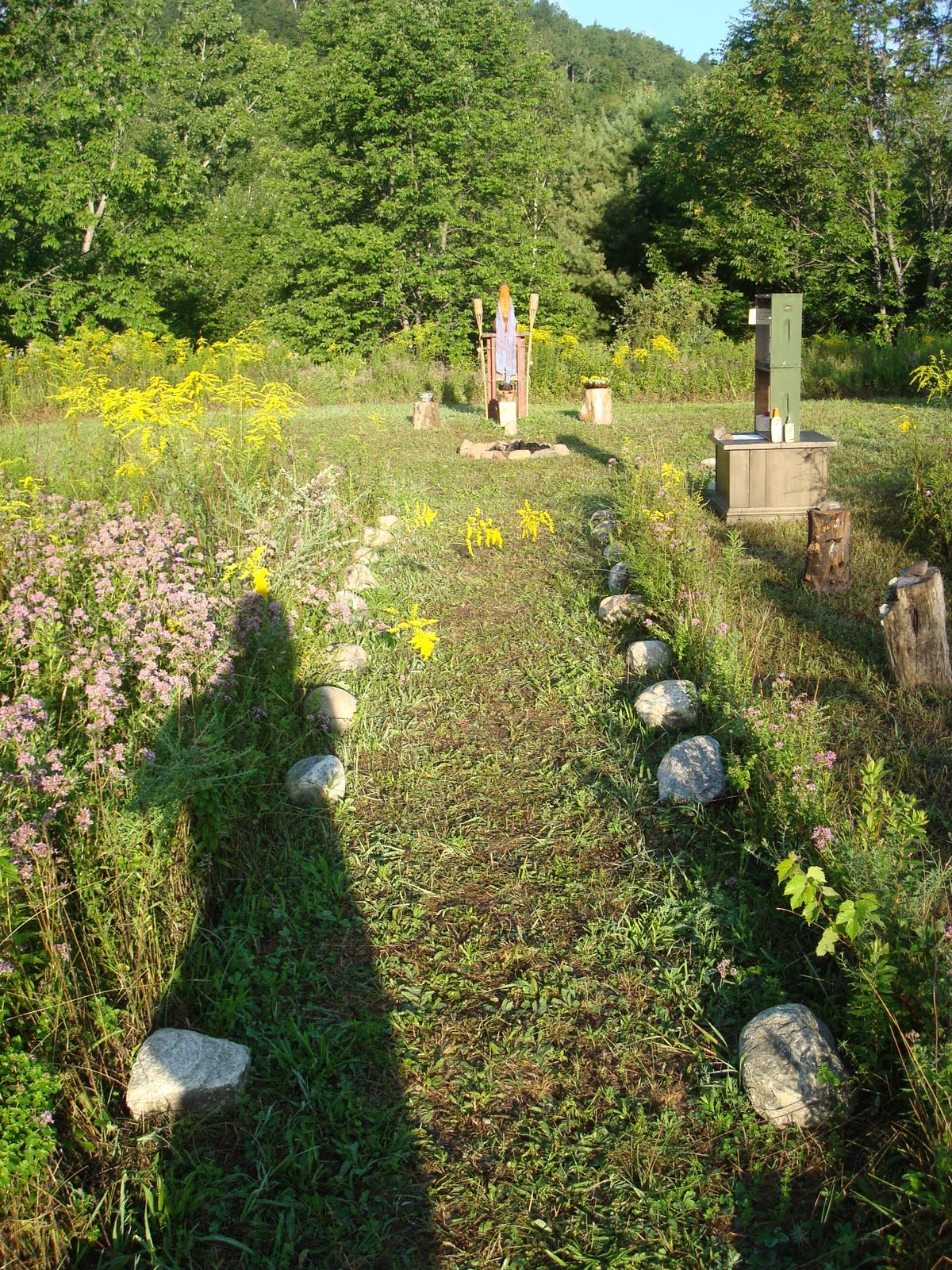 I’m feeling, uh, a little self-conscious about this post. What’s a pro-feminist, post-modernist, sometime queer theorist doing building a phallic shrine, for the use of the temporary communities that are passing through Easton Mountain, week by week, for Eros Spirit Camp, Recovery Camp, and Gay Spirit Camp? Won’t Luce Irigaray and Leo Bersani hunt me down and kill me for this? I won’t riff on the paradox for too long: I’ll save that sort of reflection for a heavily footnoted article that maybe twenty people will read.
 Instead, I’ll simply say this: the inevitable woundedness of queer male sexuality in a homophobic world needs safe containers where we can affirm our desire and the animal nature that generates it. We need welcoming spaces where nature and culture converge in our sexuality differently from the toxic ways they converge (or don’t) in a mainstream culture that serves us so badly: where we can open the connection between our hearts and our cocks; between our human sexuality and the cosmos of which we're a part.
 I set out two weeks ago to create a shrine along Shinto principles, inspired by the phallic cults of central Japan, wherein smiling middle-aged matrons in kimono carry absurdly oversize joysticks down the street in annual processions.
 Things didn’t quite turn out as I planned.
I found a circle in the meadow, recently mown for a sweat lodge yet to be built. The spot cried out. I found the perfect ceremonial table—tall, narrow, simply and roughly made but elegant—sitting neglected in the greenhouse. I flanked the mown path into the circle with two lines of stones, fanning a few more out into the circle.
 And then realized to my astonishment that I was giving form to an enormous outdoor yoni-lingam: the phallus of Lord Shiva contained by the vagina of his Consort. Eight of us carried a two-foot wooden cock up the hill, banging drums, to install it as the central symbol of veneration, the first night of Eros Spirit Camp.
 Unfortunately, I had to settle for Tiki torches for nighttime illumination. The effect is a little cheesy, as though someone is about to be voted out of the tribe on Survivor: Penis Island.
The next day along came the groundskeeper, who promptly mowed a second birth canal into the yoni: never attach to the results of your actions. I turned the second passage into a kind of gallery with sawn stumps in place of columns in order to restore the integrity of the space.
 Then a thoughtful friend pointed out that the layout made no place for anal eroticism, no place for trans men. So last week’s first project was digging a hole behind the altar on the axis of the shrine, edged with stones, covered with charcoal, and dusted with vermillion powder; and rearranging the fire circle between the altar and the entrance into a vulva.
 Next comes an entrance gate now that more of us are well and truly invited in.
Monday, June 20, 2011
Ritual Resources
A little over a year ago, I created Anchorhold to share my love of ritual. Since then, I've written here about its power to express what words fail to capture of our experience, our needs, our aspirations; about how it can help us rediscover and reinvent ourselves-as individuals and as part of a wider community of gay, bisexual, and otherwise queer men.
I’m delighted that this blog has logged over 5000 visits since then.
I’m also eager to hear if you find something useful when you come here. I encourage you to make comments and to use this site as a forum to exchange the discoveries, the wisdom, and the fun of your own practice.
Over the next weeks, I'll continue to write about specific topics in ritual practice, and then to archive these posts in the sidebar under their own heading of “Ritual Resources.” I hope you’ll use the comment function to share your own related experiences.
This July and August, I’ll serve as Ritualist in Residence at Easton Mountain, building a shrine to the community's collective erotic energy and hosting a laboratory space where men can play and experiment hands-on with symbols and practices inspired by a wide range of traditions. My Ritual Resource posts to Anchorhold will become hard-copy flyers for participants to take away as aids for the invention or enhancement of their own practice.
I also invite you to contact me one on one, if you feel I could be of use to you as a sounding board, as a facilitator, as a witness, as a participant in your practice. It’s part of my calling to offer myself as a companion on your journey of ritual exploration.
I’m delighted that this blog has logged over 5000 visits since then.
I’m also eager to hear if you find something useful when you come here. I encourage you to make comments and to use this site as a forum to exchange the discoveries, the wisdom, and the fun of your own practice.
Over the next weeks, I'll continue to write about specific topics in ritual practice, and then to archive these posts in the sidebar under their own heading of “Ritual Resources.” I hope you’ll use the comment function to share your own related experiences.
This July and August, I’ll serve as Ritualist in Residence at Easton Mountain, building a shrine to the community's collective erotic energy and hosting a laboratory space where men can play and experiment hands-on with symbols and practices inspired by a wide range of traditions. My Ritual Resource posts to Anchorhold will become hard-copy flyers for participants to take away as aids for the invention or enhancement of their own practice.
I also invite you to contact me one on one, if you feel I could be of use to you as a sounding board, as a facilitator, as a witness, as a participant in your practice. It’s part of my calling to offer myself as a companion on your journey of ritual exploration.
Friday, June 3, 2011
Brutal and Summary Dechachkefication

With the onset of Alzheimer’s, my grandmother’s lifelong habit of archiving magazines escalated into the creation of a shoulder-high maze in her bedroom, then the stacks’ consolidation into an impenetrable monolith that finally engulfed my deceased grandfather’s twin bed. Before it was over, termites were nesting in fifty years of National Geographic, Arizona Highways, and Audubon.
I could see the pattern recapitulate itself in my mother’s reluctance to part with anything that had once come into our house, and with the onset of her own dementia, a rising sense that the integrity of her life depended on the categorical preservation of everything she’d gathered around her.
My uncle left a suicide note explaining to his daughter how to install the storm windows.
I’ve labored all my life under the burden of hoarder DNA. I remember explaining at the age of four why the small and large scraps of paper on the coffee table needed each other in order not to feel lonely.
My partner and I spent the last six weeks preparing to walk away from our house in Toronto for fifteen months. Readying it for new occupants involved a brutal and summary dechachkefication.
I went through five boxes of memorabilia from my childhood home that ten years ago seemed like the barest tether to four and a half decades of memory and desire. Nine tenths went into the trash, or to the curio shop around the corner. I couldn’t bear to treat my mother’s favorite housedress as refuse, so I burned it. I hadn’t realized how splendidly cotton fabric flares up.
I sold a collection of vinyl I’d barely played in fifteen years, that as much as any artifact defined who I was in my twenties: hopelessly romantic and romantically hopeless aesthete; idolater of Bach and Mozart; incipient Wagnerian; dilettante in zydeco, alternative rock, and reggae, which represented for me the less mapped-out and rule-bound life I longed for but couldn’t choose.
What do you do with a shelf of twenty-year-old erotic videos that long ago lost their compelling allure, and have in any case turned to magnetic snow onscreen since you last beheld the divine Al Parker in all his gloriously ingenious raunchiness?
And on it went. With every carton removed from the basement; with every bag of unworn-for-a-year clothing donated to Goodwill; with every cookbook I hadn’t succeeded actually in using for ten years, there advanced a lightness that grew addictive. I found myself wandering around the house at night looking for something else I could do without. When it comes down to the choice, at least three quarters of what I hang onto bears almost no lived relation to the quality of my life.
It’s a gentle and very privileged middle-class version of renunciation that I’ve practiced since mid-April. But it’s been salutary nonetheless. What matters, it turns out, are a few dozen CD’s; a cat who spent the first six hours of The Big Shlepp from southern Ontario to the East End of Long Island screaming her head off; the altar objects now installed in a recessed niche behind my desk; some collage work in progress. Letting go of the rest is a taste of freedom, a chance to reinvent the soul and to be reinvented, a minor spark from Shiva’s ring of fire, Pentecost’s least dramatic tongue of flame.
Monday, May 23, 2011
Boys Like Us
As surely in our spiritual lives as in everything else, we’re social creatures. We don’t live in isolation from each other, but in community. This is true even for hermits in the remotest retreats: the solitude they’ve chosen is meaningful only in relation to a spiritual tradition they’ve absorbed and embraced.
Imagine any ritual you might adopt to enrich your inner life–even the simplest one you create and perform alone as part of a personal practice. It’s grounded in a community you’ve experienced. Go into a shrine alone and light a candle. You expect it to be seen by those who arrive while it’s still burning. Maybe no one will show up in time, but they might, and you have faith that, if they come, they’ll get it. Light the candle at home where no one else will see it. The community is still there, because you carry it around inside you.
Ritual involves the “I” that chooses to express itself in action, but it makes no sense if it doesn’t also involve a “You”: I do this thing because it makes sense to you as well. If you’re absent, then I imagine you there. Perhaps you participate; perhaps you just stand in witness. Or maybe you’re a little puzzled and I have to explain it to you–but with as few words as possible. Nothing kills ritual like too much abstract talk. Better I should invite you to join me, with some faith that we share enough in common that you’ll get it.
So what knits queer men into a community? Can we envision a practice of ritual that grows out of what we share, expresses it, deepens it–and brings us a richer life as individuals as well?
We spend big chunks of our lives out of touch with each other: in the closet before we come out; at times when we choose to “pass” (or maybe have no other choice) in heterosexist workplaces, social gatherings, public events, family reunions, and less-than-welcoming religious institutions. Plenty about our own individual identities separates us from each other, too: race, class, looks, language, age, physical ability.
We seek each other out, in the first place, because of the sheer power of desire. I don’t know of any better illustration of that than Peter McGehee’s wonderful, funny novella Boys Like Us, set in Toronto during the late 1980's. The main character Zero and his friends live lives of rich, flexible connection as they struggle to support one another through the burgeoning of the AIDS crisis. And the novel is unapologetic in celebrating a core fact of the history that holds them together: that nearly everyone in their circle has at some point slept with almost everybody else.
We don’t all experience oppression in the same ways, or to the same extent. But it’s safe to say that all of us experience it, and we’re kidding ourselves, despite any advances of the last decades, to say that we don’t. So we gather to create a space where we’re not the shunned outsiders. We don’t always do such a great job of respecting one another’s diversity within it. But my sense is that we’re getting better and more sensitive about acknowledging and celebrating how we’re different from each other as well as what we have in common.
I don’t think it’s a good idea to take these basic facts for granted about how we come together in sometimes patchy, intermittent experiences of community. If we’re searching for ways to express who we are, as individuals in a now-you-see-it-now-you-don’t community of queer men, we’d better keep erotic desire front and center in the rituals we adopt, adapt, or invent. We’d better pay attention to the experience of oppression and stay sensitive to how one man’s experience of living on the outside is the same as another’s, but how it’s different as well.
Perhaps most important of all, we need to focus on a third aspect of what we share: our ability as members of overlapping sexual minorities to offer each other support, affirmation, dignity, and hope in and through our flirtations and our sexual encounters, sometimes in circumstances that you’d think would more likely lead to mutual exploitation. Michael Rumaker captured this vividly in his experimental chronicle of 1979, A Day and a Night at the Baths.
I’m not suggesting (alas) that this means queer men’s ritual community ought to be a non-stop festival of erotic interaction. I’m saying we need to make sure the rituals we adopt and create don’t lose track of how eros draws us together; of how our resistance to oppression gives us common ground, amidst our differences; of how the desire we share with one another has potential to become a channel for deep grace, to remake our lives for the better.
Imagine any ritual you might adopt to enrich your inner life–even the simplest one you create and perform alone as part of a personal practice. It’s grounded in a community you’ve experienced. Go into a shrine alone and light a candle. You expect it to be seen by those who arrive while it’s still burning. Maybe no one will show up in time, but they might, and you have faith that, if they come, they’ll get it. Light the candle at home where no one else will see it. The community is still there, because you carry it around inside you.
Ritual involves the “I” that chooses to express itself in action, but it makes no sense if it doesn’t also involve a “You”: I do this thing because it makes sense to you as well. If you’re absent, then I imagine you there. Perhaps you participate; perhaps you just stand in witness. Or maybe you’re a little puzzled and I have to explain it to you–but with as few words as possible. Nothing kills ritual like too much abstract talk. Better I should invite you to join me, with some faith that we share enough in common that you’ll get it.
So what knits queer men into a community? Can we envision a practice of ritual that grows out of what we share, expresses it, deepens it–and brings us a richer life as individuals as well?
We spend big chunks of our lives out of touch with each other: in the closet before we come out; at times when we choose to “pass” (or maybe have no other choice) in heterosexist workplaces, social gatherings, public events, family reunions, and less-than-welcoming religious institutions. Plenty about our own individual identities separates us from each other, too: race, class, looks, language, age, physical ability.
We seek each other out, in the first place, because of the sheer power of desire. I don’t know of any better illustration of that than Peter McGehee’s wonderful, funny novella Boys Like Us, set in Toronto during the late 1980's. The main character Zero and his friends live lives of rich, flexible connection as they struggle to support one another through the burgeoning of the AIDS crisis. And the novel is unapologetic in celebrating a core fact of the history that holds them together: that nearly everyone in their circle has at some point slept with almost everybody else.
We don’t all experience oppression in the same ways, or to the same extent. But it’s safe to say that all of us experience it, and we’re kidding ourselves, despite any advances of the last decades, to say that we don’t. So we gather to create a space where we’re not the shunned outsiders. We don’t always do such a great job of respecting one another’s diversity within it. But my sense is that we’re getting better and more sensitive about acknowledging and celebrating how we’re different from each other as well as what we have in common.
I don’t think it’s a good idea to take these basic facts for granted about how we come together in sometimes patchy, intermittent experiences of community. If we’re searching for ways to express who we are, as individuals in a now-you-see-it-now-you-don’t community of queer men, we’d better keep erotic desire front and center in the rituals we adopt, adapt, or invent. We’d better pay attention to the experience of oppression and stay sensitive to how one man’s experience of living on the outside is the same as another’s, but how it’s different as well.
Perhaps most important of all, we need to focus on a third aspect of what we share: our ability as members of overlapping sexual minorities to offer each other support, affirmation, dignity, and hope in and through our flirtations and our sexual encounters, sometimes in circumstances that you’d think would more likely lead to mutual exploitation. Michael Rumaker captured this vividly in his experimental chronicle of 1979, A Day and a Night at the Baths.
I’m not suggesting (alas) that this means queer men’s ritual community ought to be a non-stop festival of erotic interaction. I’m saying we need to make sure the rituals we adopt and create don’t lose track of how eros draws us together; of how our resistance to oppression gives us common ground, amidst our differences; of how the desire we share with one another has potential to become a channel for deep grace, to remake our lives for the better.
Sunday, May 15, 2011
Fucking Miraculous
This weekend, I’ve been writing a paper about the nature of community among queer men; about how it shapes what kinds of authentic, meaningful ritual we can devise for ourselves and one another. I wanted to talk about gay camp: about how we simultaneously throw ourselves into an experience and stand back to evaluate, lampoon, and critique the very values we seem to embrace. So I reached for my copy of Tony Kushner’s ever-astonishing Angels in America.
You can find a YouTube clip of one of the play’s most moving scenes, in the HBO version for television that stars Al Pacino as Roy Cohn and Meryl Streep as nearly everyone else, at http://www.youtube.com/watch?v=4H0Fi83wEWk.
During Part Two, the ghost of Ethel Rosenberg has been keeping vigil by Cohn’s hospital bed during the last hours of his life: she’s haunting him in revenge for his role in her execution during the McCarthy witch hunt. Immediately after Cohn’s death, the drag queen/nurse Belize charged with his care at the hospital summons Louis, a disaffected gay Jewish leftist, to say Kaddish over the body--ostensibly to give Belize an opportunity to smuggle Cohn’s private stash of experimental AZT (the year is 1985) out of the room for distribution to PWAs with no access to treatment.
Louis protests, in keeping with his leftist principles, that he will not recite the commemoration of the dead for Cohn; he then adds that in any case he can’t remember the prayer. Giving in, he stumbles through the first phrases, halts, then begins limping through half-remembered tags from the Shabbat blessings, from the Sh'ma.
Ethel’s ghost rises from her chair in the corner of the room to coach Louis phrase by phrase through the long Aramaic text. At the last "Amen," Ethel adds, and Louis repeats, "Yousonofabitch." Loading the stolen drugs into Louis's backpack, Belize responds, “Thank you Louis. You did fine.” Louis responds, “Fine? What are you talking about, fine? That was fucking miraculous.”
The line brought down the house both times I saw the play. And it’s as good an example as I know to illustrate something said by Ronald Grimes, a leading scholar of contemporary ritual theory. “Ritualizing” Grimes observes, “is not incompatible with criticism, nor a sense of mystery with iconoclasm, provided self-critical actions are embedded in ritual itself.”
What’s more, the scene from Angels is a wonderful example of the astonishing ways that gay camp builds up layer upon layer of meaning. When Louis delivers his astonished quip, “What are you talking about, fine? That was fucking miraculous,” the miracle is revealed to the audience as unmiraculous because we see Ethel’s ghost coaching Louis as neither of the characters onstage sees her. Yet on another level, it remains a surreal marvel, if not miraculous in any theological sense, by the sheer fact of Ethel’s ghostly presence.
But most importantly, it’s truly miraculous not because it’s a paranormal marvel, but because of the profound recognition of common humanity that Ethel in this moment of closure manifests towards the man responsible for her execution decades before. In this act of forgiveness, in which the evil that Cohn did is not ignored but transcended, the scene thus offers a powerful foreshadowing of the protagonist Prior’s direct address to the audience in the last scene of the play: “You are fabulous creatures, each and every one. And I bless you.”
And finally, the transgressive edge of queer experience is aggressively foregrounded. Louis’s prayer isn’t just miraculous, but fucking miraculous, at the deathbed of a demonically powerful, hypocritical bully fallen victim to a disease transmitted by fucking and being fucked.
Camp isn’t just a touchstone of our culture as queer men. It’s an extraordinary resource as we grope for symbols, actions, and words that speak to the deepest Truth of our lives that lies beyond all capacity to express.
You can find a YouTube clip of one of the play’s most moving scenes, in the HBO version for television that stars Al Pacino as Roy Cohn and Meryl Streep as nearly everyone else, at http://www.youtube.com/watch?v=4H0Fi83wEWk.
During Part Two, the ghost of Ethel Rosenberg has been keeping vigil by Cohn’s hospital bed during the last hours of his life: she’s haunting him in revenge for his role in her execution during the McCarthy witch hunt. Immediately after Cohn’s death, the drag queen/nurse Belize charged with his care at the hospital summons Louis, a disaffected gay Jewish leftist, to say Kaddish over the body--ostensibly to give Belize an opportunity to smuggle Cohn’s private stash of experimental AZT (the year is 1985) out of the room for distribution to PWAs with no access to treatment.
Louis protests, in keeping with his leftist principles, that he will not recite the commemoration of the dead for Cohn; he then adds that in any case he can’t remember the prayer. Giving in, he stumbles through the first phrases, halts, then begins limping through half-remembered tags from the Shabbat blessings, from the Sh'ma.
Ethel’s ghost rises from her chair in the corner of the room to coach Louis phrase by phrase through the long Aramaic text. At the last "Amen," Ethel adds, and Louis repeats, "Yousonofabitch." Loading the stolen drugs into Louis's backpack, Belize responds, “Thank you Louis. You did fine.” Louis responds, “Fine? What are you talking about, fine? That was fucking miraculous.”
The line brought down the house both times I saw the play. And it’s as good an example as I know to illustrate something said by Ronald Grimes, a leading scholar of contemporary ritual theory. “Ritualizing” Grimes observes, “is not incompatible with criticism, nor a sense of mystery with iconoclasm, provided self-critical actions are embedded in ritual itself.”
What’s more, the scene from Angels is a wonderful example of the astonishing ways that gay camp builds up layer upon layer of meaning. When Louis delivers his astonished quip, “What are you talking about, fine? That was fucking miraculous,” the miracle is revealed to the audience as unmiraculous because we see Ethel’s ghost coaching Louis as neither of the characters onstage sees her. Yet on another level, it remains a surreal marvel, if not miraculous in any theological sense, by the sheer fact of Ethel’s ghostly presence.
But most importantly, it’s truly miraculous not because it’s a paranormal marvel, but because of the profound recognition of common humanity that Ethel in this moment of closure manifests towards the man responsible for her execution decades before. In this act of forgiveness, in which the evil that Cohn did is not ignored but transcended, the scene thus offers a powerful foreshadowing of the protagonist Prior’s direct address to the audience in the last scene of the play: “You are fabulous creatures, each and every one. And I bless you.”
And finally, the transgressive edge of queer experience is aggressively foregrounded. Louis’s prayer isn’t just miraculous, but fucking miraculous, at the deathbed of a demonically powerful, hypocritical bully fallen victim to a disease transmitted by fucking and being fucked.
Camp isn’t just a touchstone of our culture as queer men. It’s an extraordinary resource as we grope for symbols, actions, and words that speak to the deepest Truth of our lives that lies beyond all capacity to express.
Sunday, May 1, 2011
Love Upside Down
In 2004, the General Synod of the Anglican Church of Australia did what Anglican church meetings do interminably, all over this sorry-ass world: it debated "the problem of homosexuality" as a matter of principle. The usual bland, specious forbearance and fake charity of the discussion depended on the usual shameful fiction: namely, that delegates were arguing about abstract beliefs, not about the treatment of a sizeable minority of people within, or shut out from, the Church–and surely, especially given the fact that this was, hello, a gathering of Anglican priests, within the ranks of the delegates themselves.
Then the Rev. Dr. Steven Ogden, at the time Dean of St. Peter’s Cathedral in Adelaide, got up to make from the floor a motion he thought surely everyone could countenance, for a resolution that gay and lesbian people were fully welcome in Anglican congregations. He was jeered down by hecklers, while the majority of delegates sat spinelessly silent.
As he talks about it in a new book, Love Upside Down: Life, Love, and the Subversive Jesus, the experience clearly became a defining moment in his personal journey from an ethics of abstraction to an ethics based on love for the irreplaceable worth of others–and a journey to the radical left of the Australian Church. He writes as a fellow traveller who gets it: that sometimes the Church is the people of Israel on their way out of Egypt; but sometimes it’s Pharoah’s army; and sometimes it’s just the Red Sea that you’ve got to get across.
Then the Rev. Dr. Steven Ogden, at the time Dean of St. Peter’s Cathedral in Adelaide, got up to make from the floor a motion he thought surely everyone could countenance, for a resolution that gay and lesbian people were fully welcome in Anglican congregations. He was jeered down by hecklers, while the majority of delegates sat spinelessly silent.
As he talks about it in a new book, Love Upside Down: Life, Love, and the Subversive Jesus, the experience clearly became a defining moment in his personal journey from an ethics of abstraction to an ethics based on love for the irreplaceable worth of others–and a journey to the radical left of the Australian Church. He writes as a fellow traveller who gets it: that sometimes the Church is the people of Israel on their way out of Egypt; but sometimes it’s Pharoah’s army; and sometimes it’s just the Red Sea that you’ve got to get across.
Thursday, April 21, 2011
Jesus and Lazarus
In homage to Terence McNally and Theodore Jennings
Asleep on his chest after the dinner they’ve shared with the others, the boy doesn’t really understand what’s about to happen, any more than the rest of them. They all imagine that somehow he’ll wave his hand and the fundamentalist thugs who are coming for him will drop to the ground. Or all but one of them: the one who’s betrayed him to the authorities knows well enough that they won’t.
His heart aches for this innocent, who’s too young to lose his first love–much less to the brutal death almost certainly to come. His desire to spare him such anguish almost swamps the fear he feels for himself.
But it’s all in motion now, and the shit’s about to hit the fan. Even if he wanted to flee, the chances of escaping the net they’ve cast around him for days are negligible. He’s staked everything on blind faith that somewhere--beyond the cold, calculated brutality of those who hate him, beyond the limits of imagination--some good can come of surrender to suffering at the hands of Power for the sake of Love.
He loves them all; has loved them to the end. This boy who slipped into his bed the first night he stayed in the house of the lad’s older sisters. The hairy, thick-chested fishermen he picked up on the shore of the lake. The one everybody still labels as a sellout to the Occupation. Even the politically correct zealot who's already revealed his whereabouts to the Temple mafia.
In the flush of the wine, he’s behaved tonight like an outrageous, theatrical queen: passing bread and wine around the table and telling them all that he’d feed them his body and blood if he could; halfway through the meal, stripping off his robe and washing their feet like a half-naked slave in a bathhouse, his erection tenting the towel around his waist while he cradled his beloved's ankle in his hand.
But he still means all of it. Nudging the boy awake, rousing the others from where they sit, some of them slumped and dozing, some of them gripped by silent, half-comprehending dread, he tells them, time to move on. Time to meet what’s coming next.
Asleep on his chest after the dinner they’ve shared with the others, the boy doesn’t really understand what’s about to happen, any more than the rest of them. They all imagine that somehow he’ll wave his hand and the fundamentalist thugs who are coming for him will drop to the ground. Or all but one of them: the one who’s betrayed him to the authorities knows well enough that they won’t.
His heart aches for this innocent, who’s too young to lose his first love–much less to the brutal death almost certainly to come. His desire to spare him such anguish almost swamps the fear he feels for himself.
But it’s all in motion now, and the shit’s about to hit the fan. Even if he wanted to flee, the chances of escaping the net they’ve cast around him for days are negligible. He’s staked everything on blind faith that somewhere--beyond the cold, calculated brutality of those who hate him, beyond the limits of imagination--some good can come of surrender to suffering at the hands of Power for the sake of Love.
He loves them all; has loved them to the end. This boy who slipped into his bed the first night he stayed in the house of the lad’s older sisters. The hairy, thick-chested fishermen he picked up on the shore of the lake. The one everybody still labels as a sellout to the Occupation. Even the politically correct zealot who's already revealed his whereabouts to the Temple mafia.
In the flush of the wine, he’s behaved tonight like an outrageous, theatrical queen: passing bread and wine around the table and telling them all that he’d feed them his body and blood if he could; halfway through the meal, stripping off his robe and washing their feet like a half-naked slave in a bathhouse, his erection tenting the towel around his waist while he cradled his beloved's ankle in his hand.
But he still means all of it. Nudging the boy awake, rousing the others from where they sit, some of them slumped and dozing, some of them gripped by silent, half-comprehending dread, he tells them, time to move on. Time to meet what’s coming next.
Saturday, April 9, 2011
Saliva, Mud
Tuesdays, the dozen of us who’ve gathered every week so far during Lent to make art together begin with a check-in before we move into our studio space. This week, we started by reading, from Chapter 9 of the Gospel of John, the story of Jesus healing a man born blind.
Jesus spits on the ground to make mud that he then smears on the man’s eyes. The local authorities freak out when he's cured. Getting no answers about how it happened that they’re prepared to accept, they finally drive him out of town. Jesus searches him out, and their conversation ends with Jesus saying, “I’m the one the prophecies are about. If you can see that, you’ve got your sight. The ones who can’t are blind.”
After we’d read the story aloud to each other, we took turns sharing one or two words, at most a single phrase, that had pulled us in. One of us–God bless him–chose, “Saliva. Mud.” It’s the weirdest detail in the whole story, the one least likely to get attention from pious readers. I can’t help but think the way it unsettles well-groomed reverence for a clean-scrubbed Jesus is somehow of a piece with the suspicious, hostile reaction he gets in the story itself. The Savior of the World isn’t supposed to treat bodily fluids and dirt like sacramental substances. Holy Spit is a South Park episode waiting to happen. If Jesus had an NEH grant, he’d lose it over this one, for sure.
Later in the evening, hands figured prominently in our studio work: their outlines sometimes traced carefully in felt marker; but more often covered up to our wrists in acrylic paint and then pressed, rolled, or smeared across the paper. “Saliva, Mud” turned into something of a mantra. What struck me was how readily others in the group embraced it, as eagerly as they plunged into paint when neater media lay to hand as alternatives. In the basement of a respectable, solidly middle-class Anglican church, what most answered our longings was the prospect of an escape from Purity into the riskier territory of Dirt Out of Place.
Jesus spits on the ground to make mud that he then smears on the man’s eyes. The local authorities freak out when he's cured. Getting no answers about how it happened that they’re prepared to accept, they finally drive him out of town. Jesus searches him out, and their conversation ends with Jesus saying, “I’m the one the prophecies are about. If you can see that, you’ve got your sight. The ones who can’t are blind.”
After we’d read the story aloud to each other, we took turns sharing one or two words, at most a single phrase, that had pulled us in. One of us–God bless him–chose, “Saliva. Mud.” It’s the weirdest detail in the whole story, the one least likely to get attention from pious readers. I can’t help but think the way it unsettles well-groomed reverence for a clean-scrubbed Jesus is somehow of a piece with the suspicious, hostile reaction he gets in the story itself. The Savior of the World isn’t supposed to treat bodily fluids and dirt like sacramental substances. Holy Spit is a South Park episode waiting to happen. If Jesus had an NEH grant, he’d lose it over this one, for sure.
Later in the evening, hands figured prominently in our studio work: their outlines sometimes traced carefully in felt marker; but more often covered up to our wrists in acrylic paint and then pressed, rolled, or smeared across the paper. “Saliva, Mud” turned into something of a mantra. What struck me was how readily others in the group embraced it, as eagerly as they plunged into paint when neater media lay to hand as alternatives. In the basement of a respectable, solidly middle-class Anglican church, what most answered our longings was the prospect of an escape from Purity into the riskier territory of Dirt Out of Place.
Saturday, April 2, 2011
Rinzai/Soto
One of my all-time favorite New Yorker cartoons is a drawing of two Buddhist monks sitting next to one another, one young, smooth, and puzzled of face, the other wrinkled and clearly cranky, snapping at his junior, “Nothing happens next. This is it.”
The further you burrow down into the joke, the further its petals will open out to embrace you.
I keep coming back to it because I feel in myself, all the time, the urge to find out What Happens Next. Somewhere deep down inside, I’m after the next big splash, the next peak experience, the next shattering revelation. When things just move along as usual, I easily take on the puzzled, naive expression of the younger monk–and in doing so, run the risk of missing that what’s needful is right under my nose. (In fact, probably is my nose.)
“This Is It” is a fair approximation of the oversimplified understanding of Zen teaching that’s insinuated itself into North American pop culture over the last couple of generations. But ironically, along with the stress on what’s right in front of us, the discourse of spiritual self-improvement tends to emphasize the big, cathartic, singular experience that will get us there: we’ll fully embrace the ordinary, just as soon as we get our money’s worth out of our trip to the mountaintop. We want a dramatic opening, a flash of intuition that bowls us over and makes everything different. Then we’ll settle down to accepting that everything’s just the same as it was before–except perfect.
The paradox of wanting it both ways is like being the young monk and the old monk at the same time. It’s also in a sense the paradox of the relation between the two main schools of Zen Buddhism, Rinzai and Soto. It’s Rinzai that long held sway in the American imagination, thanks to the formative influence of D.T. Suzuki.
Rinzai is the Zen of long, rigorous training and radical breaks in consciousness, of going nuts over an insoluble riddle and getting hit by your teacher with a stick when you get it wrong, over and over and over again; of the kensho, the opening, that cuts through illusion and reveals the inherent Buddha-nature of all things as they are.
Soto is the Zen of quiet of contemplation, of just sitting by a lake, or in front of a flower, or over a cup of tea. The distinction in Japan is a class-based distinction: Rinzai was long characterized as the Zen of the samurai; Soto was the Zen of ordinary people, of farmers and shopkeepers.
The Rinzai impulse as it plays out in New Age workshop culture can turn into the macho pyrotechnics of extreme spiritual sports, up to and including incompetently conducted sweat lodges that participants leave feet first.
The Soto impulse can lead to people passing around tacky polished stones with words like TRANQUILLITY carved into them.
I struggle with this all the time. I struggle with it these days while leading a six-week art-based Lenten practice, “Restoring the Wellsprings,” at the Church of the Redeemer in Toronto. Holding space for the dozen people who meet Tuesday evenings to share their inner explorations and make art together, I want it both ways. I tell myself I’m aiming to facilitate a place of calm where people can come forward in response to the still, small voice. But I also find myself asking whether I’ve made enough room for the heightened intensity that can come with focused interaction, the jolt of surprise that something profound and exceptional is opening up for them. The fact is, in striving for either, I’m also playing out the disparate desires I have for my own life.
The further you burrow down into the joke, the further its petals will open out to embrace you.
I keep coming back to it because I feel in myself, all the time, the urge to find out What Happens Next. Somewhere deep down inside, I’m after the next big splash, the next peak experience, the next shattering revelation. When things just move along as usual, I easily take on the puzzled, naive expression of the younger monk–and in doing so, run the risk of missing that what’s needful is right under my nose. (In fact, probably is my nose.)
“This Is It” is a fair approximation of the oversimplified understanding of Zen teaching that’s insinuated itself into North American pop culture over the last couple of generations. But ironically, along with the stress on what’s right in front of us, the discourse of spiritual self-improvement tends to emphasize the big, cathartic, singular experience that will get us there: we’ll fully embrace the ordinary, just as soon as we get our money’s worth out of our trip to the mountaintop. We want a dramatic opening, a flash of intuition that bowls us over and makes everything different. Then we’ll settle down to accepting that everything’s just the same as it was before–except perfect.
The paradox of wanting it both ways is like being the young monk and the old monk at the same time. It’s also in a sense the paradox of the relation between the two main schools of Zen Buddhism, Rinzai and Soto. It’s Rinzai that long held sway in the American imagination, thanks to the formative influence of D.T. Suzuki.
Rinzai is the Zen of long, rigorous training and radical breaks in consciousness, of going nuts over an insoluble riddle and getting hit by your teacher with a stick when you get it wrong, over and over and over again; of the kensho, the opening, that cuts through illusion and reveals the inherent Buddha-nature of all things as they are.
Soto is the Zen of quiet of contemplation, of just sitting by a lake, or in front of a flower, or over a cup of tea. The distinction in Japan is a class-based distinction: Rinzai was long characterized as the Zen of the samurai; Soto was the Zen of ordinary people, of farmers and shopkeepers.
The Rinzai impulse as it plays out in New Age workshop culture can turn into the macho pyrotechnics of extreme spiritual sports, up to and including incompetently conducted sweat lodges that participants leave feet first.
The Soto impulse can lead to people passing around tacky polished stones with words like TRANQUILLITY carved into them.
I struggle with this all the time. I struggle with it these days while leading a six-week art-based Lenten practice, “Restoring the Wellsprings,” at the Church of the Redeemer in Toronto. Holding space for the dozen people who meet Tuesday evenings to share their inner explorations and make art together, I want it both ways. I tell myself I’m aiming to facilitate a place of calm where people can come forward in response to the still, small voice. But I also find myself asking whether I’ve made enough room for the heightened intensity that can come with focused interaction, the jolt of surprise that something profound and exceptional is opening up for them. The fact is, in striving for either, I’m also playing out the disparate desires I have for my own life.
Friday, March 25, 2011
In Praise of Lesser Gods

Standing exiled on the outside of institutional religion, sometimes we’ve looked in with longing. Sometimes we’ve set our faces firmly away and trekked into the desert, knowing that the way forward isn’t the road back. If sometimes we’ve reinvented our spiritual lives in ongoing struggle with traditions that have oppressed us, at other times the life-saving choice has been just to walk away, however empty the landscape in front of us has seemed. We’ve decided–or had the decision thrust upon us–to seek out the wellsprings that nourish our inner lives from the bottom up, rather than waiting for sustenance to drop from above.
Along our paths through the wilderness, we’ve turned aside to see wonders we can’t always explain or understand: the stone by the edge of a lake where we’ve dried ourselves with friends in the summer sun after a swim; the bathhouse cubicle where we experienced the exquisite kindness of a stranger whom we’ll probably never see again; the bed in which we cradled a dying lover; the garden pond he built in his last year of good health; the estuary swarmed by dozens of men trekking from the beach at afternoon high tide.
We need to give these experiences their due, to listen carefully for their wisdom, without forcing them to conform with a top-down theology that has already weighed on us so heavily.
We need ways to honor these unobtrusive times and places, where we glimpse–what? The Divine? God? A less absolute but clear inner truth? A signpost to a destination we still can’t grasp? We need ways to mark them without making either too much or too little of them. The absolute claims of the monotheistic religions may not help us much here. We need space where the small glimpses of a deeper reality can simply remain what they are for the time being, without being drawn prematurely into a Big Picture.
We need the lesser gods, and means to revere them.
Perhaps we need to draw on the resources of Shinto–a tradition of practice virtually without abstract theology, untroubled by any compulsion to reduce the variety of transcendent experience into an orderly system. We need simple means to set apart places, objects, and experiences as sites of mindfulness and of continued, focused reflection.
Lanterns to mark a path toward the place of encounter with what lies beyond.
A ceremonial vermillion gate, the torii, to divide the ordinary from the extraordinary.
A basin of water, and a ladle for purifying one’s hands and mouth.

A rope, the shimenawa, to cordon off and declare holy a tree; a well; a bed of moss; an empty space that holds nothing visible at all, but only the memory of what has come to pass there.
Strips of paper folded in a zigzag pattern, the shide that hang from the rope and strengthen the intention of reverence it represents.

A rack on which to hang votive tablets bearing the prayers of the devout. And that’s all. What it means comes later. This isn’t the time or the place for answers. It’s the time and the place for Meeting.
Tuesday, March 15, 2011
Groping in the Dark

Daisho-in sits atop a rise at the west end of Miyajima village, which stretches along the shore of the best-known island of the Inland Sea. Below, at water’s edge–in fact floating on the waves at high tide–stands Itsukushima Shrine, whose great ceremonial gate is one of the most photographed sights in Japan. Twenty-seven kilometers to the east, an atomic bomb exploded over Hiroshima sixty-six years ago this August.
Curving up the slope to the left of the temple’s main lower gate commences a trail to the top of Mt. Misen. In about ninety minutes you can walk it to a small hall just down from the peak, in which a fire smoulders that was first lit in the eighth century by Kobo Daishi, the wide-roving saint who brought Shingon Buddhism to Japan. It’s hard in central Japan not to cross Kobo Daishi’s many paths; he was the founder as well of the eighty-eight temples that ring the island of Shikoku with a 1000-kilometer pilgrimage route.
A stone staircase ascends from Daisho-in’s entrance to its upper gate and main court. Turning ranks of prayer wheels mounted beneath the banisters, you gain the merit of reciting the sutras embossed on their cylindrical surface. Further stairs lead from the central plaza to more shrines and halls, including a resting place of Kobo Daishi himself. The sound of chanting to a rapid, regular drumbeat reverberates from one of these, and from the loudspeakers that broadcast it to the whole complex.
In the Kannon Hall, a large ritually displayed photo of the Dalai Lama belongs here by virtue of his status as the living incarnation of Avalokiteshvara-Kannon. It also attests the temple’s solidarity with Tibetan Buddhism in its struggle for survival against the Chinese government's campaign of cultural genocide, as does the sand mandala made by visiting Tibetan monks, displayed beneath an acrylic shield.
Prostrating myself before the photo of His Holiness, I attract the attention of a middle-aged woman with a broad smile and an enthusiastic rapid-fire delivery. The only word I catch in her entire speech is roshi, “teacher,” but it’s clear from her gestures that she wants me to descend a staircase cut into the floor below the hall’s central entrance.
I have some idea of what’s below: a pitch-black course through a narrow, winding corridor, emerging up a flight of stairs opposite these that go down into the earth. Another Kannon temple, the Kiyomizu-dera in Kyoto, has a similar arrangement. To descend is to enter the womb of the Boddhisattva.
At Kiyomizu-dera the beads of an enormous mala strung along the wall serve as guide through the labyrinth. Here, there’s nothing but an uneven floor and walls that fall away from my blind groping on one side, then reappear on the other. I half-consciously intensify the sound of my breathing, in part to reassure myself, in part to signal my position to those ahead of me or behind.
And then out of thick darkness, limned in dimly glowing lines of gold on backgrounds of pale rose or blue or purple, a rank of boddhisattvas materializes on my left, each coming into view just as a partition I only perceive as an absence of light obscures the last. I can’t distinguish one from another by details of their dress or gesture. This is no time for detached analysis, even if I could. To identify and catalogue would accomplish nothing. They float here to light the darkness of a mind poised on the narrow ridge between calm and rising anxiety.
As the last of them disappears behind me, the darkness thins near the curtain that veils the exit. When I’ve ascended, I’m greeted again by this woman whom I can’t understand at all, and whom I understand , and who understands me, perfectly. At last, the words that only divide us fall away. Bows and a final smile are enough.
A few minutes later, I leave by the temple’s lower gate, where a sign in English reads, “It was prayed well today. Please return carefully.” I start up the mountain.
A few hours later, about 3 p.m. on Friday, 11 March, out beyond the protective barrier of Shikoku, a tsunami will claim thousands of lives.
Saturday, March 5, 2011
Kyoto Gosho, March 4

Newfallen snow, gone
from mountains and roofs. Below,
a single pine bough
still dusted where courtyard shade
slants over the stone garden.
Flash of midnight blue
strutting across the raked court:
a crow in sunlight
under watchful surveillance
of minor functionaries.
A shell of itself
clinging joyfully to life:
the ancient plum tree
but two branches flowering
from a rind of hollowed bark.
Monday, February 28, 2011
Pilgrim's Progress

The Senso-ji in the Asakusa neighbourhood of Tokyo is one of the city's few sights still recognizable from the mid-nineteenth century--albeit by way of a reconstruction from the 1960's. The southern gate, Kaminarimon, in which hangs the largest--and most celebrated--paper lantern in Japan, leads to an avenue of shops whose ramrod-straight perspective lines call Hiroshige's masterpiece woodcuts immediately to mind. Another gate at the promenade's north end opens onto the temple forecourt.
On the Sunday of the Tokyo Marathon, the compound teems with devotees and sightseers, the distinctions between them blurring in a way they haven't for many generations in the great churches of Europe; or maybe, more accurately, people are simply more animated and having more fun. For an offering of 100 yen, you can shake a numbered stick out of a metal cylinder while you pray your petition, then open a corresponding wooden drawer and retrieve a prediction of the outcome. I'm glad I wasn't praying very earnestly or for anything of real import, because I drew Number 74: "Your request will not be granted. The sick patient is hopeless. The lost article will not be found. The person you wait for will not come. Building a new home and removal are both bad. Marriage of any kind, to start a new trip and new employment are all bad." (Clearly, I might as well have been praying for social democracy in America.)
The Senso-ji is a Buddhist shrine to Kannon. Her tiny golden statue was miraculously fished from the nearby Sumida River in the seventh century. Set back to the right of the main temple stands a Shinto shrine commemorating the discovery. A fountain offers purification for devotees of both holy places: ladle the limpid water over your left hand, then over your right, then rinse your mouth and spit into the sluice below the great basin.

Centered in the forecourt below the temple steps stands a great roofed incense burner of cast bronze. Visitors fan the smoke toward their faces and over their heads and shoulders. A devout man holds up his bundle of incense sticks, bowing to the four directions before adding them to the plethora already offered. Smoke partially obscures the faces of those leaning in from the far side. Less piously--but who can tell?--another man takes a photo of his girlfriend as she stands with one hand on the rim facing his camera.
Atop the temple steps, worshippers fling coins from three or four yards back, sometimes over the heads of those standing further forward, into the slat-topped coffer set before the inner sanctuary, then raise their hands palm to palm in reverence.
Repair to the Yagoda Hall west of the main temple and you can commission a calligrapher to commemorate the date of your visit in an accordian-fold book you've brought with you; or can buy a book at the stall for the purpose.
At the far west side of the precinct you can graze on street food for lunch--grilled squid balls, or a rice-gluten cake topped with seaweed and glazed in tamari, or a flattened dumpling of sweet red bean paste deep-fried at a cart parked in front of a plum tree flowering riotously on a bright afternoon at the end of February.
Everywhere you turn, piety shades into fun, and fun into piety, while Western Christianity mostly lost track of such gradations five centuries ago. Creeds intermingle between Shinto shrine and Buddhist temple in ways unthinkable to most monotheists. Kannon herself not only offers an image of the feminine Divine, but in the historical progress of her cult opens the door to the transsexual Divine. Often referred to as the Goddess of Mercy, she is more properly the Boddhisattva of Compassion, Avalokiteshvara according to his Sanskrit origins, who in descending the Himalayas into China with the spread of Buddhism underwent an MTF sex change to become Kwan-Yin. She is Ocean of Wisdom and Mother of all who pass through these precincts, whether in laughter, curiosity, hope, or prayer.
Monday, February 21, 2011
Pratfalls

Tin Hau is an out-of-the way neighbourhood of Hong Kong--which is to say, it's no more frenetic than the Lower East Side of Manhattan. To the south of the subway line along the main east-west axis of the city, a tight rectangular street grid a few blocks wide frames impossibly narrow buildings of three or four apartments per floor, but jutting up seven or eight stories, their street-level fronts a mix of the auto-repair shops that once dominated but now yield place month by month to trendy restaurants and shops.
Tucked at the bend of a dog-leg side street behind two of the remaining repair shops, the Lin Fa Kung Temple rests against the base of a precipitous hillside. The living rock of the slope protrudes into the temple's interior. The inner sanctuary rises to a second level, following the face of the hill, accessible by stairs from either side of the lower shrine. At 7:30 in the morning, an elderly woman bustles from Buddha to Buddha, then back again to the table where she's laid out her supply of incense sticks, distributing them eventually to the various sand-filled bowls waiting to receive them. A young man with a backpack stands before the central altar on the entrance level, bows three times, then leaves to start his day.
I keep a little to one side, dependent on the kindness of strangers to accept my presence, conspicuous and naive as I am, trying to notice everything.
I head on down the street to the dim sum shop, which has spilled a dozen customers out onto the sidewalk, find a seat at a table with two strangers. I order tea and a few of the staple items I know by their Chinese names--deftly avoiding the chicken feet.
The place is glaringly lit by compact florescent potlights. The neon lime green of the formica tables matches the walls. Mounted high on the back wall is a rosewood-stained wooden shrine to a polychrome porcelain Taoist god I don't recognize, his stern expression reenforced by the two forefingers of his left hand raised in admonition--admonition to what I have no idea, but I suspect protecting his devotees by warding off unseen dangers. No-nonsense bolts visibly screwed through the shrine's back panel secure it to the wall. Below it on the floor sits another shrine in which a four-by-five grid of twenty characters printed in gold on red hang in lieu of an image. Offferings of oranges, incense, and cakes rest before the inscription. The floor-level shrine is abutted on one side by the beer cooler, on the other by a serving cart of dirty dishes. On the top sits a supply of styrofoam carry-out containers along with extra incense and more oranges in a plastic grocery bag.
Returning to the temple the next morning, I stop at the corner shop across the street, stand in line for a bundle of incense sticks, and hand the shopkeeper a HK$100 note, having no idea how much I owe. She smiles, holding up two fingers. I hand her a second $100. Shaking her head and still smiling, she hands it back and makes change, taking the 20. I owe her.
I don't even know what sect Lin Fa Kung belongs to, and half the iconography is lost on me. Upstairs, to the right of the principal altar, a wall of Buddhas sit rank and file in meditation. A conical reliquary revolves slowly, mirrors flashing above tiny niches housing further Enlightened Ones.
I make a mess of it, lighting the whole bundle, as I'd seen one worshipper do the day before. It doesn't occur to me until too late that now I have to distribute the lighted sticks among the altars. Bowing with the incense in hand, I take a blinding wallop of smoke in the face two or three times in my circuit of the altars, but no one stares; everyone is kind in their understated tolerance.
Tomorrow, I'll come a little closer to getting it right, like an eager child refusing to be intimidated by initial failure. I could instead just stay in my hotel room and do a lap around the rosary I've shlepped with me from Canada, sticking to what I know. But I'm here, just as I am, to walk a jet-lagged new path strewn with banana peels, an ignorant, well-intentioned clown eight thousand miles from home.
Sunday, February 13, 2011
Liminal This, Liminal That

It’s hard to hang out for long in any crowd draped in the fashions of post-modern or queer theory without picking up “liminality” as staple buzzword. What’s on the threshold between states of being gets a more or less immediate vote of approval by the very fact that it doesn’t fit one category or the other–that it queers the stable options and shakes the boxes that people and their experiences get put into.
But if you push beyond the sometimes sloppy generalities to an important source of the word’s popularity, you arrive at the anthropological theories of Victor Turner. From Turner, you get a different perspective on liminality, one with more positive content, with more meat on its bones.
Turner’s view of liminality embraces more than the simple fact of not fitting in. It’s about experiences, especially experiences of ritual, that suspend the clearly defined social structures of everyday life. Hovering between one state and another, outside of ordinary social categories, strips away the distinctions that normally define (and limit) individual identities. It enhances the bond between members of the ritual group and creates among them what Turner calls communitas.
The Latin word simply means community, but Turner uses it to emphasize that this experience isn’t about the structures that usually keep people in their pre-determined place or restrict them to the choices they’ve already made about their lives. Communitas unites the ritual group around a radical encounter with a deeper truth of our Being revealed when ordinary trappings of status and routine are stripped away.
Communitas is the experience of the innumerable faithful circling the Ka’aba in Mecca during the Hajj, which Malcolm X said transformed his understanding of the possibility of connection across lines of race, class, and nationality. It’s the experience of deep fellowship described by walkers on the route to the shrine of St. James at Compostela, cutting across lines of sectarian belief, age, and language in the decades since the medieval pilgrimage route was revived in the 1970's.
And here’s where the penny really dropped for me: it’s also about the distinction between ordinary eros and sacramentalized eros. Turner’s ideas about liminality and communitas help me make sense out of the intense transpersonal bonds that we’re capable of forming in erotic contexts where a focus on predictable individual identities aren’t key to the interaction’s quality. Turner provides insight, for example, into the final, redemptively celebratory scene of John Stuart Cameron’s wonderful romp of a film, Shortbus, set in and around a New York sex club; out of the deep, albeit sometimes ephemeral connections and insights that men experience at retreats offered by the Body Electric School; out of some men’s focused and articulate commitment to BDSM practices and culture; out of the reflection of some queer men (Armistead Maupin among them) that they’ve never felt closer to God than they felt in bathhouses in the 1970's.
The energy of the liminal state–in ritual, in erotic life–is not an unmitigated good. Its power is life-giving; and it’s dangerous. Hitler’s Nuremberg Rallies also forged liminal communitas of a sort. The hucksterism of the religious right draws much of its power from the liminality it manipulates in the service of homophobia, misogyny, and class oppression. And the rush of liminal experience can become a drug of sorts, drawing us, if we’re not mindful and grounded, into a pattern of “chasing the dragon,” like the addict who goes on endlessly hoping that the intensity of his first high will be repeated with the next hit. Distorted into a fixture of our daily lives, the liminal recedes endlessly into the distance. Ironically, and sometimes tragically, the more obsessively we try to assure ourselves of access to its power and energy, the more we risk trivializing our search for something precious and unpredictable into a search for cheap thrills.
The liminal exists in balance with the fact that ordinary life goes on. We always return from liminal experiences: to daily lives that often look much as they did before; to jobs that depend on our qualifications and our personal connections; to friendships and primary relationships founded on the specifics of our individual personalities; in short, to life options shaped and limited by the sum of all the choices we’ve made so far. The liminal can reshape our relation to our ordinary lives, but it can only manifest itself in tension with the ordinary. We get into trouble when we imagine that we can make the liminal into “the new normal”; but when we welcome it as an unpredictable guest, we meet extraordinary moments that have the power to change the way we inhabit our skins and walk in them through the world.
Saturday, February 5, 2011
Waiting on Troubled Waters: A Queer Midrash on John 5

Here you lie, with all the other walking wounded, in the portico of the pool called Bethesda, hoping for a wholeness that never arrives. You’ve given up on the miracle cure. The wounds your soul sustained that distant summer of your fourteenth year, when the longings of your heart found new voice in your flesh, have remained open too long.
Desire blossomed into shame that has gone on bearing strange and bitter fruit down all the years since. In broken relationships. In hopeless love for the wrong men. In the anger you’ve used to mask your pain. In the constant, compulsive attention to the needs of others that has so effectively obscured your own. In the loneliness that’s come of obscuring them so well.
The waters of Bethesda will cure you, if you reach them first among the crowd, just as the angel comes down to skim the pool with his outstretched foot, its surface troubled by the wind from huge wings rowing in place. You’ve come so close, sometimes moving forward timidly, sometimes dashing up in a panic before it’s too late. You wait for the next time, but you’ve given up thinking your turn will ever come. Now you want to be rid of the desire for healing as much as you want healing itself.
A man lies next to you in the portico, waiting as well. The joy and gentleness in his eyes drew you in as soon as he sank down against the wall beside you. In the quiet warmth of his smile glows a wistfulness that speaks of yearning as deep as your own. For better or worse this sadness also attracts you. To hear him speak of his own longings makes you feel more alive–and that’s part of your wound as well: that you see yourself reflected in him better than you see yourself; and yet don’t see him as clearly as you could if your own reflection didn’t get in the way. But it’s all the comfort you have, and you bless God for its consolation, even as you long to see face to face, not obscurely as through a smoky mirror.
You glimpse out of the corner of your eye before anyone else has looked up the flash of white moving above you, and suddenly you know what you have to do. You lean forward to plant a kiss on your companion’s forehead, and for a split second his eyes are deeper than the pool. Reaching your arm around him, you gather up all the strength you’ve got to hurl him into the water, before someone beats him to it.
But he’s too strong for you. The sinews erupting from his shoulder-blade defy your hold. Locked in his embrace, you both roll towards the pool amidst the sound of beating wings. Your erections collide momentarily before you fall into the water. When you come up sputtering, his face is turned down towards you from where he floats stationary, his foot grazing the surface as he churns the air.
Sunday, January 23, 2011
Hope and Deliverance
It’s not just that I think Rebecca Drysdale is wonderful. It’s that the world is a vastly better and richer place because Rebecca Drysdale is in it. I would become a lesbian for Rebecca Drysdale.
This is why: http://www.youtube.com/watch?v=cTQNwMxqM3E
It's her contribution to YouTube’s “It Gets Better” campaign, kicked off by Dan Savage and his partner in the fall in response to a cascade of highly publicized suicides by bullied queer teens and young adults. It’s brilliantly produced, stunningly edited music video. The lyrics are supple and brash. The choreography moves like sexy lightning.
But it’s the balance of rage, compassion, and the celebratory promise of hope that takes her video to the top of my list. An often-voiced critique of the campaign over the last months has been that too many segments–certainly not all of them, but more than a few–however well-intentioned, leave the kids who watch them in limbo, no clearer than they were before about how to survive the oppression and pain they endure daily, no clearer about how they’ll ever make it from the hell they’re living in to the safe haven they’re told awaits them. There’s no bridge from here to there, but a great gulf fixed.
What sets this video apart is that it briefly but vividly imagines individual lives and dwells on them from the inside. Rebecca doesn’t just offer herself as an example of a survivor. She stands in solidarity with the stories of half a dozen kids and presents herself as though she could be their classmate–that in some emotionally real sense, she is their classmate. The message of hope she offers doesn’t drop down out of the sky. It’s proclaimed from the midst of the virtual assembly of those who sit in something near despair and yet long for deliverance. She doesn’t just express compassion. She models it.
The rage and contempt she expresses for the perpetrators doesn’t dismiss the suffering they inflict as negligible. When she holds out survival and fulfillment down the road as the best revenge, she’s immersed in just how awful the experience kids go through can be. The solidarity implied in the anger of her lyrics is a cry for justice. And it throws out a lifeline.
No more than anyone else can she offer a roadmap to show the shortest way out of a land of darkness. But she says, pack what you need, put your shoes on your feet, and get ready to move out. Somewhere the fuck beyond this enslavement to daily misery, there’s a shore on the other side where it’s safe to sing and dance. Believe in it. Breathe it in. And along the way, remember that you’re in solidarity with a whole community of the oppressed, with whom you’ll live to celebrate together. Treat them with compassion, protect them when you need to with your righteous anger. In doing so you’ll experience compassion and protection yourself.
This is why: http://www.youtube.com/watch?v=cTQNwMxqM3E
It's her contribution to YouTube’s “It Gets Better” campaign, kicked off by Dan Savage and his partner in the fall in response to a cascade of highly publicized suicides by bullied queer teens and young adults. It’s brilliantly produced, stunningly edited music video. The lyrics are supple and brash. The choreography moves like sexy lightning.
But it’s the balance of rage, compassion, and the celebratory promise of hope that takes her video to the top of my list. An often-voiced critique of the campaign over the last months has been that too many segments–certainly not all of them, but more than a few–however well-intentioned, leave the kids who watch them in limbo, no clearer than they were before about how to survive the oppression and pain they endure daily, no clearer about how they’ll ever make it from the hell they’re living in to the safe haven they’re told awaits them. There’s no bridge from here to there, but a great gulf fixed.
What sets this video apart is that it briefly but vividly imagines individual lives and dwells on them from the inside. Rebecca doesn’t just offer herself as an example of a survivor. She stands in solidarity with the stories of half a dozen kids and presents herself as though she could be their classmate–that in some emotionally real sense, she is their classmate. The message of hope she offers doesn’t drop down out of the sky. It’s proclaimed from the midst of the virtual assembly of those who sit in something near despair and yet long for deliverance. She doesn’t just express compassion. She models it.
The rage and contempt she expresses for the perpetrators doesn’t dismiss the suffering they inflict as negligible. When she holds out survival and fulfillment down the road as the best revenge, she’s immersed in just how awful the experience kids go through can be. The solidarity implied in the anger of her lyrics is a cry for justice. And it throws out a lifeline.
No more than anyone else can she offer a roadmap to show the shortest way out of a land of darkness. But she says, pack what you need, put your shoes on your feet, and get ready to move out. Somewhere the fuck beyond this enslavement to daily misery, there’s a shore on the other side where it’s safe to sing and dance. Believe in it. Breathe it in. And along the way, remember that you’re in solidarity with a whole community of the oppressed, with whom you’ll live to celebrate together. Treat them with compassion, protect them when you need to with your righteous anger. In doing so you’ll experience compassion and protection yourself.
Monday, January 17, 2011
Camera Obscura
I came with my last lover
to long for trinity--
that the pentecost
overwhelming the two of us
so infrequently
a third man might ignite:
his tongue of flame unshrouding
what we studiously veiled
(noli me tangere)
from one another.
And went so far
as arrange a tryst
numinous in its unfolding:
“that’s only for me,” I told a Guest
polite enough to ask permission;
“these,” I said, “are yours to share,”
as faces nuzzled into necks
and sacramental jets
splayed roping across the Newcomer’s chest.
And now: having acquired the taste
(or learned at last I’ve had it all along),
find that my beloved cannot bear
the thought of sharing me--
while I needs share him with the man
whose spirit this house inhabits;
whose images of my beloved
silver-salt away years I never knew:
a lithe brown god, those summers,
naked, luminous.
Toward him my gratitude must overflow
that he brought the man to whom my soul is knit
to the place where, at last, we met;
miraculously held
his innocence in trust
against the casualty
of our finding one another--
two grizzled boys learning to fuck again
among the ruins.
Copyright David Townsend 2010, 2011. All rights reserved.
to long for trinity--
that the pentecost
overwhelming the two of us
so infrequently
a third man might ignite:
his tongue of flame unshrouding
what we studiously veiled
(noli me tangere)
from one another.
And went so far
as arrange a tryst
numinous in its unfolding:
“that’s only for me,” I told a Guest
polite enough to ask permission;
“these,” I said, “are yours to share,”
as faces nuzzled into necks
and sacramental jets
splayed roping across the Newcomer’s chest.
And now: having acquired the taste
(or learned at last I’ve had it all along),
find that my beloved cannot bear
the thought of sharing me--
while I needs share him with the man
whose spirit this house inhabits;
whose images of my beloved
silver-salt away years I never knew:
a lithe brown god, those summers,
naked, luminous.
Toward him my gratitude must overflow
that he brought the man to whom my soul is knit
to the place where, at last, we met;
miraculously held
his innocence in trust
against the casualty
of our finding one another--
two grizzled boys learning to fuck again
among the ruins.
Copyright David Townsend 2010, 2011. All rights reserved.
Monday, January 10, 2011
Commodifying the Soul
In yesterday’s New York Times, city critic Ariel Kaminer describes three forays into ritual observation of the New Year. “A new year, a new opportunity to cleanse the soul and start afresh. Isn’t that what everybody says?” she begins (on p. 22), and then soon goes on to observe, “I’m not sure where my soul resides, but wherever it is, it’s probably a terrible mess.” She writes wittily and vividly about three very different encounters, beginning with scaring off a family of tourists while standing in Central Park, holding an egg to various parts of her body and uncomprehendingly chanting kabbalistic invocations.
So much for five-dollar rituals off an internet site. (I’m not making this up, and apparently neither is she.) If the two ritual consultants she subsequently visits have better credentials, her experiences with them don’t prove much more meaningful. In the last paragraph of her column, she writes: “as much as these women charge for expert consultations... the mere fact that New York can support a blessing business is in itself cheering.”
It’s a clever quip, and an artful parting shot. And sadly demonstrates at the same time that, yes, perhaps her soul is in a terrible mess. Not a mess unique to her, certainly, or entirely a mess of her own making, or any worse than the mess lots of people’s souls are in, whether they consider themselves to have a spiritual life or not. But the mess that comes of turning even the quality of your inner life into a commodity that you shop for; of going to someone for spiritual counsel not in a relationship of trust, but as a smart (and smart-ass) modern consumer buying a service.
Could the exchanges she relates have turned out differently? As she describes them, they’re all about the externals of some simple ceremonies. There’s no way of knowing much about the thick texture of her interactions with the advisers who led her through them, of how effectively they invited her to drop down out of the role of arch observer to take seriously any unfulfilled longings for change and growth that might have led her to seek them out, had she not simply been covering her beat. In short, it’s dicey to speculate how these experiences gone so badly and comically awry could have turned out to her genuine good. Claiming to sell enlightenment– running a “blessing business”–is if anything less admirable and more soul-destroying than trying to buy it. There’s nothing cheering about the prospect that New York or any city can support such an enterprise, though of course many cities can–often in the form of evangelical Christian megachurches preaching a “prosperity gospel.”.
But the way Ms. Kaminer writes, it’s hard to see whether any of the three practitioners she profiles is actually doing such a thing, and in fact I rather think not. Even the loopiness of her five-dollar internet egg ritual might have come to good: twenty minutes of web-surfing for more creditable sources on Kabbalah to supplement its eccentricity would have at very least given her some insight into the meaning of the invocations she was instructed to perform.
The fact is, ritual is a sort of language. It has a vocabulary and a grammar, and what seems like meaningless babble to an outsider conveys rich significance only between those who share the dialect. Like any language we learn, we learn through immersion, repetition, and a relationship of cooperative trust with those who speak it already. The creation of non-traditional personal ritual is even more precarious, and even more dependent on the authenticity of the connection between those who are devising it, precisely because they have to cobble such a language together as they go, creating as it were a kind of spiritual pidgin. In this, the simple-minded adoption of half-understood practices from a tradition one has barely grazed is perhaps merely the inverse of Ms. Kaminer’s skepticism. But at very least, such incomprehension has good will on its side.
So much for five-dollar rituals off an internet site. (I’m not making this up, and apparently neither is she.) If the two ritual consultants she subsequently visits have better credentials, her experiences with them don’t prove much more meaningful. In the last paragraph of her column, she writes: “as much as these women charge for expert consultations... the mere fact that New York can support a blessing business is in itself cheering.”
It’s a clever quip, and an artful parting shot. And sadly demonstrates at the same time that, yes, perhaps her soul is in a terrible mess. Not a mess unique to her, certainly, or entirely a mess of her own making, or any worse than the mess lots of people’s souls are in, whether they consider themselves to have a spiritual life or not. But the mess that comes of turning even the quality of your inner life into a commodity that you shop for; of going to someone for spiritual counsel not in a relationship of trust, but as a smart (and smart-ass) modern consumer buying a service.
Could the exchanges she relates have turned out differently? As she describes them, they’re all about the externals of some simple ceremonies. There’s no way of knowing much about the thick texture of her interactions with the advisers who led her through them, of how effectively they invited her to drop down out of the role of arch observer to take seriously any unfulfilled longings for change and growth that might have led her to seek them out, had she not simply been covering her beat. In short, it’s dicey to speculate how these experiences gone so badly and comically awry could have turned out to her genuine good. Claiming to sell enlightenment– running a “blessing business”–is if anything less admirable and more soul-destroying than trying to buy it. There’s nothing cheering about the prospect that New York or any city can support such an enterprise, though of course many cities can–often in the form of evangelical Christian megachurches preaching a “prosperity gospel.”.
But the way Ms. Kaminer writes, it’s hard to see whether any of the three practitioners she profiles is actually doing such a thing, and in fact I rather think not. Even the loopiness of her five-dollar internet egg ritual might have come to good: twenty minutes of web-surfing for more creditable sources on Kabbalah to supplement its eccentricity would have at very least given her some insight into the meaning of the invocations she was instructed to perform.
The fact is, ritual is a sort of language. It has a vocabulary and a grammar, and what seems like meaningless babble to an outsider conveys rich significance only between those who share the dialect. Like any language we learn, we learn through immersion, repetition, and a relationship of cooperative trust with those who speak it already. The creation of non-traditional personal ritual is even more precarious, and even more dependent on the authenticity of the connection between those who are devising it, precisely because they have to cobble such a language together as they go, creating as it were a kind of spiritual pidgin. In this, the simple-minded adoption of half-understood practices from a tradition one has barely grazed is perhaps merely the inverse of Ms. Kaminer’s skepticism. But at very least, such incomprehension has good will on its side.
Thursday, December 30, 2010
New Year's Thaw
If there’s anything more pleasurable than making it into New York City just under the wire before a massive blizzard, it’s being snowed safely into New York on arrival. If anything is more pleasurable than getting snowed into New York, it’s watching the city dig out in bright afternoon sun two days later, the runoff sheeting down the facades of buildings and over shop awnings like an endless cascade of diamonds, the resilience and toughened joy that’s the birthright of New Yorkers pulsing at every intersection on the Upper West Side.
If anything is more pleasurable than watching New York dig out, it’s making the trip up Amsterdam Avenue to look at Keith Haring’s 1990 altarpiece at the Cathedral of St. John the Divine.
I don’t share the love of many for the building. It’s a hulking barn, utterly out of human scale, the jumped-up emulation of medieval Europe that you’d expect of New York’s Episcopalian plutocracy in the Gilded Age of industrial rape and pillage. If you’re butch enough, you could pass a football down the length of the choir. From the back of the nave, you need binoculars to see the celebrant at the altar. But it’s home to a remarkable, welcoming community and the repository of vast treasures–-cultural, social, and human--Haring’s altarpiece being for me among its greatest.
Deeply incised in the triptych’s luminous matte surface, you can spot Haring’s unmistakable compositional vocabulary down the length of the dimly lit chapel where it stands. Spanning the lower third of all three panels, a tangle of figures gyrate over what can only be the dance floor of a crowded downtown club. Above them, angels hover in the side panels--one taking a dive to the viewer’s left. At center, an impossible multi-limbed composite figure pulsates, an enfant cradled in its two lowest arms below a heart radiating energy and a cross superimposed over this loopy Trinity’s head. Oversize droplets rain down from this figure on the dancers below. To one side, the sun bursts out over the crowd. (The artist made a second version of the altarpiece for San Francisco’s Grace Cathedral.)
Haring would die of AIDS just after he completed this last sculptural piece of his brief, joyous career, a fag saint whose faith in life never failed, for whom loving, celebratory promiscuity was a path to the community of the beloved; whose playfulness in everything he touched was itself his prayer; whose littering of New York’s streets and subways with random acts of whimsical delight and incitements to hope was his expression of love. Seeing his triptych, here in this glacial yet vastly inclusive cavern of a building, is the best New Year’s thaw of all.
If anything is more pleasurable than watching New York dig out, it’s making the trip up Amsterdam Avenue to look at Keith Haring’s 1990 altarpiece at the Cathedral of St. John the Divine.
I don’t share the love of many for the building. It’s a hulking barn, utterly out of human scale, the jumped-up emulation of medieval Europe that you’d expect of New York’s Episcopalian plutocracy in the Gilded Age of industrial rape and pillage. If you’re butch enough, you could pass a football down the length of the choir. From the back of the nave, you need binoculars to see the celebrant at the altar. But it’s home to a remarkable, welcoming community and the repository of vast treasures–-cultural, social, and human--Haring’s altarpiece being for me among its greatest.
Deeply incised in the triptych’s luminous matte surface, you can spot Haring’s unmistakable compositional vocabulary down the length of the dimly lit chapel where it stands. Spanning the lower third of all three panels, a tangle of figures gyrate over what can only be the dance floor of a crowded downtown club. Above them, angels hover in the side panels--one taking a dive to the viewer’s left. At center, an impossible multi-limbed composite figure pulsates, an enfant cradled in its two lowest arms below a heart radiating energy and a cross superimposed over this loopy Trinity’s head. Oversize droplets rain down from this figure on the dancers below. To one side, the sun bursts out over the crowd. (The artist made a second version of the altarpiece for San Francisco’s Grace Cathedral.)
Haring would die of AIDS just after he completed this last sculptural piece of his brief, joyous career, a fag saint whose faith in life never failed, for whom loving, celebratory promiscuity was a path to the community of the beloved; whose playfulness in everything he touched was itself his prayer; whose littering of New York’s streets and subways with random acts of whimsical delight and incitements to hope was his expression of love. Seeing his triptych, here in this glacial yet vastly inclusive cavern of a building, is the best New Year’s thaw of all.
Friday, December 24, 2010
On the Eve of Nativity: Shekinah

What fires our devotion to either masculine or feminine aspects of the Divine–in Its intrinsic nature, Its relation to the world, Its presence enthroned in our souls? Why does such imagery feel so essential at one stage of the journey, then less so at another? And how does all this relate to the sexual identities of queer men?
The very traditional crucifix I bought when I was twenty-one was gaunt and Germanic. It freaked out more than one of my best friends–and especially those with strong feminist commitments. Jesus wasn’t just undeniably dead, but undeniably male, and I was hardly the first conflicted gay youth who needed the dying Christ as the one lean, naked man he could adore without enduring a toxic amalgam of crushing shame and guilt. I certainly won't be the last. Eventually the crucifix came down off the wall when I fled Christianity entirely for fifteen years. When that long sabbatical was over, my pieties had shifted.
Still, I needed to find room within the life of God for my own embodiment–for what was unmistakably transcendent and sacred in my erotic experience; for what was undeniably erotic in my devotion. By dwelling on the gender and sexuality of Jesus, as resolutely as mainstream Christian religiosity works to strip him at least of the latter, if not always the former, I staked an essential claim to my wholeness as a sexual being with a spiritual life and a spiritual being with a sexual life. St. John of the Cross, riffing on the Song of Songs with a homoeroticism that hid in plain sight, gave voice to the roiling welter of my longings. Theodore Jennings’ The Man Jesus Loved (Cleveland: Pilgrim Press, 2003), opened for me a vision of queer men’s marginalized experience enshrined at the heart of the Christian tradition–as did Terence McNally’s sometimes maligned but courageous and moving play, Corpus Christi.
And then–something shifted. Profoundly. Slowly. Starting with a day given over entirely to imagery of the Goddess at the Body Electric School’s Erotic Temple retreat. In digging deeper into Julian of Norwich’s vision of God as both Father and Mother. In building an outdoor altar that turned out to be disastrously and arrogantly incomplete in its failure to honor God’s feminine aspect in the world. In praying for Luke, a friend’s grandson born dangerously premature: I knew nothing better that I could ask on his behalf, but that God’s Shekinah–her Presence–would enfold him as the womb he still so desperately needed in order to survive--and realizing that, when all was said and done, Luke and I were in the same boat. Finally, in my spiritual director's encouragement to meditate on Jesus’s own experience of Advent–the whole of which he spent in amniotic fluid.
The shift has been, and continues to be, a wondrous discovery. After years of needing an image of God in which I could recognize myself in order find validation, I surprise myself by taking rich comfort in the enfolding Shekinah of God as Mother; in a validation prior to all our searching, all our striving. I have no idea how long I’ll float here, before the next stage in the journey. I only know that this is a place of safety and of deep, unspoken joy.
Wednesday, December 15, 2010
Between Equinox and Solstice
Andrew and David and Nick and Robert: for twelve weeks, we’ve formed a community of four men, in long-distance covenant with one another to explore together Julia Cameron’s course-book in creative self-empowerment, The Artist’s Way. We agreed we’d keep the channel open by writing three unpremeditated, unedited and uncensored pages every morning, then setting them aside without critique. We’d take the child within out on a play-date every week–to a sculptor’s studio; to an open mic poetry reading; into the woods to build a delicate assembly of twigs and acorns; to a pet shop to find plants for a newly set up aquarium. We’d share our process and our creativity with one another via e-mail. Who knew, when at the Autumn Equinox we undertook to walk this path together, where it would lead us?
Here is some of what we have become in one another’s presence.
Nick Bovalino: Hope for Release

Andrew Graham: Earthyman

David Townsend: Wisdom
Robert Gross: Daedalus

Andrew: Drew Blur

Andrew: The Offering

Robert: Scribble

Nick: Crystalline

Here is some of what we have become in one another’s presence.
Nick Bovalino: Hope for Release

Andrew Graham: Earthyman

David Townsend: Wisdom

Robert Gross: Daedalus

Andrew: Drew Blur

Andrew: The Offering

Robert: Scribble

Nick: Crystalline

Friday, December 10, 2010
The Way of the Tea Garden

I had a solid professional excuse to spend five days in San Francisco last week. The weather stayed obligingly grey and wet most of the time I sat indoors glued to a computer screen side by side with my collaborator. The morning of my free day at the end of the trip, the sun rose without a wisp of fog in sight, and I made straight for the Hagiwara Tea Garden in Golden Gate Park.
For twenty-five years, no spot on earth has brought readier healing to my soul. The place is full of small, gentle gods: the spirit of this clump of rushes, growing at the edge of a broad, shallow pond where koi undulate like stoned holdovers from the Summer of Love; the god of this expanse of moss, stretching out below a grove of cedars behind the pagoda that rises above the steep hill in the northwest corner of the garden; the god of this stone basin, water brimming from its lip amidst a stand of bamboo at a turn in the path from the teahouse just before it descends again toward the entrance gate.
The bottom of the stream was strewn with drowned russet maple leaves on Monday morning; a fading yellow carpet of ginko lay sloping down over the bank.
The timelessness of the place is an illusion. Sand sifted over dunes here in the late nineteenth century. The garden was created as a permanent park after the 1894 World’s Fair by Makoto Hagiwara, who first invited the kami–these quiet, unassuming gods of small things–into the heart of his adopted city. From the 1950's, various restorations and rebuildings have transformed its design. The stone basin welling endlessly below a bamboo waterspout arrived only in 1996. The pagoda at the crest of the slope above the koi pond has begun to disintegrate, its paint peeling, the shredding edges of its staged rooflines sporting gardens of lichen among the pine boughs high above the paving stones.
The Hagiwaras tended these five acres for over forty-five years–until they were interned along with most other Japanese Americans by the U.S. government in 1942. The place was renamed the Oriental Tea Garden and left to languish. Many of the family’s original buildings were demolished, including the Shinto shrine that stood at the top of the great hill behind a torii–a temple gate–as out of place before the Buddhist pagoda that replaced the earlier building as a crucifix in a mosque. The garden is named for the Hagiwaras once again; the torii has vanished since my last visit.
Walking these paths as a queer man, I can’t but draw the line between the plight of the Hagiwaras, victims of one of American history’s more shameful injustices, and the marginalization of my own kind. The same morning as my visit, the Federal Ninth Circuit Court of Appeals was hearing arguments for and against the constitutionality of California’s Proposition Eight prohibiting same-sex marriage in the state. It’s a mere two months since the rash of suicides by bullied gay teens that spurred the It Gets Better campaign. I weep freely for the Hagiwaras this morning in part because I know what it’s like to be denied my rights and treated like a threat rather than seen for who I am. But I also sit beneath the roof of the tea house in gratitude for the family that created this place and invited these gods into it–as for those who have tended it ever since their departure. I sit here in gratitude for their example: that kindness, civility, and quiet reverence before the simple miracle of beauty can prove stronger and more enduring than bigotry and injustice.
Subscribe to:
Posts (Atom)