Monday, December 26, 2011

En Plein Air--A Guest Post by Tantrika au Naturale

Since receiving the request from David to share MY RITUAL, I have struggled to identify whether I have a suitable ritual and, if so, how to communicate it.


It is easy to state what ritual is not for me:
• It is not a supplication for personal benefit from a Santa Claus/Godfather celestial master
• It is not a sacrificial appeasement of other worldly destructive forces
• It is not the means of personal sanctification.

Rather, ritual for me is the vehicle for departure from the multi-tasking chaos of everyday life into the unity of simply being: the integration of my body-mind-spirit as the small self realizes the universal Self. The overt manifestation of this process is my morning yoga practice: a mélange of active and quiescent traditions linked by awareness of breath. This practice is done within a contrived sacred space before a contrived altar.

A less overt but equally valid ritual, I now realize, is my avocation of en plein air aquarelle (water color painting outdoors). This is a less contrived ritual of self and Self integration achieved through acceptance of all sensory perceptions to pass through noted without judgment or grasping. Perhaps this poem can convey the process whereby the accompanying images came to be.

En plein air

In Montana
Between yoga sessions
I gravitate
To a natural carin atop a small hill
Beneath prayer flags.

As in years before (and years to come)
I set out my supplies
And settle: rooting my body to untether my mind and spirit.

The fluidity of lodgepole pines and rainbow flags and body hairs
Delineates the peaks and troughs of the wind
Announced in Doppler sound of arboreal chimes.
This moment’s light and warmth, having departed a nuclear holocaust eight minutes before,
Fleeting white clouds across a cerulean canopy play hide-and-seek with
On-again, off-again shadow modulating vision and temperature.

Illusory perceptions condense
Activating the pencil line, the color choice, the brush stroke
There is no objective: my painting is not commissioned, will not be sold and only viewed by a few
A keep sake of surrender to Unity.


Monday, December 19, 2011

Not All Sweetness and Light

I don’t remember a year in which I’ve been so acutely aware of bright afternoon sunlight as sheer, fleeting gift in late December; nor one in which falling darkness has felt so absolute. I’m trying to sort out how much geography accounts for my heightened awareness: I’ve never before spent a whole winter on eastern Long Island, so close to the leading edge of the time zone that night falls before 5 p.m. The light slants down with a clarity that’s almost a cliché; but the grey of an overcast winter day here somehow sucks the light out of even a well-lit room.

Reminders of mortality all around me account for a lot of what geography can’t explain: a spectacularly gifted friend whom I much admired, dead in November long before his time; another, deeply beloved, with whom I share nearly twenty years of intimate, varied connection, now newly battling an aggressive recurrence of cancer; a third I’ve come to know this last year and a half, now living with a recent diagnosis of lymphoma. All of them, my age or younger. I find myself noticing every ache and pain, and thinking to myself, what kind of cancer could I get?

Hanukkah begins tomorrow at sundown; Thursday (if you’re being astronomically exact about it) comes the Solstice; and Christmas lights are everywhere. I’ve always loved this season—loved it for the poignant bravery of light kindled in darkness. This year, I find myself looking for the lesson somewhere in the darkness itself. In the silence, in the not knowing, in the nothingness that the light shines out of. In giving the darkness its due, before moving too quickly into the attempts to lighten it.

Kevin Smith, in an eloquent and wise and funny post to his TouchPractice blog just a few days ago, wrote this: “Here’s a holiday wish: embrace your bleakest self, the shadow self. That side that you’re NOT listing on your resume these days. The photos that you’re NOT posting. Just look at it. Acknowledge it. And lest you fear that doing so in some way might grant the part of yourself that you’re not thrilled with some sort of permanence, consider that nothing gets granted permanence, neither the things we love about ourselves nor our biggest disappointments.” (http://touchpractice.com)

I have no idea what I’ll find over the next days, but I know where I need to look for it: wrapped up against the cold, listening to the surf crash, on a beach where perhaps I’ll see stars in the night sky, or perhaps, huddled below cloud, see almost nothing at all.

And then, yes—but only at last—kindle a light.

Friday, December 16, 2011

And One More New Tarot


0 The Trickster
The banana peel, the one who drops it, and the one who slips on it, all rolled into One. When you’re expecting something, the Big Zero you get. When you’re expecting nothing, the Big Surprise. The bait, the catch, hook, line, and sinker. You name it.

Thursday, December 8, 2011

My Bracelet of Surrender: A Guest Post by Steve Brammeier

Here Steve shares his experience of creating and walking with a prayer that can be held in the hand--and perhaps call the mind back when it decides to go off in another direction.

My Spiritual practice isn't always the same. Sometimes, I feel that I'm failing because I'm not disciplined in specific spiritual ritual and therefore less spiritual. I'm fortunate enough to have an extra bedroom that serves as a "quiet room." I have my altar there. There's also an easy chair for comfortable sitting and enough room to set up a massage table. My altar holds items that are sacred to me; things that have come into my life at special times, or from individuals who have touched my life. For a while I was meditating every morning for ten minutes or so at my altar. In the last few months I seem antsy when I try to do that every day. I feel like my day is pulling me into it.

At the suggestion of a mentor well-versed in the spiritual practices of many different cultures, I decided to create a beaded bracelet as a ritual that could become a portable sacred object. I was fortunate to be at Easton Mountain during the summer, with Easton's wonderful “Beading Tree,” an outdoor craft studio created by Hunter Reynolds, as a resource. I didn't have a specific theme or design in mind as I made my bracelet. I just found beads that appealed to me and assembled them. The finished product ended up being highly symbolic of earth, fire, wind and water. I place the bracelet on my altar and frequently take it with me into my day. When I get to work, I take it off, wrapping in around my wallet, which I place in my desk drawer, so I'm less likely to forget it when I leave. Then before I go to bed I place it back on my altar, spending a few minutes connecting with the sacred objects there.

The bracelet became a large part of my Vision Quest experience this summer in Colorado. I took the bracelet into nature on my solo of four days of fasting. I kept it tied in a bandana with the rest of my sacred objects. I would open the bandana every morning as part of my ritual on the mountain. On the third day, I took the bracelet on a meditating walk through the forest. I held it in my hand, moving from bead to bead as I walked. Later that day back at my campsite, I realized I did not have the bracelet. I looked through everything multiple times. I was devastated that somehow I had lost it. How could this object that had come to me in such a meaningful way and become so sacred to me be lost? How could I now believe in whatever seemed to me to be intuitively connecting with me? I knew it was just an object, but it held my hope, my joy, and my trust in the knowledge of my own spirit.

I became despondent. I considered ending my solo time on the mountain early. I went deep into the shadow of doubt. I climbed into my sleeping bag well before sundown and stewed in my own juices of misery.

The next morning I resolved to retrace my steps, figuring I likely would come across the place where I'd set it down. There is not a lot else to do alone on the mountain and no one else there to pick it up, so I went out again. It was not a frantic walk, but a quiet, deliberate, thoughtful search. I did not find it. Part of my practice on the mountain also included drawing Animal Spirit cards. My card that morning called me to "surrender." So, I resolved that my spiritual path could be less about actively seeking or searching and more about surrendering to what was being put in front of me: my bracelet and my guidance would "find" me if I keep an open awareness.

More things transpired that day and night, but that realization was a turning point. I moved out of the shadow and came down the mountain the next morning as scheduled, feeling strong.

Two days later, while riding my bicycle from Breckenridge to Frisco, I discovered a little bead shop. I went in to see what I could find and ended up with specific intention recreating my bracelet—this his time with a stretchy cord that allows it to fit perfectly over my hand and snugly on my wrist. It has almost exactly the same design and has come to be a significant part of my life. I feel like spirit taught me a huge lesson and my bracelet indeed "found" me again.

Friday, December 2, 2011

A Few More New Tarot


Three more of the Major Arcana from the alternative Tarot deck on which I collaborated with Sara Norquay.

X The Miser
Losing his fist would give him back his hand. He’s too stuck with the reality of the one to imagine the other. What’s killing him seems the only thing that keeps him alive. A windfall received as though it were a God-given right. A privilege defended to the death.

XI The Matchmaker
An alliance effected from outside. The web of connections from which a particular connection emerges. Social agony. Grounds for a lawsuit.

XII The Foundling
Hope floating precariously. Waters of life, or of destruction. The protection of temporary obscurity. Eventual victory or vindication.

Friday, November 25, 2011

In Memoriam Oscar Wolfman, 1956-2011

We lost one of our best queer artists this week, a man whose vision was as idiosyncratic and unsettling as it was fresh and luminous, whose photography is, as he often said, “too Jewish for most queers, and too queer for most Jews.”


More often than not, Oscar Wolfman’s sexiest nudes are shot through with allusions to the Torah, the Psalms, the Prophets. An aging, muscular man dances naked in a tallis. A young woman in a blue turban and white stole out of Caravaggio prepares to drive a spike through the ear of a man sleeping with his head in her lap, in a scene that tropes the story of Yael and Sisera from the Book of Judges. Human flesh never appears apart from the charge of desire; nor apart from its mutability and mortality. Still lifes gleam with rich, saturated colour, fruit and fabric vibrating against impossibly pure blacks.


Oscar was early on a dancer, a choreographer, later a high-school English teacher, then a university teacher of sociology. He came to photography late in a life that should have gone on for decades more. He was charming, irreverent; unabashedly forward, unselfconscious, and casual in speaking about his own sexual experience and pleasure; shy, introspective, perceptive; a brilliant and generous commentator on the creative work of others; the child of Holocaust survivors; a man who hungered and thirsted after righteousness.

He lived long enough to see the High Holidays this fall; to curate a last solo exhibition of his work at Queen Gallery in Toronto last month; to prepare for his death with the same care, dignity, and grace with which he lived. Those of us who knew him feel the impoverishment of our lives for his absence. Those of us who know his work bless his memory and the Source of his life for what he brought into the world.

Oscar’s photography remains at present on view at his website: www.wolfmanstudio.ca. His biography and further images are at http://queengallery.ca/2010/07/oscar-wolfman/. Photographer Bill Pusztai shares his memories and his own splendid, joyous pictures of Oscar, at http://bitterlawngnome.livejournal.com/820258.html.

Thursday, November 17, 2011

The Soul Upon the Skin: Larson Rose's Reflections on Body Painting as Spiritual Practice

"... I never suspected that [my body painting practice] would have such a huge emotional impact on the men who volunteered to participate with me. I was actually surprised at first how the men reacted. I watched shy men prancing about painted and naked, inviting pictures to be taken of them and openly desiring men to look closely at their bodies. Bodies that they weren’t so thrilled about earlier in the day. I have been told by men that they experienced for the first time in their lives being able to simply lie still and relax for an hour and a half. I have seen tears, laughter and a great deal of gratitude. Some men are rather speechless and stare at their images in amazement. I have been told that it has changed a few people’s lives.

"For me, my body painting practice has increased my awareness of the intuitive gifts I am so blessed to have and how important my work can be. I confirm and reconfirm that I must stop denying to myself that my psychic, sexual and spiritual side is a powerful force for positive change. That my upbringing and prejudices about doing spiritual work, energy work, intuitive work, body work, needs to continue to be challenged. That I need to be proud of what I am able to bring to the world as a spiritual gay man and not apologize for it. Which is also what inspired me to share this in writing..."

For Larson's full reflections on why he paints naked men--and for more examples of his work--see the page in Ritual Resources and the photos to the right.

Wednesday, November 16, 2011

A Few New Tarot

Three Major Arcana from an alternative Tarot deck: my version of cards from a collaboration with Sara Norquay

XIII The Costume Mistress
The putting on or off of an assumed role. A tension between freedom and restraint. A combination of seemingly disparate possibilities. Fluid identity. Inverted: the compulsion to perform a part imposed upon the individual.

XIV The Front Man
Deceptive congeniality, disguised malice, or at least hypocrisy. An immanent collapse of what has seemed stable.

XV The Customs Broker
A facilitator of border crossings. Specialized or arcane knowledge available for a price. Passage from one state to another.

Sunday, November 6, 2011

Share Your Ritual

The Ritual Tent last summer at Easton: a laboratory, play space, and refuge for the ritually gifted and challenged.

I’m amazed by the riches of an on-line clearing-house for progressive Jewish rituals in everyday life: www.ritualwell.org, coordinated by Rabbi Roni Handler. You can find there rituals for the adoption of a pet; for acknowledging the advancing Alzheimer’s disease of a family member; for healing from trauma and abuse; for coming out; for gender transitioning; for the preservation of the earth from ecological violence; and for far more. Even better, this is a grassroots effort: members send in rituals they’ve created or discovered and found helpful.

What consciously spiritual gay and bisexual men need is our own version of RitualWell. I’m inviting you to help create it.

You’ve got a wealth of wisdom stored up in your own experience of creating ritual that expresses and nourishes your inner life as a man who loves other men. What’s helped you grow and move forward is a potential resource to your brothers. Sharing what’s within you builds a bridge that spans from your own internal life to widening circles of community.

The ritual supports of your inner life may be absolutely simple and unelaborated—as simple as pausing mindfully before beginning a meal, or lighting a candle before a photo of someone you love. If so, they’re likely to speak all the more easily to other men you share them with. They may be rich and elaborately developed. If so, they’re all the more generous an invitation to men who may be grateful to draw on your practice.

Maybe you have a ritual to center yourself in times of stress; to deal with loss and grief; to remind you of who you are most deeply and who you want to be; to connect yourself with the natural world; to reaffirm the bond you share with a partner or a friend; to deal with the effects of homophobia in your life; to honor the humanity and worth of a stranger you’ve just made love to for the first and last time. (Maybe your ritual is pure vanilla, and you could share it with your grandmother; maybe it’s deeply engrained in your erotic life and oy, may your grandmother never know.)

I invite you to share your rituals here—in a few lines that describe a simple practice; or in a longer explanation of something more elaborate and personal. Post them as comments on this entry; or send them as e-mails to my address in the sidebar. Attach photos if you’d like. I’ll move your contribution from there into the more permanent “Ritual Resources” module to the right, posted with your name if you want to share it, or anonymously if you don’t.

Thursday, October 27, 2011

Breaking and Entering


The Kingdom of God shows up in the oddest places. Like the southernmost stretch of Broadway, just north of Wall Street.

It’s pretty rag-tag. Twenty-somethings with cooler piercings than the likes of me would ever entertain. A contingent from the American Indian Movement. An elderly matron in a Liberty scarf patiently holding up a copy of Ron Suskind’s exposé Confidence Men, cover visible to those walking by on the street. Two middle-aged daddy bears just arrived from West Virginia to be part of the occupation for the weekend. Next to them where we flank the sidewalk, a mother of two teenagers from central California. People line up for lunch from a makeshift kitchen in the middle of Zuccotti Park. Plastic crates hold a lending library of 2000 volumes, just beyond a clearly posted but thinly inhabited Queer Space. A fresh edition of the Occupied Wall Street Journal, newly delivered to the square, sits on an information table.

Placards lie in a pile near the sidewalk for anyone who needs one. The slogans they bear prove the point that the scoffers make to discredit the movement: there’s no fixed or unified agenda here. But in the diversity lies strength and the bonds of a solidarity that difference doesn’t jeopardize, and surely that’s what’s terrifying, under the dismissive comments, to those who’d be glad for a narrower, more tightly defined interest that could be more easily coopted. “Do I contradict myself? I contain multitudes,” reads the quotation from Whitman at the information table.

Instead of rage, there’s celebration and a calm mutual respect, born of the moment when the dispossessed find one another and amongst themselves forge the will to see their lot as a bond between them rather than as a fate that each must try to escape on his own. There’s a gracious generosity, which sees that what’s particular to one or a few points the way to what all share. This is what happens when miscellaneous slaves decide they’re ready to leave Egypt whether they have a clear plan for getting through the desert or not.

This small concrete plaza amidst the high-rises is full of what the unbridled greed of international capital has most to fear: human beings following their hearts into the holy play of community, a non-sectarian liturgy in the making. A tall, beautiful young man with a black beard sits in lotus position on a tarp laid out on the pavement before a tanka of a wrathful bodhisattva. He carefully and steadily rings a singing bowl for fifteen minutes before the assembly of a meditation flash mob at the stroke of noon. A man in his sixties sits at a table churning out “We are the 99 Per Cent” buttons, inviting voluntary contributions as passers-by claim his output.

It’s all unbearably fragile, and inevitably subject to change. Perhaps the City of New York will try to sweep it away. In Oakland, California, another occupation faced tear gas, flash grenades, and rubber bullets two days ago, on the excuse of a few actions marginal to the protest . But for the moment, what matters most is raw hope. “The beginning is near,” reads another sign.

Last Saturday, walking into the midst of this wonder for a morning I’d stolen from errands uptown, holding a borrowed placard between the daddy bears and the retired matron, the clear tone of a meditating angel’s singing bowl ringing in our ears, I was grateful for the unlooked-for miracle of standing where I most wanted to be in the world.

Thursday, October 20, 2011

Open to Desire

I’ve just gone back to Mark Epstein’s Open to Desire: The Truth About What the Buddha Taught (Gotham Books, paperback edition 2006). As intelligent as it is accessible, it holds up wonderfully to a second reading, and I suspect to a third down the road. A Jewish-Buddhist psychiatrist in private practice in New York, Epstein makes a clear and convincing argument for desire, and particularly for sexual desire, as a tool for spiritual growth—providing we see desire clearly for what it is.

He’s at pains to tweak some unfortunately standard English translations of the basic principles of Buddhism, the Four Noble Truths. Epstein rephrases them more or less as follows: that all life is marked by pervasive dissatisfaction; that the cause of this dissatisfaction is our constant attempt to cling to the illusory promises of fulfillment; that to genuinely relinquish that clinging eliminates the cause of our dissatisfaction; and that we can overcome clinging by following Buddhism’s Eightfold Path of right living, action, and attitude.

He’s saying that, contrary to many assumptions about Buddhist teaching, it’s not desire we have to eliminate. Instead, we need to renounce attachment to a false image that turns the Beloved into an object, a vehicle for achieving what we want. If we don’t, the alternative is “chasing the dragon”: endlessly shopping for the ideal lover, the perfect experience, the mind-blowing orgasm, the hot scene to end all hot scenes. It’s not pretty when hunger and thirst feed only themselves: when, on the altar of an illusion, we sacrifice the reality of the life that unfolds before us and within us as a glorious, unpredictable, and fleeting gift.

If we instead experience desire mindfully, it becomes a great teacher: it leads us to recognize that what we yearn for always exceeds what we grasp. It reminds us that lack is fundamental to the reality of our lives, and that paradoxically we can only live fully when we embrace that fact instead of trying to escape it. Mindful desire invites us to accept that what we most truly long for always lies Beyond what we grasp after or strive to retain. We come to understand that the Beloved is not an object, but an unknowable Other with a life of his own that we can witness as a miracle and honor face to face but never possess—that our task (and our pleasure) is to go on desiring without clinging.

Here (p. 108) is Epstein at his most precise and, to me, most compelling: “The therapist, by not gratifying, but not rejecting, the unfinished cravings … models a new approach to desire. By examining those cravings in the nonjudgmental space of the therapeutic encounter, the therapist encourages a renunciation, not of desire itself, but of the clinging that comes to obscure it.” Though he’s talking about the therapeutic relationship in particular, I find myself thinking that to behave like this toward my partner, toward my friends, toward those whose lives touch mine in small, daily encounters, is a high, challenging, and worthy aspiration.

Monday, October 10, 2011

Lying Fallow

I've been thinking a lot about compost lately.

My neighbors and I have a new bin on order. It puzzles me how little attention composting gets in a village where what you throw out, you carry to the dump yourself. We're aiming for smaller, less smelly, and less frequent loads. And for the alchemy by which the remains of last night's meal, and last season's growth, become the matrix of new life: of worms, insects, and microbes converting nutrients; of next year's foliage and fruit nourished on the rich black leavings of that slow, dark process.

This isn't my first foray into the romance of garbage. Toronto, where I live when I'm not on an oversized spit of land jutting into the North Atlantic, is light years ahead of most American cities on matters of urban ecology and provides free bins to anyone who wants them. The compost pile's been a fixture of daily life there for years. But this is the first time I've identified so strongly with what goes into the bins.

I love seasons of growth: the burgeoning of spring, the green riot of summer; in my own life, the new adventure, the momentum of intentions coming to fruition; insights consolidated, awareness heightened, my sense of connection to the Sacred sure and full of energy, my love and compassion for those around me flowing easily out of the Love and Compassion I experience poured out upon me from that Presence.

Seasons when nothing seems to be happening next, I'm not so good at. After a summer of growth and discovery and fulfillment, I spent most of September describing myself as "needing to find traction."

Now it's beginning to dawn on me that the lesson that's staring me in the face isn't to be learned by getting the wheels to turn, but by looking down at what lies on the ground--a season's fallen foliage, awaiting slow transformation.

The outdoor altar I've tended the last year and a half goes on teaching me. Divided into upper and lower levels, it betrays its origins as a long-disused brick barbecue. Above, it's open to the light, facing south and warmed by the midday sun, a few tiny plants inexplicably rooted in the crumbling mortar. Below, a dark recess belongs not to the well-lit clarity above, but to the ants that have colonized the chinks and to sowbugs milling beneath the detritus that shelters them.

The upper platform is now cleared, since Equinox, of many of the objects that had been part of my morning and evening practice--but the floor of its lower chamber remains layered with leaves and withered blossoms from summer's prayers and offerings. Gently turning these remnants of a season of my life now past, I find the bottommost stratum of rich, moist decay and carefully restore an alarmed earthworm to the safety of the dark. Praying as my hands make contact with the unseen workings of God's dark, fallow fecundity, I reach toward the lesson I need to learn now.

Monday, October 3, 2011

Unnatural Relationships

(The font in Sjaeloer Kirke, Copenhagen--Wikimedia Commons)

Amidst the religious right’s endless hammering away at the sanctity of the heterosexual nuclear family, here’s one of the biggest ironies: that Christian relationships are the product not of bloods lines, “but of water and the spirit.” That phrase, from the third chapter of the Gospel of John, echoes later in the New Testament and into liturgies of baptism as well as into some of the rites of same-sex union that John Boswell brought to the attention of a wider public in a study published in 1994, very shortly before his death.

I have one godchild, N., the son of an old college friend. For eighteen years, living as I did some hundreds of miles from his parents, and drifting inexorably apart from them—my friend veered as far right as I veered left in matters both social and religious—I was about as feckless a godfather as I possibly could have been. I sent N. gently subversive books that I thought should go into the hands of the child of conservative parents, though by the time he was seven, I’d fled the toxicity of institutional Christianity altogether. That was virtually the extent of our relationship. Finally in his teens we simply lost touch.

It’s sheer grace that some ten years ago, thanks to the internet, he tracked me down—he at a juncture when his path forward required a new way to tell the story of his upbringing; me at a time when I’d found a queer-positive congregation where I could call myself Christian again with some sense of integrity; the two of us meeting on the margin of a wilderness into which we’d fled from what oppressed us. Somehow, together, we struck the rock and found living water, as much a gift to the one of us as to the other.

He’s thirty-five now, and married; smart, prodigiously accomplished, funny, with the heart and mind of a true seeker, a man who understands that in the absence of the firm answers we never get, what we have is longing and hope. Sitting at dinner with him and his wife last weekend, expansively reviewing the story of our interrupted relationship over a long, slow meal, then sitting beside him the next morning at the tiny church I frequent on the East End (“Last Lutherans before England,” the sign used to read out by the road), I thought, this is as good as it gets, and as good as it needs to get.

Wednesday, September 28, 2011

Three Quotes for a New Season

"It is a serious mistake on the part of religious and spiritual people to divide the world into believers and unbelievers. We are all believers. The real question has to do with the object of our belief. Is it sufficiently great, infinite, worthy of our absolute endearment? Anything can become a god and idol. The substitutes for divinity are innumerable. They betray the fact that we haven’t yet found deep religion, and they are the raw material to be transformed into the mysteries by which we can live." -Thomas Moore, The Soul’s Religion: Cultivating a Profoundly Spiritual Way of Life, New York: Perennial, 2003, p. 30.

"The Scriptures are in fact full of diverse forms of family and familial relations. Why? What does this say about the majority who do not practice sexuality according to this dictum? Our formulas for sexual ethics are theoretical and do not match the realities of human lives where sex really matters. Instead, our questions ought to be probing and profoundly reflective of sex where it is found and not how we think it is. How do we treat one another when it comes to sexual expression and commitment? How do we treat our primary intimate relationship—with or without a sense of the Sacred and the potential for good?" –Olive Elaine Hinnant, God Comes Out: A Queer Homiletic, Cleveland: Pilgrim, 2007, pp. 4-5.

"The queer Christ comes at a time when Christian rhetoric is used as an anti-gay political weapon. He is a beacon of hope in a world where Christians and gays seem to be at war. He mends the split between body and spirit that has led to violence, poverty, and ecological destruction. Like the Jesus of first-century Palestine, the queer Christ images have come to teach, heal and free anyone who accepts the challenge." —Kittredge Cherry, Jesus in Love, Berkeley: AndroGyne Press, 2006, pp. 13-4.

Tuesday, September 20, 2011

Finding an Altar That Was There All the Time: A Guest Post by Nirmal Chandraratna


Nirmal, a composer who divides his time between Boston and New York City, is also the New York coordinator of the Body Electric School. Above, Nirmal connecting with a friend.

Until two years ago, I’d never considered building a personal altar at home. Growing up Catholic, I always longed to feel a strong sense of spirit in Mass and the other sacraments, but no one around me in my church seemed to feel true passion in practicing our religion. Over the years I gravitated towards Eastern philosophy and experiences involving ritual like those I encountered in workshops with the Body Electric School. I soon began to understand how an act or object can be imbued with personal significance, and how I can recall the act or the object to renew my spirit in a specific manner.

I finally approached the project of building an altar after my life coach Collin Brown suggested I create one. At first I was reluctant, but as I scanned my apartment, I realized I already had an altar of sorts: I collect drums, and I’d arranged them in a corner and placed on some of them statues of figures important to me--the Buddha, a cellist, and Shiva. A conga at the center of the arrangement added a vertical element. I didn't need to change much to actively use that space for meditation. After some minor rearrangement, I placed a pillow to sit upon and added some candles: I had my altar. The more I meditated in front of it, the more important the objects became to me. I sometimes spend many days without sitting in front of my altar, but it’s always there when I need it and has aided me in times both of appreciation and of need.

Wednesday, September 14, 2011

In the Wake

(Image Wikimedia Commons)

In the wake of the tenth anniversary, it’s driven home for me how imperfectly I’ve been able to wrap my mind around the enormity of 9/11. Often, I’ve felt disquiet at the failure of my compassion. The endless repetition of the footage of the smoking towers and of their collapse places the disaster too far from any human scale. At that remove, I retreat into the contemplation of statistics. I start asking questions of cold calculation and distanced, self-righteous judgment: why don’t we commemorate the same day, September 11, as the anniversary of the CIA-backed coup that in 1973 destroyed the democratically elected government of Salvador Allende in Chile and ushered in a reign of state-sponsored terror? What’s happened to the memory of the thousands who died in Bhopal in the wake of a cyanide leakage from a Union Carbide plant?

And then I hear the individual stories: a friend in his apartment in the West Forties, not knowing for ninety minutes whether his partner would ever come home from a downtown office. The terrifying and mysterious contingency of another friend and his one-night-stand heading to breakfast together at Windows on the World, looking up as they approached the building to see the first plane hit. The same friend hours later, walking with a shattered stranger across the Williamsburg Bridge, hoping somehow to make it home; at the top of the bridge, puzzled and alarmed at an indistinct, roiling sea of black where the pavement should have opened out below them at the Brooklyn end; then realizing, as they pressed on, that they were looking down at the afternoon light reflected off the hats and coats of the Hasidim, who milled along the street passing out water to those fleeing Manhattan on foot.

The real enormity of 9/11 isn’t the enormity of hatred that planned and executed the attacks--which pale in comparison to a dozen other atrocities of the last century. The real enormity is not even the deaths of the victims, outnumbered as they are by the victims of those other spasms of demonic cruelty, as by a score of natural disasters within living memory. It’s not the self-imprisoning impulses to revenge, which have taken so many hostage in their souls, and that have led America into two supremely ill-considered and pointless wars over the last nine years.

One of the options for last Sunday’s Scripture readings in many Christian churches was the passage from Genesis 50 in which Joseph speaks grace to the brothers who threw him into a well, then drew him out to sell to merchants passing through the wilderness, then went home to lie to their father that all they could find of him in the desert was a blood-soaked coat—only to find themselves years later owing him their lives and utterly in his power. Gripped by fear at the thought that after their father’s death he’ll finally exact vengeance, they beg for mercy because they project their own vengefulness onto him. And he replies, “Am I God to punish you? You worked evil against me; but God turned it to good. You have nothing to fear from me.”

The real enormity of 9/11 is the enormity of evil and suffering being turned to good: the acts of generosity by which survivors and witnesses comforted and supported one another; the acts of grace and forgiveness that have transformed the memory of trauma into pleas for healing. It’s in these that I find my compassion freed up, and finally I can weep for the lot I share with the living and the dead.

Wednesday, September 7, 2011

After the Storm

We braced for something bigger: laid in canned food, taped diagonal strips over the windows, filled containers with water. The hardware store was already running low on batteries; the gas station had only premium left when we went to fill the car.

The surf started rising Thursday, when the hurricane had barely passed Bermuda. Predictions of Irene’s path wobbled. As Friday and Saturday wore on, she seemed endlessly poised off the coast of North Carolina. On Saturday the town of East Hampton blocked public access to the beach roads. From a friend’s second-floor windows, you could see the height and power of the breakers beyond the dunes.

As always before a hurricane, it’s the trees that are simply there, rooted where they are rooted, their limbs raised as they're raised. Roots hold, or they don’t. Limbs sway, or they crack and come crashing down. Of the trees nearest us, one maple shades our living room, declared sound a year ago when we and the neighbors made the decision to take down its contemporary, after a major branch collapsed in a smaller storm, revealing disease deep in the trunk.

The choice, before a storm, is to treat a tree as an object, or else to address it: to wish it well, to bless it for its strength, to ask mercy for its sake and one’s own.

The wind came up Saturday night; the power went out some time before dawn on Sunday. Leaves, whole or shredded, flew horizontally past the windows until mid-afternoon. The maple thrashed through it all. And held. Up and down the block, limbs had snapped; power lines lay looped over hedges.

At dusk, the power still out, in a corner of the world lit only by fire, it seemed only right to thank this tree for what--and who--it is.

Monday, August 29, 2011

Eruptions of the Divine: A Guest Post by Suzanne Akbari

I'm delighted to share this space with my friend and fellow traveller Suzanne Akbari--as I hope to share it in the future with other readers and seekers. Suzanne speaks eloquently of times when we think we're attuned to the presence of the Divine in our experience--and then suddenly find out that we've almost missed it, until it presses in on us whether we're ready or not: sometimes smacking us square in the face; sometimes coming at us obliquely, right at the periphery of where we're so intently focused on finding it.

We expect to find the divine in quiet places – serene places, houses of worship, peaceful gardens. But sometimes the divine erupts, with a kind of bright, abrupt violence, and it comes as a beautiful surprise. One afternoon last month, in Provincetown, I came to meet my daughter before her early evening sailing race. She asked me to meet her in the enclosed garden behind a shop on Commercial Street called WA. I knew that she and her friends used this garden all the time as a kind of teen rendezvous location, usually during the lunch break from their sailing club.

I followed the narrow passageway that runs along the left side of the building into the garden. I had never been in the garden before, but I had seen the store, which is full of tastefully arranged household accessories for the enlightened home decorator. Right behind the store is a tiled garden space surrounded by greenery on all sides, with a leafy wooded hillside at the back (the Bradford Street side is high there) and an assortment of tasteful waterfalls, wooden benches, and Buddha statues (all of these items with price tags). I got there a couple of minutes early and so I waited quietly in the empty garden. It’s a lovely space with the dripping water and the greenery, though the piped in New Age music was a little off-putting. I walked around, looking at the smooth smiling faces of the Buddha statues, and sat on a wooden bench at the side of the garden to wait.

So then comes trickling in a whole bunch of kids, about a dozen of them aged eight to fourteen, just gotten out from the sailing club, dressed in damp rags of various sorts, wet from swimming and sailing all day. They were all chatting and flirting and quarreling, eating and drinking, sitting on each others’ laps and chewing gum, as children that age do, and I started thinking, My god, this is so inappropriate, they're so disruptive, someone is going to come out of the store – and then I suddenly thought, ‘No, this is totally appropriate.’ Someone had brought a pizza and they were all eating and talking, all colorful and half dressed and entirely full of young life. I looked at them and thought, Wow, this is as Buddhist as the WA garden could ever possibly get.

I had seen the divine erupt before: I had seen it for the first time as a teenager practicing meditation by looking at a candle flame, and suddenly I saw waves and waves of red light. Even though I kept practicing meditation, I never saw it again. I had felt the sudden pressure of the divine once when floating in the water on an intensely sunny day, feeling the water outside and the water inside me, and no longer having any sense – just for a moment – of the boundaries of my body. But I had never seen so vividly and with such pulsing animation the energy of the divine. It’s good to make spaces for the divine, sacred enclosures or altars where we invite the divine to dwell. But sometimes the divine erupts upon you, in the most unexpected way; it takes your breath away.

Tuesday, August 23, 2011

Praying in Front of God and Everybody

“What are you doing?” my four-year old neighbor asked me as I approached my backyard altar yesterday morning. Our houses stand less than ten yards apart, and the grownups observe a studied and necessary convention of privacy. It’s hard not to be aware of one another’s comings and goings, our social arrangements, even sometimes a fragment of domestic argument that drifts from one window to another. We’re careful to maintain the fiction that we know of one another’s lives only what we’ve chosen to share. It’s the business of a four-year-old, thank God, to chip away at the careful artificiality of our boundaries.

“I’m taking this bowl away to fill with fresh water for some flowers,” I answered breezily, brushing off her well-founded curiosity why a grown man goes out, rings a bell, kneels briefly twice day, five steps from her cellar door, in front of a half-disintegrated brick barbecue, gets up a few minutes later, bows, and goes back into the house. I’m already exotic, since I live with another man. This puts me right over the top.

What kept me from instead sharing some less evasive introduction to my practice? I could have explained that this is where I say prayers twice a day: as the daughter of practicing Roman Catholics, she would have found that intelligible enough. I could have explained that the flowers are like the flowers in church, that the bell helps me remember that the time I spend here is important, like the incense I burn at dusk and the small camphor fire I light in the clay puja lamp. I could have explained that the colored stones arranged in a circle in front of the small bronze Buddha represent the north, east, south, and west and remind me that the earth is our mother.

Instead, I let my self-consciousness about personally chosen ritual get in the way of our exchange, and in the process contributed to a child’s incipient sense that ritual is private, eccentric, and not to be talked about—perhaps that it’s even, in some sense, illicit.

I can do better than this. I can do better by her, and by myself, and by the world she’s growing up to create.

Sunday, August 7, 2011

Dickhenge

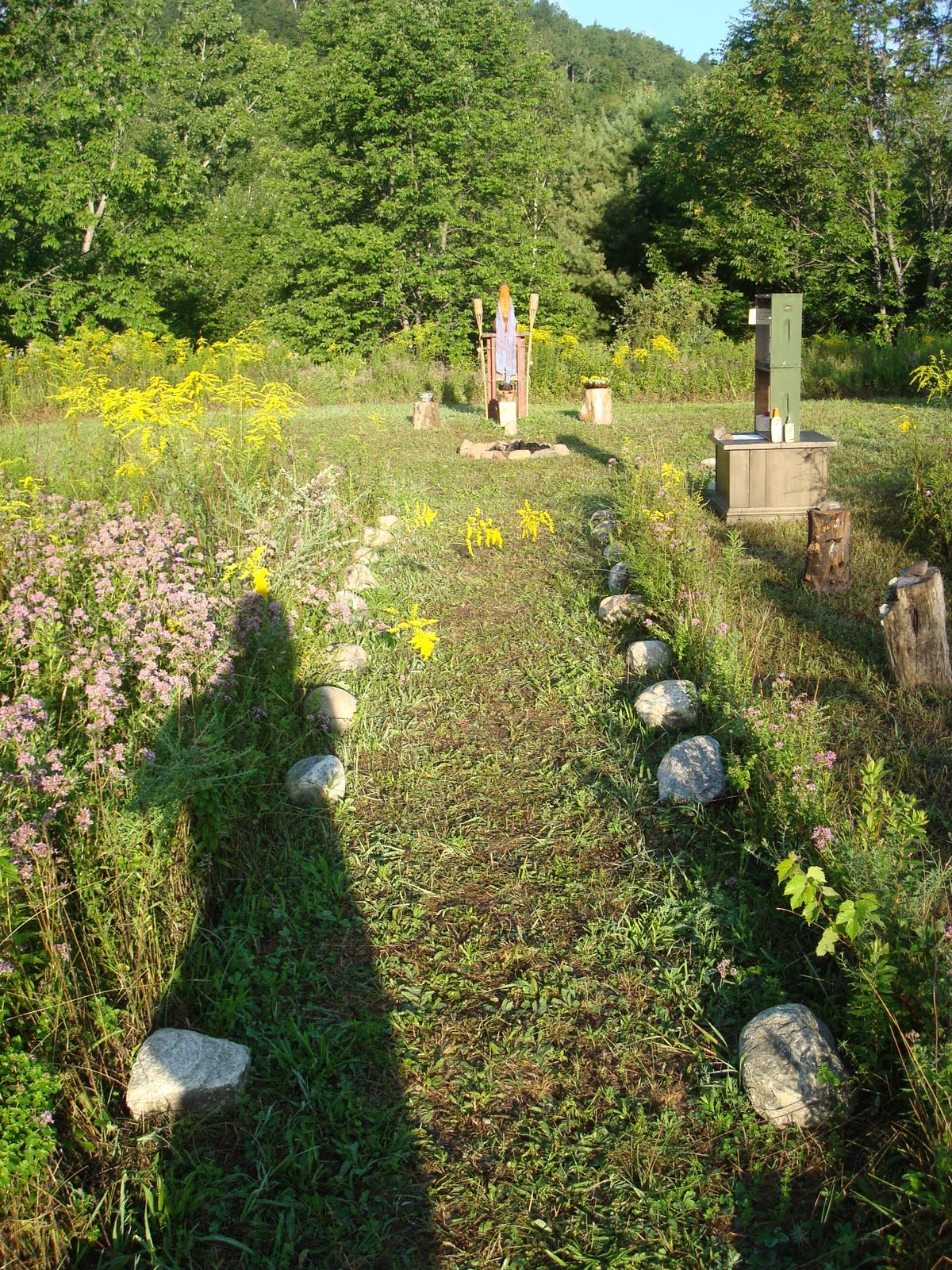
I’m feeling, uh, a little self-conscious about this post. What’s a pro-feminist, post-modernist, sometime queer theorist doing building a phallic shrine, for the use of the temporary communities that are passing through Easton Mountain, week by week, for Eros Spirit Camp, Recovery Camp, and Gay Spirit Camp? Won’t Luce Irigaray and Leo Bersani hunt me down and kill me for this? I won’t riff on the paradox for too long: I’ll save that sort of reflection for a heavily footnoted article that maybe twenty people will read.

Instead, I’ll simply say this: the inevitable woundedness of queer male sexuality in a homophobic world needs safe containers where we can affirm our desire and the animal nature that generates it. We need welcoming spaces where nature and culture converge in our sexuality differently from the toxic ways they converge (or don’t) in a mainstream culture that serves us so badly: where we can open the connection between our hearts and our cocks; between our human sexuality and the cosmos of which we're a part.

I set out two weeks ago to create a shrine along Shinto principles, inspired by the phallic cults of central Japan, wherein smiling middle-aged matrons in kimono carry absurdly oversize joysticks down the street in annual processions.

Things didn’t quite turn out as I planned.

I found a circle in the meadow, recently mown for a sweat lodge yet to be built. The spot cried out. I found the perfect ceremonial table—tall, narrow, simply and roughly made but elegant—sitting neglected in the greenhouse. I flanked the mown path into the circle with two lines of stones, fanning a few more out into the circle.

And then realized to my astonishment that I was giving form to an enormous outdoor yoni-lingam: the phallus of Lord Shiva contained by the vagina of his Consort. Eight of us carried a two-foot wooden cock up the hill, banging drums, to install it as the central symbol of veneration, the first night of Eros Spirit Camp.

Unfortunately, I had to settle for Tiki torches for nighttime illumination. The effect is a little cheesy, as though someone is about to be voted out of the tribe on Survivor: Penis Island.

The next day along came the groundskeeper, who promptly mowed a second birth canal into the yoni: never attach to the results of your actions. I turned the second passage into a kind of gallery with sawn stumps in place of columns in order to restore the integrity of the space.

Then a thoughtful friend pointed out that the layout made no place for anal eroticism, no place for trans men. So last week’s first project was digging a hole behind the altar on the axis of the shrine, edged with stones, covered with charcoal, and dusted with vermillion powder; and rearranging the fire circle between the altar and the entrance into a vulva.

Next comes an entrance gate now that more of us are well and truly invited in.

Monday, June 20, 2011

Ritual Resources

A little over a year ago, I created Anchorhold to share my love of ritual. Since then, I've written here about its power to express what words fail to capture of our experience, our needs, our aspirations; about how it can help us rediscover and reinvent ourselves-as individuals and as part of a wider community of gay, bisexual, and otherwise queer men.

I’m delighted that this blog has logged over 5000 visits since then.

I’m also eager to hear if you find something useful when you come here. I encourage you to make comments and to use this site as a forum to exchange the discoveries, the wisdom, and the fun of your own practice.

Over the next weeks, I'll continue to write about specific topics in ritual practice, and then to archive these posts in the sidebar under their own heading of “Ritual Resources.” I hope you’ll use the comment function to share your own related experiences.

This July and August, I’ll serve as Ritualist in Residence at Easton Mountain, building a shrine to the community's collective erotic energy and hosting a laboratory space where men can play and experiment hands-on with symbols and practices inspired by a wide range of traditions. My Ritual Resource posts to Anchorhold will become hard-copy flyers for participants to take away as aids for the invention or enhancement of their own practice.

I also invite you to contact me one on one, if you feel I could be of use to you as a sounding board, as a facilitator, as a witness, as a participant in your practice. It’s part of my calling to offer myself as a companion on your journey of ritual exploration.

Friday, June 3, 2011

Brutal and Summary Dechachkefication


With the onset of Alzheimer’s, my grandmother’s lifelong habit of archiving magazines escalated into the creation of a shoulder-high maze in her bedroom, then the stacks’ consolidation into an impenetrable monolith that finally engulfed my deceased grandfather’s twin bed. Before it was over, termites were nesting in fifty years of National Geographic, Arizona Highways, and Audubon.

I could see the pattern recapitulate itself in my mother’s reluctance to part with anything that had once come into our house, and with the onset of her own dementia, a rising sense that the integrity of her life depended on the categorical preservation of everything she’d gathered around her.

My uncle left a suicide note explaining to his daughter how to install the storm windows.

I’ve labored all my life under the burden of hoarder DNA. I remember explaining at the age of four why the small and large scraps of paper on the coffee table needed each other in order not to feel lonely.

My partner and I spent the last six weeks preparing to walk away from our house in Toronto for fifteen months. Readying it for new occupants involved a brutal and summary dechachkefication.

I went through five boxes of memorabilia from my childhood home that ten years ago seemed like the barest tether to four and a half decades of memory and desire. Nine tenths went into the trash, or to the curio shop around the corner. I couldn’t bear to treat my mother’s favorite housedress as refuse, so I burned it. I hadn’t realized how splendidly cotton fabric flares up.

I sold a collection of vinyl I’d barely played in fifteen years, that as much as any artifact defined who I was in my twenties: hopelessly romantic and romantically hopeless aesthete; idolater of Bach and Mozart; incipient Wagnerian; dilettante in zydeco, alternative rock, and reggae, which represented for me the less mapped-out and rule-bound life I longed for but couldn’t choose.

What do you do with a shelf of twenty-year-old erotic videos that long ago lost their compelling allure, and have in any case turned to magnetic snow onscreen since you last beheld the divine Al Parker in all his gloriously ingenious raunchiness?

And on it went. With every carton removed from the basement; with every bag of unworn-for-a-year clothing donated to Goodwill; with every cookbook I hadn’t succeeded actually in using for ten years, there advanced a lightness that grew addictive. I found myself wandering around the house at night looking for something else I could do without. When it comes down to the choice, at least three quarters of what I hang onto bears almost no lived relation to the quality of my life.

It’s a gentle and very privileged middle-class version of renunciation that I’ve practiced since mid-April. But it’s been salutary nonetheless. What matters, it turns out, are a few dozen CD’s; a cat who spent the first six hours of The Big Shlepp from southern Ontario to the East End of Long Island screaming her head off; the altar objects now installed in a recessed niche behind my desk; some collage work in progress. Letting go of the rest is a taste of freedom, a chance to reinvent the soul and to be reinvented, a minor spark from Shiva’s ring of fire, Pentecost’s least dramatic tongue of flame.

Monday, May 23, 2011

Boys Like Us

As surely in our spiritual lives as in everything else, we’re social creatures. We don’t live in isolation from each other, but in community. This is true even for hermits in the remotest retreats: the solitude they’ve chosen is meaningful only in relation to a spiritual tradition they’ve absorbed and embraced.

Imagine any ritual you might adopt to enrich your inner life–even the simplest one you create and perform alone as part of a personal practice. It’s grounded in a community you’ve experienced. Go into a shrine alone and light a candle. You expect it to be seen by those who arrive while it’s still burning. Maybe no one will show up in time, but they might, and you have faith that, if they come, they’ll get it. Light the candle at home where no one else will see it. The community is still there, because you carry it around inside you.

Ritual involves the “I” that chooses to express itself in action, but it makes no sense if it doesn’t also involve a “You”: I do this thing because it makes sense to you as well. If you’re absent, then I imagine you there. Perhaps you participate; perhaps you just stand in witness. Or maybe you’re a little puzzled and I have to explain it to you–but with as few words as possible. Nothing kills ritual like too much abstract talk. Better I should invite you to join me, with some faith that we share enough in common that you’ll get it.

So what knits queer men into a community? Can we envision a practice of ritual that grows out of what we share, expresses it, deepens it–and brings us a richer life as individuals as well?

We spend big chunks of our lives out of touch with each other: in the closet before we come out; at times when we choose to “pass” (or maybe have no other choice) in heterosexist workplaces, social gatherings, public events, family reunions, and less-than-welcoming religious institutions. Plenty about our own individual identities separates us from each other, too: race, class, looks, language, age, physical ability.

We seek each other out, in the first place, because of the sheer power of desire. I don’t know of any better illustration of that than Peter McGehee’s wonderful, funny novella Boys Like Us, set in Toronto during the late 1980's. The main character Zero and his friends live lives of rich, flexible connection as they struggle to support one another through the burgeoning of the AIDS crisis. And the novel is unapologetic in celebrating a core fact of the history that holds them together: that nearly everyone in their circle has at some point slept with almost everybody else.

We don’t all experience oppression in the same ways, or to the same extent. But it’s safe to say that all of us experience it, and we’re kidding ourselves, despite any advances of the last decades, to say that we don’t. So we gather to create a space where we’re not the shunned outsiders. We don’t always do such a great job of respecting one another’s diversity within it. But my sense is that we’re getting better and more sensitive about acknowledging and celebrating how we’re different from each other as well as what we have in common.

I don’t think it’s a good idea to take these basic facts for granted about how we come together in sometimes patchy, intermittent experiences of community. If we’re searching for ways to express who we are, as individuals in a now-you-see-it-now-you-don’t community of queer men, we’d better keep erotic desire front and center in the rituals we adopt, adapt, or invent. We’d better pay attention to the experience of oppression and stay sensitive to how one man’s experience of living on the outside is the same as another’s, but how it’s different as well.

Perhaps most important of all, we need to focus on a third aspect of what we share: our ability as members of overlapping sexual minorities to offer each other support, affirmation, dignity, and hope in and through our flirtations and our sexual encounters, sometimes in circumstances that you’d think would more likely lead to mutual exploitation. Michael Rumaker captured this vividly in his experimental chronicle of 1979, A Day and a Night at the Baths.

I’m not suggesting (alas) that this means queer men’s ritual community ought to be a non-stop festival of erotic interaction. I’m saying we need to make sure the rituals we adopt and create don’t lose track of how eros draws us together; of how our resistance to oppression gives us common ground, amidst our differences; of how the desire we share with one another has potential to become a channel for deep grace, to remake our lives for the better.

Sunday, May 15, 2011

Fucking Miraculous

This weekend, I’ve been writing a paper about the nature of community among queer men; about how it shapes what kinds of authentic, meaningful ritual we can devise for ourselves and one another. I wanted to talk about gay camp: about how we simultaneously throw ourselves into an experience and stand back to evaluate, lampoon, and critique the very values we seem to embrace. So I reached for my copy of Tony Kushner’s ever-astonishing Angels in America.

You can find a YouTube clip of one of the play’s most moving scenes, in the HBO version for television that stars Al Pacino as Roy Cohn and Meryl Streep as nearly everyone else, at http://www.youtube.com/watch?v=4H0Fi83wEWk.

During Part Two, the ghost of Ethel Rosenberg has been keeping vigil by Cohn’s hospital bed during the last hours of his life: she’s haunting him in revenge for his role in her execution during the McCarthy witch hunt. Immediately after Cohn’s death, the drag queen/nurse Belize charged with his care at the hospital summons Louis, a disaffected gay Jewish leftist, to say Kaddish over the body--ostensibly to give Belize an opportunity to smuggle Cohn’s private stash of experimental AZT (the year is 1985) out of the room for distribution to PWAs with no access to treatment.

Louis protests, in keeping with his leftist principles, that he will not recite the commemoration of the dead for Cohn; he then adds that in any case he can’t remember the prayer. Giving in, he stumbles through the first phrases, halts, then begins limping through half-remembered tags from the Shabbat blessings, from the Sh'ma.

Ethel’s ghost rises from her chair in the corner of the room to coach Louis phrase by phrase through the long Aramaic text. At the last "Amen," Ethel adds, and Louis repeats, "Yousonofabitch." Loading the stolen drugs into Louis's backpack, Belize responds, “Thank you Louis. You did fine.” Louis responds, “Fine? What are you talking about, fine? That was fucking miraculous.”

The line brought down the house both times I saw the play. And it’s as good an example as I know to illustrate something said by Ronald Grimes, a leading scholar of contemporary ritual theory. “Ritualizing” Grimes observes, “is not incompatible with criticism, nor a sense of mystery with iconoclasm, provided self-critical actions are embedded in ritual itself.”

What’s more, the scene from Angels is a wonderful example of the astonishing ways that gay camp builds up layer upon layer of meaning. When Louis delivers his astonished quip, “What are you talking about, fine? That was fucking miraculous,” the miracle is revealed to the audience as unmiraculous because we see Ethel’s ghost coaching Louis as neither of the characters onstage sees her. Yet on another level, it remains a surreal marvel, if not miraculous in any theological sense, by the sheer fact of Ethel’s ghostly presence.

But most importantly, it’s truly miraculous not because it’s a paranormal marvel, but because of the profound recognition of common humanity that Ethel in this moment of closure manifests towards the man responsible for her execution decades before. In this act of forgiveness, in which the evil that Cohn did is not ignored but transcended, the scene thus offers a powerful foreshadowing of the protagonist Prior’s direct address to the audience in the last scene of the play: “You are fabulous creatures, each and every one. And I bless you.”

And finally, the transgressive edge of queer experience is aggressively foregrounded. Louis’s prayer isn’t just miraculous, but fucking miraculous, at the deathbed of a demonically powerful, hypocritical bully fallen victim to a disease transmitted by fucking and being fucked.

Camp isn’t just a touchstone of our culture as queer men. It’s an extraordinary resource as we grope for symbols, actions, and words that speak to the deepest Truth of our lives that lies beyond all capacity to express.

Sunday, May 1, 2011

Love Upside Down

In 2004, the General Synod of the Anglican Church of Australia did what Anglican church meetings do interminably, all over this sorry-ass world: it debated "the problem of homosexuality" as a matter of principle. The usual bland, specious forbearance and fake charity of the discussion depended on the usual shameful fiction: namely, that delegates were arguing about abstract beliefs, not about the treatment of a sizeable minority of people within, or shut out from, the Church–and surely, especially given the fact that this was, hello, a gathering of Anglican priests, within the ranks of the delegates themselves.

Then the Rev. Dr. Steven Ogden, at the time Dean of St. Peter’s Cathedral in Adelaide, got up to make from the floor a motion he thought surely everyone could countenance, for a resolution that gay and lesbian people were fully welcome in Anglican congregations. He was jeered down by hecklers, while the majority of delegates sat spinelessly silent.

As he talks about it in a new book, Love Upside Down: Life, Love, and the Subversive Jesus, the experience clearly became a defining moment in his personal journey from an ethics of abstraction to an ethics based on love for the irreplaceable worth of others–and a journey to the radical left of the Australian Church. He writes as a fellow traveller who gets it: that sometimes the Church is the people of Israel on their way out of Egypt; but sometimes it’s Pharoah’s army; and sometimes it’s just the Red Sea that you’ve got to get across.