Do not be daunted by the enormity of the world's grief.
Do justly, now.
Love mercy, now.
Walk humbly, now.
You are not obligated to complete the work, but neither are you free to abandon it.
--The Talmud

Do not be daunted by the enormity of the world's grief.
Do justly, now.
Love mercy, now.
Walk humbly, now.
You are not obligated to complete the work, but neither are you free to abandon it.
--The Talmud
A while back, I sat down with Julian Crossan-Hill to talk about the transformative power of authentic ritual, and about the deep connection that some of us feel between our erotic and spiritual lives. You can access our conversation as Episode 22 of the Queer Spirituality Podcast. Julian's series is profiled below in the post of September 20.
Some of the takeaways of our talk:
Queer spirituality is about finding the extradordinary in the middle of our ordinary life. It's not a separate dimension of our lives, but an integral part of our existience. When we embrace our queerness, we can tap more fully into what's already present in our lives that connects with the divine.
We're hardwired to be happiest when we're grateful.
What we do in and with our bodies we do with our souls. We build our spiritual life out of physical acts and gestures, out of interactions with physical objects and with each other.
(A word about words here: I acknowledge that the word "queer" doesn't work for everyone. For some of us, it still evokes the trauma of a taunt that was hurled at us for years, sometimes with physical along with verbal violence.
If those negative connotations are a stumbling block, I apologize. Julian uses it as a way of embracing what's outside the mainstream of cultural and sexual expectations. He's affirming what sets us in the margins of heteronormative expectation--what therefore allows us a perspective that's not only authentic for us, but a resource for the rest of the world, to move the needle toward a freer, fuller life. It has the advantage of encompassing, in one syllable, shorthand for a wide range of sexual diversities, from full-on Kinsey-6 gayness, through bisexuality, polyamory, solosexuality, ace life on the gray scale, trans life, gender-fluidity, and more.
It's less cumbersome than an endless alphabet of possibilities, and less self-parodic than QUILTBAG (Queer, Undecided, Intersex, Lesbian, Trans, Bisexual, Asexual, Gay).
In my own life, and in the lives of men I talk to, I encounter again and again how powerfully we desire a natural solidarity with other men. We want to find our tribe. We want to find them because we experience ourselves as being somehow in exile from a core identity. We long for home, for refuge, or whatever other metaphor expresses what we feel we lost, or were shut out from, or never had. Often, it started with a sense that our fathers weren't there for us in the ways we needed them to be. Or that we were excluded somehow from the ordinary world of other boys.
For many of us, it's hard-wired that as men-loving men we paradoxically desire what we already are. Some of us experience this as a foundational condition of our erotic (and spiritual) worlds. (Daniel Mendelsohn writes eloquently of this paradox in The Elusive Embrace: Desire and the Riddle of Identity.)
Then comes the seduction. We want to resolve the confusion over what it is we're seeking. We want to know that what we're looking for is really out there. That it has substance, solidity, a stable core that we can seek and maybe will eventually find. We get taken in by facile language about "archetypes" and core mythic structures.
We transfer our desire for the concrete experience of community with other men onto an imaginary realm of How It Really Is--some Core Truth about what it is to be male, to be masculine, to be a man, to be among men. And then we focus our efforts on getting more deeply in touch with that Truth, as though attaining it will finally answer the longings of our hearts.
But will it? Really?
Consider the Seven of Cups:

In this Tarot card, we see a male figure from behind, in silhouette, and thus devoid of distinguishing individual characteristics. He's confronted (as are we along with him) not with one Holy Grail as the goal of his quest, but with seven grails filled with the tokens of a whole range of possible outcomes: a perfect relationship, stability, wealth, success, a poisonous basilisk, a serpent that might represent danger but might also represent wisdom--and a glowing velied figure with hands extended.
OK, the smart money is on that last cup. The one that doesn't entirely and unambiguously reveal its contents. The one that leaves room for uncertainty.
In any case, if the silhouetted figure is paralyzed, he's paralyzed by his own agonized compulsion to get it right. To nail it down.
If we're uncertain about "authentic" masculine identity, it's because masculine identity is not one stable thing. Supposing that it is can easily lead us into restrictive dead ends--some of them exclusionary, some of them misogynistic, some of them simply self-punishing and counterproductive. We don't need to go off to get in touch with our inner King, our inner Warrior, our inner Whatever. We just need to hang with each other in the here and now, as we are, as butch or as nelly, as macho or as gender-fluid, as we may be.
At some point, we need to affirm that we are already what we long to be. That we are already the older and wiser men we always wanted to meet.

Sometimes, making love with my partner, I have an odd sense of the two of us being in a roomful of men.
When I say odd, I mean it's not exactly the fantasy of sharing him with others, and sharing others with him, that's coming forward for me. Nothing odd about that: to be clear, the prospect turns my crank, and if it suited him as well--which it doesn't--we could explore it.
Partly, it's the enduring presence of his former partner--in his life and by extension in mine. Bob died over twenty ago. His books still line the shelves that cover whole walls of our summer house--many of them inscribed to him by their authors, some of them annotated in his hand. I still find postcards addressed to him when I pull a novel out. His photographs hang everywhere. Years after his death, we finally poured his ashes into the bay, floating in a kayak together with Bob's first high school lover and lifelong friend, reading Whitman to each other in a light drizzle and watching a white heron fly low over the water toward an island at the mouth of the creek. Early on, only half jokingly, I came to say that I was in a three-way relationship, and that sometimes one of us being dead made it less challenging, sometimes more so.
Partly, it's the long, ongoing repair and reinvention of my friendship with my own former partner, now long coupled up again himself, and the nostalgia of remembering the house I bought with him, and then finally sold eleven years ago, and the garden we created together before we separated. There are times I can't escape the awareness, never entirely comfortable, that I'm still in love with him too. It took me years to admit that to myself.
Partly, it's the wider awareness of the other men I've let into my heart, and into my pants, over the years--some of whom I dated; some who became soulmates on the short, intense roller-coaster rides of workshops; some whose names I only learned while we were having sex, or never learned at all, and never saw again. Objects that represent them sit on my altar: the icon G. gave me on my fiftieth birthday; the crystal pendant cross S. brought me on a visit twenty years ago; the natural phallus of stone, ground smooth by millennia in a creek bed, that A. found walking with his dogs and saved for me; W.'s tuning fork.
Partly, it's my partner's erotic history, more active and varied than my own--and how my nose is now and then pressed to the glass with envy about that.
In the shadow of all these, it's something else as well, something more. It's a sense that when we're in bed together, though we're two isolated individuals, we're also part of something larger, something more general. Something that embraces the other men who dwell within us: those who've slipped away, carried elsewhere on the diverging currents of our lives; even those who've passed beyond the veil of death-- "these waves of dying friends" that the late poet Michael Lynch so movingly commemorated in the early years of the AIDS crisis.
I can't describe more precisely what I sometimes sense so strongly within/behind/beneath/beyond the experience of being with this particular man. But whatever it is, it flies in the face of the romantic cult of the couple as a self-sufficient unit. It's radically opposed to the notion that we find one person who somehow completes us, so that anything else becomes an admission of emotional failure and defeat. Queer cultural theorists like Michael Warner and Eric Rofes long argued that the focus on same-sex marriage rights flattened and suppressed the richness of this broader web of emotional, erotic, and spiritual connection. I can't help but agree.
Strangely, I'm reminded of what Plato said about (gay) love in the Symposium: that we start by loving an individual, progress by loving many individuals, and end (ideally) by loving what we find embodied in them all. That's one of the few things I can take away from Plato at this point in my life without vehement disagreement.
And perhaps even more strangely--I connect what I'm feeling to this moment in the year--Hallowe'en, All Souls, the Day of the Dead, Samhain--when the curtain between what's present and what's vanished from our daylight lives is pulled aside, and we're in communion with the dead--and by extension, with the otherwise departed, and with the alternative worlds of our unrealized longings. If Bob's ever in bed with my partner and me, surely it's now. I'm glad for the thought he's there. Along with all those others, alive and dead and alive, across town or across oceans, at the far-flung corners of my life and my husband's, the men of our queer tribe, who nestle and nuzzle around us.
"... we are called to judge ourselves with love; to love ourselves, and also to face the truth about our shortcomings and grave misdeeds. In our self-scrutiny we strive to emulate the true positive essence within ourselves. In our truth we cannot be fooled by evasions, or excuses. Tradition bids us to approach this day with both solemnity and joy, knowing that we will contemplate matters of life and death; and tradition reminds us, as well, that we celebrate the world's creation and our own moral rebirth."
"But at a deeper level, the entire journey is one in which we are called over and over again to surrender to a self-transforming process not of our own making. Each time we give ourselves over to our contemplative practices, whatever they might be, we find ourselves, once again, one with the communal mystery in which there is no separate self."
James Finlay, The Contemplative Heart, p. 207.
*****
Listen Up, Y'all
"Listen up, y'all," says Shekhinah
who looks today like a teacher
in corduroy dress and sedate boots.
"Let the smartphone rest a bit,
or learn how to hear My voice
coming through its speaker.
Let your love for Me well up
like unexpected tears. Everyone serves
something: give your life to Me.
Let the channel of your heart open
and My abundance will pour through.
But if you prefer profit, if you pretend --
if you're not real with Me
your life will feel hollow
and your heart be embittered.
I won't punish you; I won't need to.
Your hollowness will be punishment enough,
and the world will suffer for it.
So let My words twine around your arm,
and shine like a headlamp
between your eyes to light your way.
Teach them to everyone you meet.
Write them at the end of your emails
and on your business cards.
Then you'll remember how to live
with the flow of all that is holy --
you'll have heaven right here on earth."
Rabbi Rachel Barenblat
https://velveteenrabbi.blogs.com/blog/2016/02/listen-up-yall.html

For Conrad Alexandrowicz
That afternoon, in the crypt,
I saw them coming
over the rise, weapons
at the ready. Only for me,
I thought at first. Then turned
aware that He
was even more vulnerable.
Naked. Hanging. Nailed.
The only choice
to shield His body, knowing
the bullets might
lodge in me, or else
passing through would knit
us wound to wound.
Nothing for it,
then, but climbing up
to entwine Him,
as consort to
my Boddhisattva.
His erection in extremis
miraculous, a pledge of Life's
Longing for Itself.
He, turned outward
toward the death squad. I,
facing Him. Unable
to welcome them
with open arms except
by way of the embrace.
By welcoming Forgiveness
Itself deep
into my body.
Exposed Tip of the Heart
Key to the Temple
Taproot to the Earth
Antenna of the Soul
Ladder to Heaven
(The banners are the loving work of Barrie Petterson.)

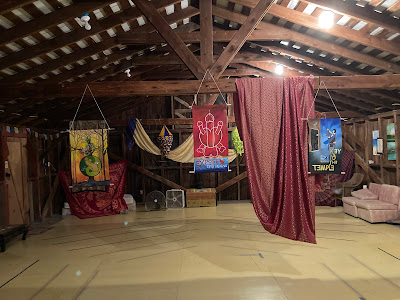


A mandala is a two-dimensional representation of a temple, an aid to visualization as you move through the temple, contemplating its details and the lessons to be learned from them.
In the wilds of Western Maryland, we were ourselves the temple.


"Importantly, when men love, it changes the nature of their sexuality, both how they think about sex and how they perform sexually. Many men fear learning to love because they cannot imagine a sexuality beyond the patriarchal model. In a world where men love, a focus on eros and eroticism will naturally replace male obsession with sex. All men could have the opportunity to enjoy sexual pleasure, and that includes sexual fantasy, for its own sake and not as a substitute for fantasies of domination or as a way to assert manhood in place of selfhood, were they taught a healthy eroticism."
--bell hooks, The Will to Change: Men, Masculinity, and Love, pp. 178-9.

Peter (played by Hugh Jackman) is the loving father of a newborn son by his second wife, Beth. The unfinished work of fathering his deeply troubled seventeen-year-old son Nicholas from his previous marriage to Kate breaks through this idyllic frame. Peter longs to connect, and at key moments succeeds in expressing his love toward Nicholas. Yet at every turn, he blows past acknowledgement of the psychic pain that lies behind the boy's troubling behaviour. The central trauma that's swamped his son's life--Peter's desertion of his first family--simply falls below the bar.
Everyone in Peter's high-flying, over-achieving, overwhelmingly male professional world exudes a perfunctory warmth devoid of genuine empathy: inquiries about the state of his family are hollow gestures soliciting equally hollow responses that all is well.
Later in the film comes Peter's devastating meeting with his own narcissistic, emotionally sadistic father, a conversation over lunch that quickly descends into a recapitulation of the heartless abandonment Peter himself suffered as a boy. In light of that scene, we understand more vividly his acknowledgement, near the end of the film, that for all his attempts to be a better father himself, his behaviour toward Nicholas has reproduced the patterns of his own upbringing.
Despite Peter's self-recriminations over a disastrous turn of events, the ultimate catalyst of tragedy subtending the whole plot is the web of emotional denial in which nearly every character is enmeshed, and in which nearly every character colludes, women as well as men. It's an ingrained pattern that goes on forbidding the deep recognition of loss.
Without that recognition, the life that lies ahead for Peter is likely to admit of no more redemption than what has transpired to that point. His failures as a father aren't a matter of personal culpability, but of a system of relations in which he's trapped, of which he's a victim as well as a perpetuator. Throughout, it's the injunction--the quinessentially patriarchal and capitalist injunction--to get over it, solve the immediate problem, and move on with life that destroys the hope of either restoration or atonement.
The power and privilege that patriarchy accords men is a devil's bargain from which no one escapes with their life intact. Renouncing patriarchy isn't as simple as wishing it so: that's the lesson this film conveys. And perhaps that at least partly explains why audience reaction hasn't been more favourable, and why some reviews have more or less missed the point--a notable case being Nell Minow's dismissive assessment.
As viewers we hate it--men hate it, and women hate it too--when men don't suck it up and soldier on. Insistence on easy, masterful resolution of loss is wired into our culture, just as it's wired into the fictional world of the film. Perhaps we're uncomfortable that the film too effectively holds a mirror up to our own intolerance of unresolved emotion, exposing our own reluctance to witness consequences that can't be easily ascribed to individual guilt or negligence. We're all for a sensitive male protagonist, but only as long as he holds it together, and isn't too flawed or damaged himself to save the day in the end.
The undoing of patriarchy is far from completed--in the world, but also within ourselves. Perhaps it can never be completed, because the allure of impervious mastery and the denial of vulnerabiltiy are too universal ever simply to disappear, Perhaps there will always be wounded sons who go on to become clandestinely wounded and openly wounding men--some of them fathers in turn. Toxic masculinity goes on attracting a new generation of proponents. The construction of alternative masculinities is a work in progress. We're not there yet. We're only on the road.

These days, I'll take any and all good news that comes through in the morning paper. And today, a federal judge in Arkansas striking down that state's law prohibiting gender-affirming care for trans kids.
Eighteen other states have followed Arkansas's lead in passing such laws. All of them are now in plausible jeopardy of being struck down.
I'm grateful for the courage of the plaintiffs in the case. I'm grateful for the Arkansas ACLU for taking it up. I'm grateful for a federal judge who makes a reasoned decision in the face of the specious justifications spouted by proponents of the law.
When we come together, we're strong. When we recognize that none of us is safe until we're all safe, we claim our dignity and our power.


